DUE TO SPAM, SIGN-UP IS DISABLED. Goto Selfserve wiki signup and request an account.
...
- Diskless Topic: A topic which does not append directly to block storage devices, and does not utilize direct replication.
- Classic Topic: A topic which appends directly to block storage devices and utilizes direct replication, the present Kafka status quo.
- Tiered Topic: A classic topic using KIP-405 Tiered Storage to move inactive segments off of block storage, but still appends to block storage devices.
- Diskless-Ready Cluster: An Apache Kafka cluster which is configured to host Diskless Topics in addition to Classic and Tiered topics.
- Broker Disk: A local block device available for a broker to store log directories on. May be direct-attached or network-attached.
- Object Storage: A shared, durable, concurrent, and eventually consistent storage supporting arbitrary sized byte values and a minimal set of atomic operations: put, delete, list, and ranged get.
- Object Key: A unique reference to an object within Object Storage.
- Broker/Client Rack: A hint provided to Apache Kafka brokers and clients about the underlying infrastructure topology. Data transfers within a rack are assumed to have lower costs and lower latency than transfers between racks. Failures are assumed to be less correlated across racks, so durable information is persisted across multiple racks. When Apache Kafka is deployed in a hyperscaler, this is typically synonymous with “Region”, “Availability Zone”, or “Zone”.
- Batch: A container for Kafka records and a unit of record representation in the network protocol and storage format in both classic and diskless topics.
- WAL Segment: An object containing a batches for one or more diskless topic-partitions on the object storage.
- Batch Coordinate: A reference to a record batch within a WAL Segment, at some byte range.
- Diskless Batch Coordinator: Component serving as source of truth about batch coordinates and WAL Segments. Establishes a global order of batches within a diskless topic, and serves coordinates to enable retrieval of batches.
- Hyperscaler/Cloud: Widely available cloud computing vendors offering compute, storage, and networking solutions.
...
- Data in diskless topics is durably stored in object storage at all times.
- Local segments on broker disks serve as caches and not sources of truth
- Remote storage may have higher latency than local disks, increasing the latency of Kafka requests and end-to-end data latency.
- Kafka delegates replication of diskless topics to object storage, and does not perform replication itself.
- Replicas placement is still used to control client traffic and cache placement
- Any broker may build a replica of any set of diskless partitions by contacting the diskless coordinator, lowering load on other brokers and eliminating unclean leader elections
- Classic concepts of replication, ISR, and unclean leader elections do not apply.
- All operators can use efficient types of storage backends, such as ones with erasure coding.
- Hyperscaler operators can avoid most inter-zone data replication costs.
- All brokers are capable of interacting with all diskless topics, and no broker is uniquely considered the leader of a partition.produce requests do not need to be handled by the partition leader.
- Produce requests are preferentially served by replicas of the partition, and do not need to be directed to the partition leader.
- Partition leaders are still elected to upload to manage the ISR state, upload to tiered storage, and handle share fetches
- Classic replica leader election for diskless topics does not affect produce request functionality, and all requests may use any broker as if it were the leader.
- Clusters are able to perform fine-grained client balancing across the cluster independently of topic/partition hot spots.Any broker may build a replica of any set of diskless partitions by contacting the batch coordinator, without any other replicas being live.
- Hyperscaler operators can avoid most inter-zone zone data ingress/egress costs.
Similar to Tiered Topics, Diskless Topics will not immediately support compaction. In the future, once Compaction for Tiered Topics is designed and implemented, Diskless topics will immediately support compaction.
In other functional aspects, diskless topics In other functional aspects, diskless topics are indistinguishable from classic topics. This includes durability guarantees, ordering guarantees, transactional and non-transactional producer API, consumer API, consumer groups, share groups, data retention (deletion & compact), and authorization mechanisms.
All existing APIs for Classic topics will also be supported with equivalent semantics for Diskless topics. Streaming applications can be moved from classic to diskless topics without changing client versions, application code, or experiencing correctness problems.
...
- Validating the incoming data.
- Assigning offsets and timestamps.
- Injecting offsets/timestamps into the batch data.
- Writing batches to durable storage.
- Waiting for replication to complete.
- Returning the Produce response.
For diskless topics, the Batch Diskless Coordinator is now responsible for offset/timestamp assignment (2), and each replica is responsible for injecting the offsets into the batch data (3). These components provide the effect that fetched data sent to the consumer has the same structure as data appended to a classic segment.


In diskless topics, we separate storage I/O from batch ordering. The data being persisted to object storage has no implicit order, and ordering is delegated to the batch coordinates. Coordinates passed from each broker to the batch diskless coordinator are locally ordered, and have an order only relative to other coordinates passed from that same broker. The batch diskless coordinator performs the append and assigns a global order to the batch coordinates in each partition.
...
By locating data from multiple partitions together, WAL Segments prevent the number of topic-partitions from influencing object read and write behavior, and reduce the total number of individual reads and writes to the backing storage.
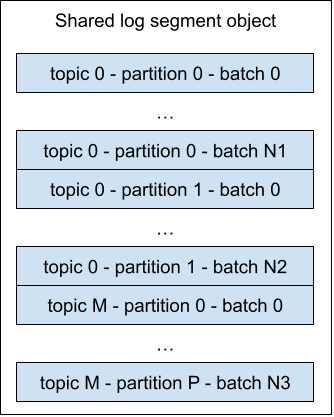
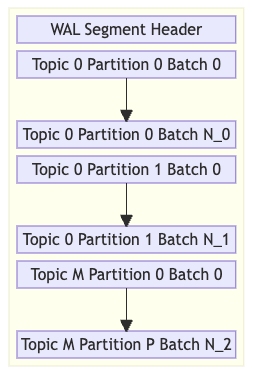
Batches are grouped by partition into contiguous parts of the object. This improves the locality of later operations in the same way as segments do for classic topics. WAL Segment objects are given globally unique (e.g. UUID) names and uploaded without coordination or conflicts.
The WAL Segment objects are immutable, similar to inactive segments in classic and tiered topics. Once an object is uploaded, its content is associated with its name for the whole lifetime of the object. This also aligns with the typical interface of object storage where random writes to an object are not supported.
Produce path
Data is produced to diskless topics in the following way:
A 1-byte header is prepended to the beginning of the WAL Segment, before any batch data. This header byte should always be set to 0, to indicate the version of the WAL Segment. Future KIPs may extend this header with additional fields, and increment the version number. The information present in this header will not be necessary to interpret the batch data within the remainder of the WAL Segment.
Produce path
Data is produced to diskless topics in the following way:
- Producers send Producers send Produce requests to any broker.
- The broker accumulates Produce requests in a buffer until exceeding some size or time limit.
- When enough data accumulates or the timeout elapses, the Broker creates a shared log segment and batch coordinates for all of the buffered batches.
- The shared log segment is uploaded to object storage and is written durably.
- The broker commits the batch coordinates with the Batch Diskless Coordinator (described in details in KIP-1164).
- The Batch Diskless Coordinator assigns offsets to the written batches, persists the batch coordinates, and responds to the Broker.
- The broker sends responses to all Produce requests that are associated with the committed object.
This is illustrated on the following sequence diagram:
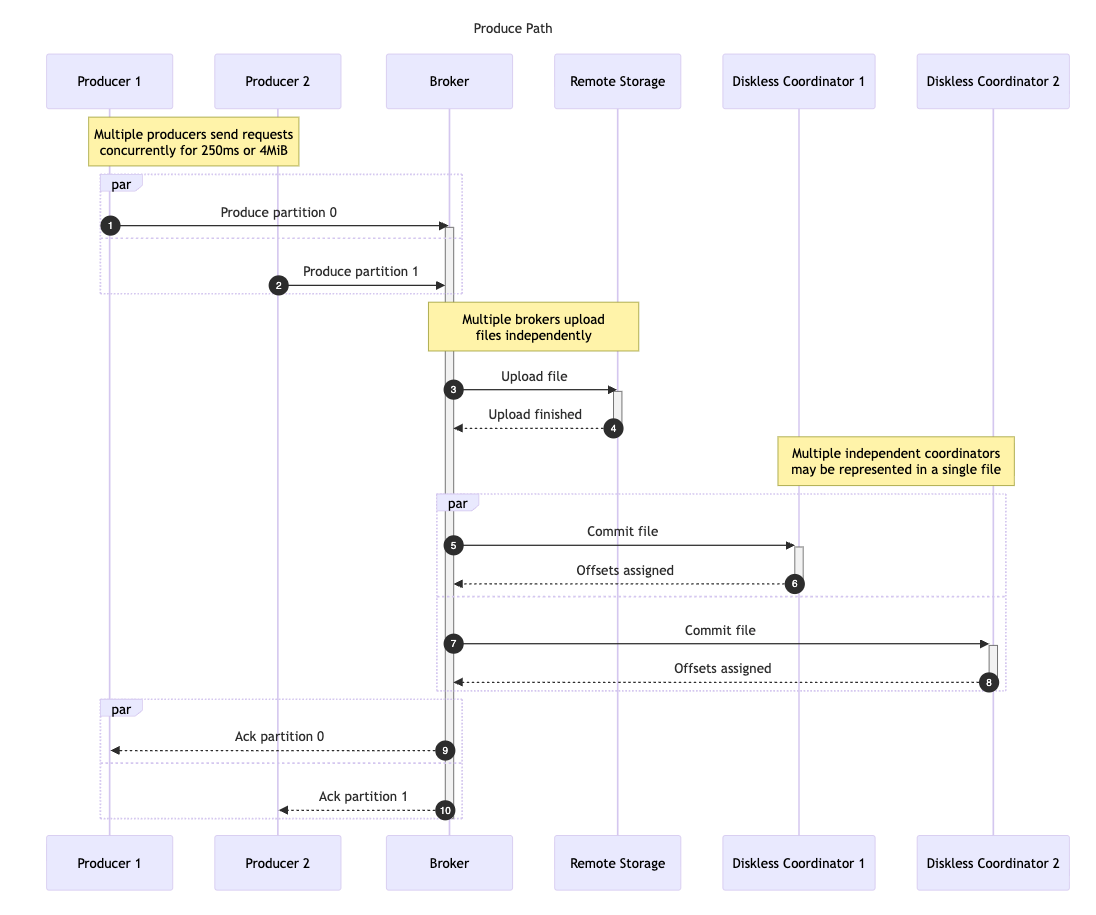
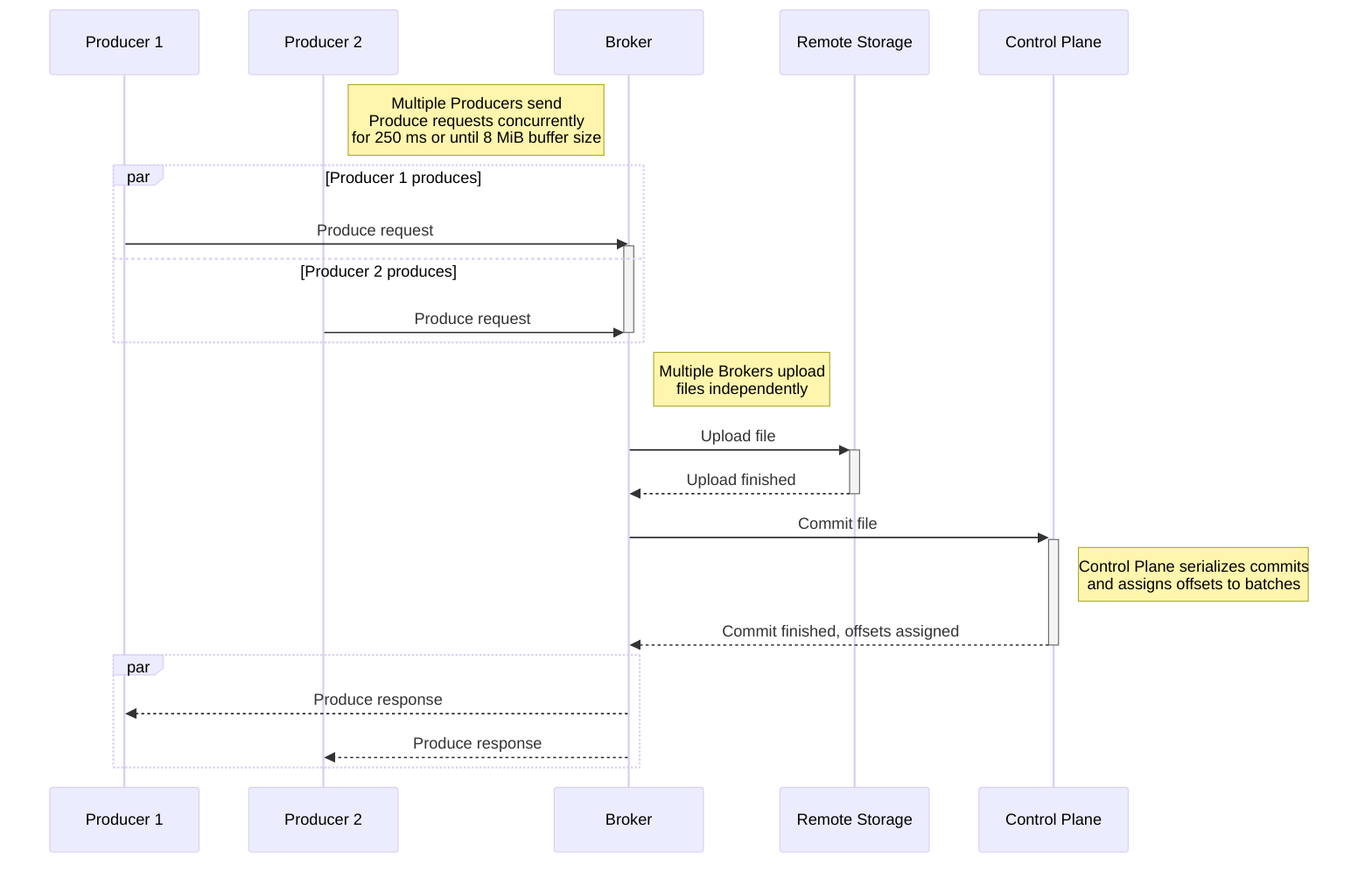
Each broker accumulates its buffers and uploads objects with its requested offsets independently, with no coordination. However, the Batch Diskless Coordinator ensures that the batch coordinates are committed in order and the offsets are assigned correctly. Moreover, a broker can upload multiple objects in parallel, it only needs to commit them with the Batch Diskless Coordinator in their order.
...
Append latency is broadly composed by:
- Buffering: up to 250ms or 8MiB 4MiB (both configurable)
- Upload to Remote Storage: P99 ~200-400ms, P50 ~100ms
- Batch Coordinates Commit: P99 ~20-50ms, P50 ~10ms (depending on the number of batches)
...
There may be errors during various steps of this process. In some cases, garbage objects (i.e. objects that are uploaded but not committed to the batch diskless coordinator) may be left in the object storage. Sometimes, these objects cannot be cleaned up on the spot. Consider the following scenarios:
- The Broker fails to upload the object. No garbage object is created. The pending Produce requests receive responses with errors. It’s safe for the producers to retry.
- The Brokers succeeds in uploading the object, tries to commit it, and couldn’t receive a response from the batch diskless coordinator. A garbage object is left on the object storage. It’s not safe to clean it on the spot without consulting the batch diskless coordinator, which may not be available. The garbage cleanup is delegated to the separate asynchronous process. The pending Produce requests receive responses with errors. It’s safe for the producers to retry provided they use idempotent produce.
The concrete details of the asynchronous garbage collection process is out of scope of this KIP and will be described in a separate KIP.
Caching in local segments
Once data is persisted in WAL segments and the batch coordinator, the next step is to populate a cache with the data in its finalized order as determined by the batch coordinator. Each broker will be assigned as a replica for a subset of partitions in the cluster, using the existing KRaft metadata mechanisms. The broker will issue a read operation for each object containing at least one replicated partition. Once the read completes, the broker will inject record offsets as determined by the batch coordinator, and append the finalized batch to a local log segment on-disk. This will build the typical indexes used to optimize fetch queries and interactions with segments.
Distinct from Classic topics, these local segments are not required to be durable, as durable storage of data is delegated to the batch coordinator and WAL segments.
Consume path
Data is consumed from Diskless topics from the local segments on-disk. This is essentially the same as consuming from a follower for classic topics. It also permits use of the kernel page cache, reducing memory pressure from the consume path to be allocated for the produce path buffers, and uses indexes built during the cache building step. This decouples the Fetch request rate from the batch coordinator operation rate.
Moving to Tiered Storage
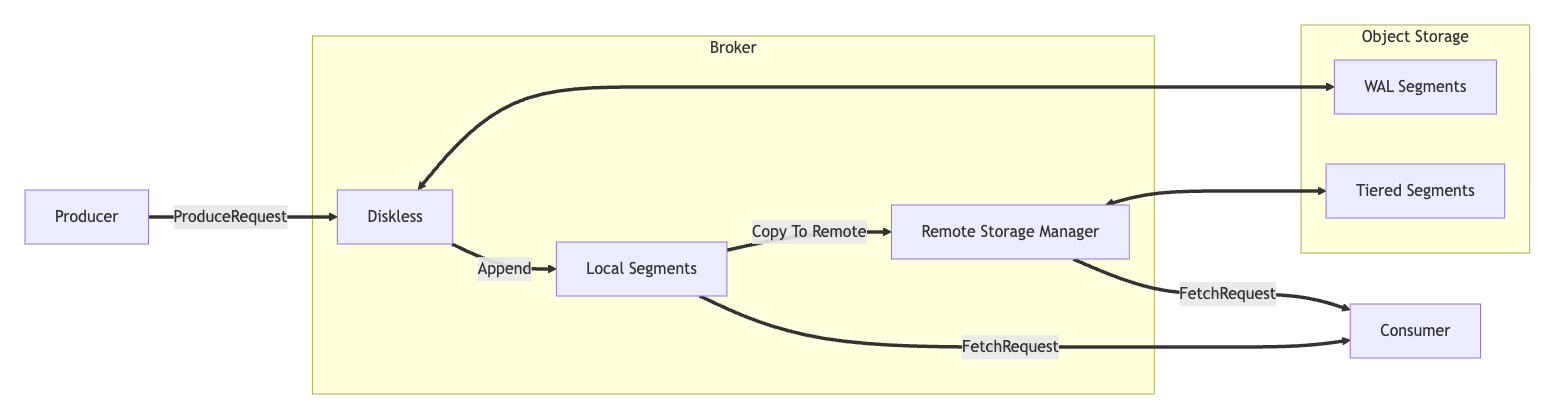
In order to control the number of many small WAL files, the batch coordinator memory size, and the rebuild time of local segments after a replica change, data is moved to Tiered Storage using the existing KIP-405 interfaces. Existing implementations of tiered storage RSM and RLMM can be used as-is, with no knowledge of the presence or absence of the Diskless produce path in front.
In order to use the existing interfaces, one broker per partition is chosen as the leader. This leader is permitted to copy segments to tiered storage. Replicas are responsible for serving fetch requests from tiered segments, similar to classic topics.
Effectively, Diskless becomes a front-end for Local Segments, and Tiered Storage becomes the back-end, providing the same benefits for optimizing storage usage for both Diskless and Classic topics.
Batch deletion
There are various reasons a batch may require deletion:
- the local size and/or time retention settings of the topic;
- the partition truncation by the user;
- deletion of a topic.
Since objects are immutable, logical batch deletion doesn’t change the object content. For each object, it’s necessary to track its effectively used size. This size decreases by the batch size when a batch is deleted from the object. When the used size becomes 0, the object could be actually deleted.
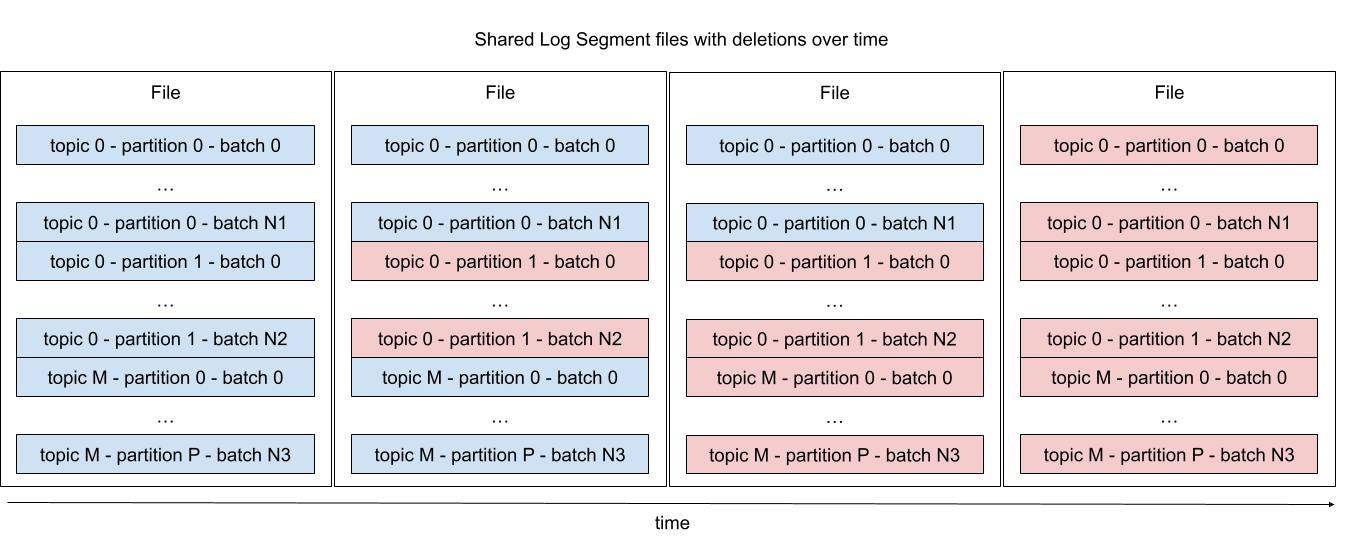
Object deletion will be implemented as an asynchronous operation. First, the object is marked for deletion by the batch coordinator and a broker performs the actual deletion from the object storage. This has two advantages:
- The Batch Coordinator doesn’t need to be concerned about the object storage, to have credentials and the code to access it.
- The deletion could have a grace period. The grace period is a useful way to allow potentially in-progress Fetch requests to successfully finish.
To enforce the time and size retention settings of topics, a background process will periodically check metadata of diskless topics and logically delete affected batches.
It’s quite possible that for compliance reasons, a particular batch has a deadline for physical deletion. Despite the batch being logically deleted, its data are located in an object that may be kept alive by other batches, potentially forever. Therefore, batches with physical deletion deadlines must be either moved to isolated files during merging, or additional merge passes will be necessary to physically delete the data. This problem is addressed in KIP-1165.
Public Interfaces
Plugin Interfaces
Apache Kafka will provide pluggable interfaces which are intended to abstract functionality that may require contacting an external service.
Batch Coordinator
This interface abstracts the batch order consensus mechanism needed to establish the order of batches within each partition and generally keep track of the metadata. This interface is out of scope for this KIP and discussed in KIP-1164
Storage Backend
This interface abstracts the access methods to the object storage.
| Code Block | ||
|---|---|---|
| ||
public record ByteRange(long offset, long size) {}

public interface ObjectStorage extends Configurable {
    /**
     * Uploads an object to object storage.
     * <p>An exception must be thrown in case the number of bytes streamed from
     * {@code inputStream} is different from {@code length}.
     * @param key                      key of the object to upload.
     * @param inputStream              data of the object that will be uploaded.
     * @param length                   length of the data that will be uploaded.
     * @throws StorageBackendException if there are errors during the upload.
     */
    void upload(ObjectKey key, InputStream inputStream, long length)
        throws StorageBackendException;


    /**
     * Fetch a range of an object from object storage.
     * <p>This result should be cached for later access
     * @param key                      key of the object to fetch.
     * @param range                    range of bytes within the object.
     * @throws StorageBackendException if there are errors during the fetch.
     */
    InputStream fetch(ObjectKey key, ByteRange range)
        throws StorageBackendException;

    /**
     * Idempotently delete multiple objects.
     * <p>If an object doesn't exist, the operation should still succeed
     * to be idempotent.
     * @param keys                     keys of objects to delete.
     * @throws StorageBackendException if there are other errors which prevent deletion.
     */
    void delete(Set<ObjectKey> keys)
        throws StorageBackendException;
} |
Apache Kafka will not provide a production-grade implementation of this interface, because this would require Kafka depending on third party storage drivers. The list of potential storage is big and it’s not possible to provide implementations for all of them. Implementations will be provided by 3rd party developers in the Kafka ecosystem.
Broker Configurations
diskless.system.enable: enables diskless support on a broker.diskless.storage.class.name: the object storage class name for diskless topics.diskless.storage.class.path: the object storage class path for diskless topics.diskless.batch.coordinator.class.name: the batch coordinator class name for diskless topics.diskless.batch.coordinator.class.path: the batch coordinator class path for diskless topics.diskless.append.commit.interval.ms: defines how long to wait before closing a shared log segment object to be uploaded/committed.diskless.append.buffer.max.bytes: defines the maximum size of a shared log segment object before closing it for further upload/commit.
Topic Configurations
diskless.enable: Sets a topic as a diskless topic. Diskless topics can only be defined at creation time (updating a classic topic to a diskless topic is out of scope.)
Client Configurations
Producer:
...
Idempotent Produce and Transactions
Diskless topics will support idempotent produce and transactions as classic topics do. The support for these features in classic topics depends on the interactions between three actors: clients (mostly producers, but also consumers), partition leaders, and transaction coordinators. In classic topics, many pieces of state important for these features are local on partition leaders (the log content being the source of truth). In Diskless topics, batch metadata is detached from data and is stored in the Diskless Coordinator. Therefore, we aim to preserve the high-level flows for idempotent produce and transactions, replacing partitions leaders with the Diskless Coordinator when needed.
Transactions will be able to span both Diskless and classic topics. We propose to focus on v2 and newer transaction versions only.
The concrete details of the support for these features is out of scope of this KIP and will be described in a separate KIP.
Replicas
Diskless topics will have the same concept of replicas as classic topics, managed by the KRaft controller.
Data on replicas are not filled by inter-broker replication, but instead by downloading data from the remote storage based on metadata in the Diskless coordinator. All replicas will monitor the log tail (active part) in order to learn about newly appended batches, download them, and append to their local log.
Despite that there is no inter-broker replication, replicas will still issue FetchRequest to leaders. Leaders will respond with empty (no records) FetchResponse. This is the mechanism for leaders to track ISR.
Local segments on replicas will be the caching mechanism, not the persistence mechanism. It will benefit the fetch performance, but still is safe to lose.
“In-sync replica” for Diskless topics means “in sync with the Diskless coordinator” (which is the source of truth) and not with the leader. An important implication and difference to the classic topics is that a leader is just another replica from the point of view of being caught-up with the latest data and can also be out-of-sync. This means:
- the leader can’t perform its duties such as offloading segments to the tiered storage efficiently;
- it’s not recommended to read from it (like from any other out-of-sync replica).
The replica reassignment will follow the same flow as in classic topic:
- New replicas are added to the partition's replica set.
- The controller waits for the new replicas to become in-sync.
- Old replicas are removed from the partition's replica set.
When a replica is assigned to a broker, it needs to start filling its local log from some point. There are various possible policies, such as:
- Start building the local log from the earliest non-tiered offset.
- Start building it from the latest available offset.
- Start building it from some configurable amount, e.g. 100 MiB prior to the current log end or earliest available offset, whichever is later.
1 may take a long time if there is a large amount of data in the Diskless Coordinator. 2 may not work if the partition is idle (the local log will never be built on new replicas). Because of this, we propose to follow approach number 3.
In contrast to replicas, leaders must build the local log from the beginning in order to offload segments to the tiered storage. To not make compromises between fetch performance and this duty, caching and segment offloading to the tiered storage may happen independently: the cached segments will be built by the common rules and the tiered storage offloading will build its segments from the log beginning.
- When a replica is the elected leader and does not yet have a segment containing the earliest available offset, it will open a new segment starting at the earliest available offset. This segment will be open concurrently with the active segment.
- When a replica loses leadership, it will not evacuate any partially-built segments immediately, but let them expire according to local retention configurations. This permits leadership to be lost and recovered quickly without restarting downloading.

Consume path
Diskless will rely on the existing follower fetching mechanism (broker returning PreferredReadReplica) in order to allow consumers to read from replicas in their racks and avoid inter-rack network traffic costs. In contrast to classic topics, non-ISR replicas will not be excluded. Instead, they will be deprioritezed and used only if no in-sync replicas are available in the client rack.
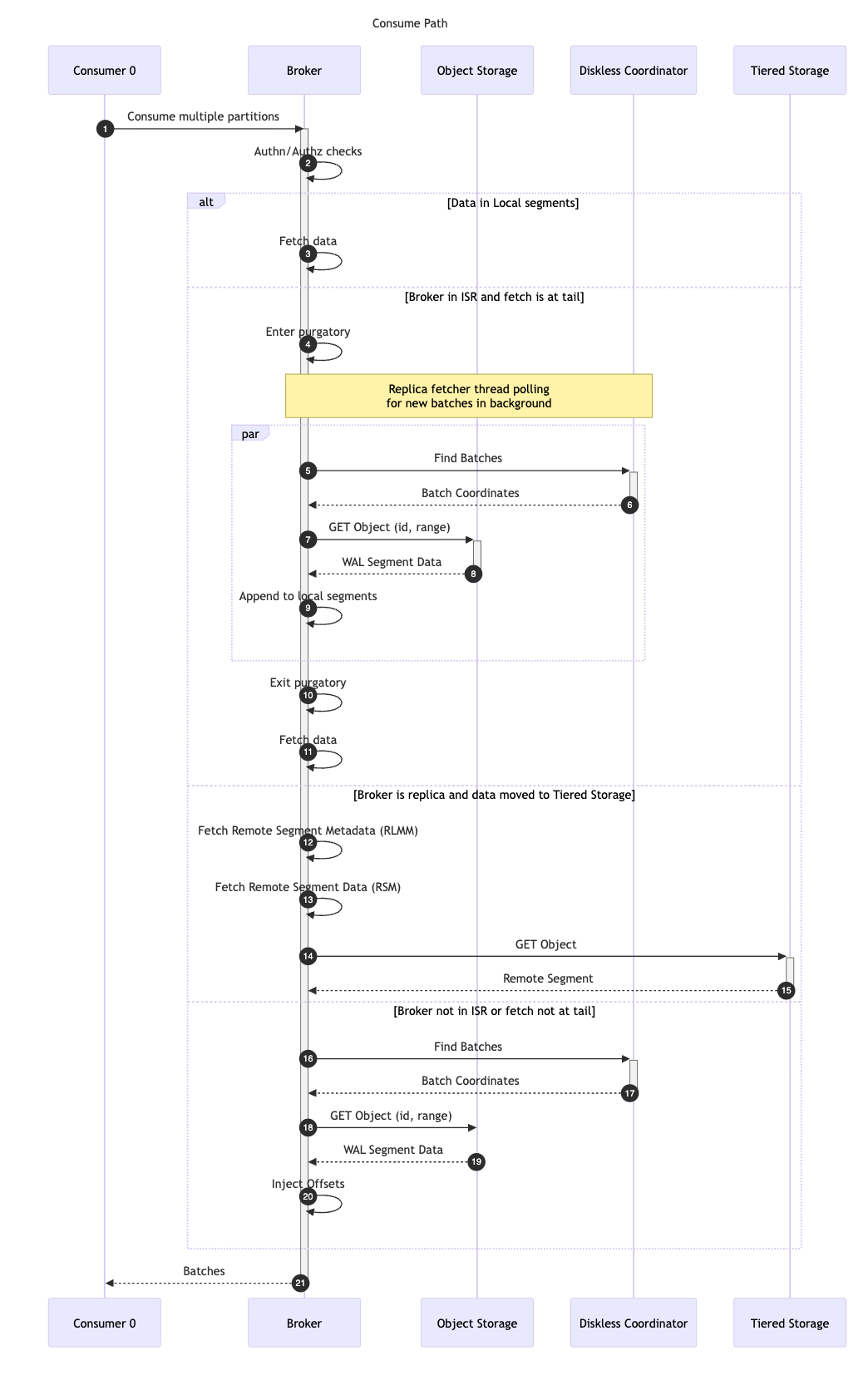
The replicas will strive to serve responses from the local segments on disk. However, there are two exceptions when direct read from the remote storage will be used:
- When the replica is not in-sync, i.e. there's a long gap between the log end in the Diskless Coordinator and the local log.
- When the requested offset is older than the earliest offset available locally.
A direct read from remote storage involves:
- The broker determines a fetch for a partition cannot be served from local segments
- The broker queries the Diskless Coordinator for the relevant batch coordinates.
- The broker gets the data either from the object storage.
- The broker injects the computed offsets and timestamps into the batches in-memory.
- The broker constructs and sends the Fetch response to the Consumer.
Depending on the structure of the shared log segment, a single Fetch request could be satisfied by one GET request, or may need multiple requests.
Queues
In contrast to normal Fetch requests, ShareFetch requests can only be served by the share-partition leader, which is co-located with the partition leader and manages internal state, such as record state.
Because of this, in the scope of this KIP, queue consumers will have to send their ShareFetch requests to partition leaders and will not be able to always benefit from consumer inter-rack traffic elimination.
Opportunistic rack-awareness for queues is out of scope of this KIP, and will be described in a separate KIP.
Moving to Tiered Storage
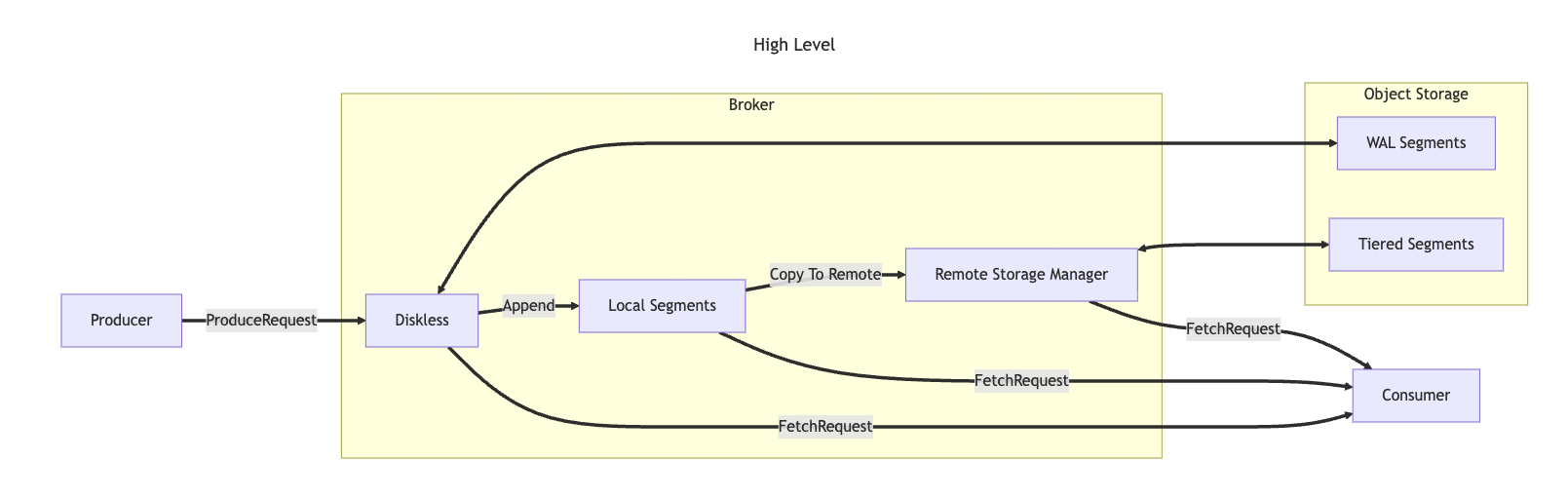
In order to control the number of many small WAL files, the diskless coordinator memory size, and the rebuild time of local segments after a replica change, data is moved to Tiered Storage using the existing KIP-405 interfaces. Existing implementations of tiered storage RSM and RLMM can be used as-is, with no knowledge of the presence or absence of the Diskless produce path in front.
The partition leader will use existing tiered storage interfaces to copy constructed segments to tiered storage. Replicas are responsible for serving fetch requests from tiered segments, similar to classic topics.
Effectively, Diskless becomes a front-end for Local Segments, and Tiered Storage becomes the back-end, providing the same benefits for optimizing storage usage for both Diskless and Classic topics.
The concrete details of this feature are out of scope of this KIP and will be described in a separate KIP.
Batch deletion
There are various reasons a batch may require deletion:
- the local size and/or time retention settings of the topic;
- the partition truncation by the user;
- deletion of a topic.
Since objects are immutable, logical batch deletion doesn’t change the object content. For each object, it’s necessary to track its effectively used size. This size decreases by the batch size when a batch is deleted from the object. When the used size becomes 0, the object could be actually deleted.
Object deletion will be implemented as an asynchronous operation. First, the object is marked for deletion by the diskless coordinator and a broker performs the actual deletion from the object storage. This has two advantages:
- The Diskless Coordinator doesn’t need to be concerned about the object storage, to have credentials and the code to access it.
- The deletion could have a grace period. The grace period is a useful way to allow potentially in-progress Fetch requests to successfully finish.
To enforce the time and size retention settings of topics, a background process will periodically check metadata of diskless topics and logically delete affected batches.
It’s quite possible that for compliance reasons, a particular batch has a deadline for physical deletion. Despite the batch being logically deleted, its data are located in an object that may be kept alive by other batches, potentially forever. Therefore, batches with physical deletion deadlines must be either moved to isolated files during merging, or additional merge passes will be necessary to physically delete the data. This problem is addressed in KIP-1165.
Public Interfaces
Plugin Interfaces: Storage Backend
This interface abstracts the access methods to the object storage.
| Code Block | ||
|---|---|---|
| ||
public record ByteRange(long offset, long size) {}

public interface ObjectStorage extends Configurable {
    /**
     * Uploads an object to object storage.
     * <p>An exception must be thrown in case the number of bytes streamed from
     * {@code inputStream} is different from {@code length}.
     * @param key                      key of the object to upload.
     * @param inputStream              data of the object that will be uploaded.
     * @param length                   length of the data that will be uploaded.
     * @throws StorageBackendException if there are errors during the upload.
     */
    void upload(ObjectKey key, InputStream inputStream, long length)
        throws StorageBackendException;


    /**
     * Fetch a range of an object from object storage.
     * <p>This result should be cached for later access
     * @param key                      key of the object to fetch.
     * @param range                    range of bytes within the object.
     * @throws StorageBackendException if there are errors during the fetch.
     */
    InputStream fetch(ObjectKey key, ByteRange range)
        throws StorageBackendException;

    /**
     * Idempotently delete multiple objects.
     * <p>If an object doesn't exist, the operation should still succeed
     * to be idempotent.
     * @param keys                     keys of objects to delete.
     * @throws StorageBackendException if there are other errors which prevent deletion.
     */
    void delete(Set<ObjectKey> keys)
        throws StorageBackendException;
} |
Apache Kafka will not provide a production-grade implementation of this interface, because this would require Kafka depending on third party storage drivers. The list of potential storage is big and it’s not possible to provide implementations for all of them. Implementations will be provided by 3rd party developers in the Kafka ecosystem.
Configurations
Broker Configurations
diskless.system.enable: enables diskless support on a broker.diskless.storage.class.name: the object storage class name for diskless topics.diskless.storage.class.path: the object storage class path for diskless topics.diskless.append.commit.interval.ms: defines how long to wait before closing a shared log segment object to be uploaded/committed.diskless.append.buffer.max.bytes: defines the maximum size of a shared log segment object before closing it for further upload/commit.
Topic Configurations
diskless.enable: Sets a topic as a diskless topic. Diskless topics can only be defined at creation time (updating a classic topic to a diskless topic is out of scope.)
Client Configurations
Producer:
client.rack: Similar to Consumer's usage of client rack on the follower fetching feature, it defines the producer rack to align with brokers on the same rack.
Broker API
Diskless Coordinator
A new set of APIs will be required to allow brokers to contact the diskless coordinator.
These new requests are out of scope for this KIP, and will be fully defined in KIP-1164: Diskless Coordinator
Client Metadata
We propose to create the version 14 of the Metadata API with the following definition:
MetadataRequest:
| Code Block | ||
|---|---|---|
| ||
{
 "apiKey": 3,
 "type": "request",
 "listeners": ["broker"],
 "name": "MetadataRequest",
 "validVersions": "0-14",
 "flexibleVersions": "9+",
 "fields": [
   // In version 0, an empty array indicates "request metadata for all topics."  In version 1 and
   // higher, an empty array indicates "request metadata for no topics," and a null array is used to
   // indicate "request metadata for all topics."
   //
   // Version 2 and 3 are the same as version 1.
   //
   // Version 4 adds AllowAutoTopicCreation.
   //
   // Starting in version 8, authorized operations can be requested for cluster and topic resource.
   //
   // Version 9 is the first flexible version.
   //
   // Version 10 adds topicId and allows name field to be null. However, this functionality was not implemented on the server.
   // Versions 10 and 11 should not use the topicId field or set topic name to null.
   //
   // Version 11 deprecates IncludeClusterAuthorizedOperations field. This is now exposed
   // by the DescribeCluster API (KIP-700).
   // Version 12 supports topic Id.
   // Version 13 supports top-level error code in the response.
   // Version 14 supports Diskless and allows to send client.rack
   { "name": "Topics", "type": "[]MetadataRequestTopic", "versions": "0+", "nullableVersions": "1+",
     "about": "The topics to fetch metadata for.", "fields": [
     { "name": "TopicId", "type": "uuid", "versions": "10+", "ignorable": true, "about": "The topic id." },
     { "name": "Name", "type": "string", "versions": "0+", "entityType": "topicName", "nullableVersions": "10+",
       "about": "The topic name." }
   ]},
   { "name": "AllowAutoTopicCreation", "type": "bool", "versions": "4+", "default": "true", "ignorable": false,
     "about": "If this is true, the broker may auto-create topics that we requested which do not already exist, if it is configured to do so." },
   { "name": "IncludeClusterAuthorizedOperations", "type": "bool", "versions": "8-10",
     "about": "Whether to include cluster authorized operations." },
   { "name": "IncludeTopicAuthorizedOperations", "type": "bool", "versions": "8+",
     "about": "Whether to include topic authorized operations." },
   { "name": "RackId", "type":  "string", "versions": "14+", "default": "", "ignorable": true,
     "about": "Rack ID of the client making this request."}
 ]
} |
Here, RackId is the new field.
MetadataResponse:
| Code Block | ||
|---|---|---|
| ||
{
 "apiKey": 3,
 "type": "response",
 "name": "MetadataResponse",
 // Version 1 adds fields for the rack of each broker, the controller id, and whether or not the topic is internal.
 //
 // Version 2 adds the cluster ID field.
 //
 // Version 3 adds the throttle time.
 //
 // Version 4 is the same as version 3.
 //
 // Version 5 adds a per-partition offline_replicas field. This field specifies
 // the list of replicas that are offline.
 //
 // Starting in version 6, on quota violation, brokers send out responses before throttling.
 //
 // Version 7 adds the leader epoch to the partition metadata.
 //
 // Starting in version 8, brokers can send authorized operations for topic and cluster.
 //
 // Version 9 is the first flexible version.
 //
 // Version 10 adds topicId.
 //
 // Version 11 deprecates ClusterAuthorizedOperations. This is now exposed
 // by the DescribeCluster API (KIP-700).
 // Version 12 supports topicId.
 // Version 13 supports top-level error code in the response.
 // Version 14 supports Diskless.
 "validVersions": "0-13",
 "flexibleVersions": "9+",
 "fields": [
   { "name": "ThrottleTimeMs", "type": "int32", "versions": "3+", "ignorable": true,
     "about": "The duration in milliseconds for which the request was throttled due to a quota violation, or zero if the request did not violate any quota." },
   { "name": "Brokers", "type": "[]MetadataResponseBroker", "versions": "0+",
     "about": "A list of brokers present in the cluster.", "fields": [
     { "name": "NodeId", "type": "int32", "versions": "0+", "mapKey": true, "entityType": "brokerId",
       "about": "The broker ID." },
     { "name": "Host", "type": "string", "versions": "0+",
       "about": "The broker hostname." },
     { "name": "Port", "type": "int32", "versions": "0+",
       "about": "The broker port." },
     { "name": "Rack", "type": "string", "versions": "1+", "nullableVersions": "1+", "ignorable": true, "default": "null",
       "about": "The rack of the broker, or null if it has not been assigned to a rack." }
   ]},
   { "name": "ClusterId", "type": "string", "nullableVersions": "2+", "versions": "2+", "ignorable": true, "default": "null",
     "about": "The cluster ID that responding broker belongs to." },
   { "name": "ControllerId", "type": "int32", "versions": "1+", "default": "-1", "ignorable": true, "entityType": "brokerId",
     "about": "The ID of the controller broker." },
   { "name": "Topics", "type": "[]MetadataResponseTopic", "versions": "0+",
     "about": "Each topic in the response.", "fields": [
     { "name": "ErrorCode", "type": "int16", "versions": "0+",
       "about": "The topic error, or 0 if there was no error." },
     { "name": "Name", "type": "string", "versions": "0+", "mapKey": true, "entityType": "topicName", "nullableVersions": "12+",
       "about": "The topic name. Null for non-existing topics queried by ID. This is never null when ErrorCode is zero. One of Name and TopicId is always populated." },
     { "name": "TopicId", "type": "uuid", "versions": "10+", "ignorable": true,
       "about": "The topic id. Zero for non-existing topics queried by name. This is never zero when ErrorCode is zero. One of Name and TopicId is always populated." },
     { "name": "IsInternal", "type": "bool", "versions": "1+", "default": "false", "ignorable": true,
       "about": "True if the topic is internal." },
     { "name": "Partitions", "type": "[]MetadataResponsePartition", "versions": "0+",
       "about": "Each partition in the topic.", "fields": [
       { "name": "ErrorCode", "type": "int16", "versions": "0+",
         "about": "The partition error, or 0 if there was no error." },
       { "name": "PartitionIndex", "type": "int32", "versions": "0+",
         "about": "The partition index." },
       { "name": "LeaderId", "type": "int32", "versions": "0+", "entityType": "brokerId",
         "about": "The ID of the leader broker." },
       { "name": "LeaderEpoch", "type": "int32", "versions": "7+", "default": "-1", "ignorable": true,
         "about": "The leader epoch of this partition." },
       { "name": "ReplicaNodes", "type": "[]int32", "versions": "0+", "entityType": "brokerId",
         "about": "The set of all nodes that host this partition." },
       { "name": "IsrNodes", "type": "[]int32", "versions": "0+", "entityType": "brokerId",
         "about": "The set of nodes that are in sync with the leader for this partition." },
       { "name": "OfflineReplicas", "type": "[]int32", "versions": "5+", "ignorable": true, "entityType": "brokerId",
         "about": "The set of offline replicas of this partition." },
       { "name": "PreferredProduceBrokers", "type": "[]int32", "versions": "14+", "ignorable": true, "entityType": "brokerId",
         "about": "The ordered list of brokers to which the client is recommended to send Produce requests." }
     ]},
     { "name": "TopicAuthorizedOperations", "type": "int32", "versions": "8+", "default": "-2147483648",
       "about": "32-bit bitfield to represent authorized operations for this topic." },
     { "name": "IsDiskless", "type": "bool", "versions": "14+", "default": "false", "ignorable": true,
       "about": "True if the topic is diskless." }
   ]},
   { "name": "ClusterAuthorizedOperations", "type": "int32", "versions": "8-10", "default": "-2147483648",
     "about": "32-bit bitfield to represent authorized operations for this cluster." },
   { "name": "ErrorCode", "type": "int16", "versions": "13+", "ignorable": true,
     "about": "The top-level error code, or 0 if there was no error." }
 ]
} |
Here, the topic definition has the new field IsDiskless and the partition definition has the new field PreferredProduceBrokers.
Monitoring
The following metrics may be useful for operators:
...
Various failure scenarios (e.g. the Batch Diskless Coordinator or Object Storage are inaccessible or partially accessible) should be tested extensively, with the focus primarily on correctness.
...