DUE TO SPAM, SIGN-UP IS DISABLED. Goto Selfserve wiki signup and request an account.
...
Abort case:
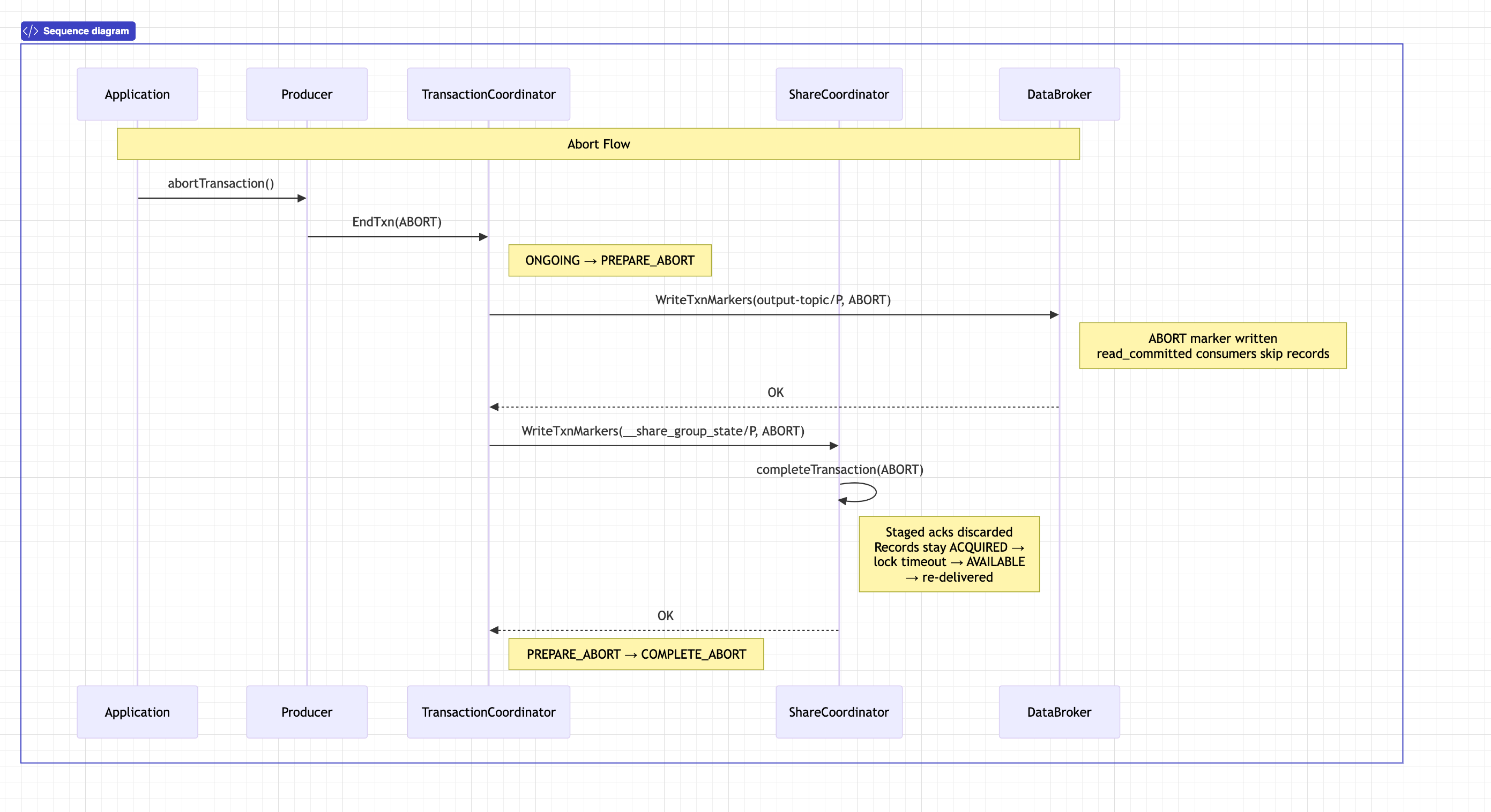
6. Corner Cases
Case 1: Crash BEFORE beginTransaction()
poll() -> records [0..9] ACQUIRED
<CRASH>
What happens:
- No transaction was started, no output produced, no acks sent
- ACQUIRED locks on records 0-9 expire (controlled by
share.record.lock.duration.ms) - Broker re-delivers records 0-9 to another member of the share group
- No data loss, no duplicates
Case 2: Crash AFTER send() but BEFORE commitTransaction()
poll() -> records [0..9] ACQUIRED
beginTransaction()
send(output for 0-9)       ← records written to broker, but transactional
<CRASH>
What happens:
- Output records are in the partition log but invisible (
read_committedconsumers skip uncommitted) - No
EndTxnRequestwas sent - TC detects transaction timeout (
transaction.timeout.ms), auto-aborts - TC sends
WriteTxnMarkers(ABORT)-> output records get ABORT marker, permanently invisible - Share group: no acks were sent, ACQUIRED locks expire, records 0-9 re-delivered
- No data loss, no duplicates
Case 3: Crash AFTER sendShareAcksToTransaction() but BEFORE commitTransaction()
poll() -> records [0..9] ACQUIRED
beginTransaction()
send(output)
sendShareAcksToTransaction()  ← acks written to SGC as PENDING
<CRASH>
What happens:
- Output records: in log, invisible (uncommitted)
- Share acks: stored in SGC as PENDING (not materialized)
- TC detects timeout, sends
WriteTxnMarkers(ABORT)to both data partitions AND__share_group_state - Output: ABORT marker written, records permanently invisible
- Share acks: SGC discards pending acks, locks expire, records 0-9 re-delivered
- No data loss, no duplicates -- this is the critical case that KIP-1289 solves
Case 4: Crash AFTER EndTxn(COMMIT) sent but BEFORE WriteTxnMarkers completes
poll() -> records [0..9] ACQUIRED
beginTransaction()
send(output)
sendShareAcksToTransaction()
commitTransaction()            ← EndTxn sent, PREPARE_COMMIT logged
<TC crashes or broker restart>
What happens:
PREPARE_COMMITis durable in__transaction_statelog- When TC recovers (or new leader elected for
__transaction_statepartition), it replays the log - TC sees PREPARE_COMMIT, resumes sending
WriteTxnMarkers(COMMIT)to all partitions - Output records become visible, share acks materialized
- No data loss, no duplicates -- the two-phase commit guarantees completion
Case 5: ProducerFencedException (zombie detection)
Instance A: beginTransaction(), send(), ...
Instance B: initTransactions() with same transactional.id
            ← TC bumps epoch, A is now a zombie
Instance A: commitTransaction()
            ← TC rejects: ProducerFencedException
What happens:
- Instance A's transaction is aborted by the TC (epoch fenced)
- Any pending output and share acks from A are discarded
- Instance B takes over, re-processes the records
- No data loss, no duplicates -- fencing prevents split-brain
Case 6: abortTransaction() called explicitly
poll() -> records [0..9] ACQUIRED
beginTransaction()
send(output for 0-4)
record 5 fails validation
abortTransaction()             ← explicit abort
What happens:
- TC writes PREPARE_ABORT, sends
WriteTxnMarkers(ABORT) - Output records 0-4: ABORT marker, permanently invisible
- Share acks (if any sent): discarded
- ACQUIRED locks expire, all records 0-9 re-delivered
- Application gets fresh batch, can retry
- No data loss
Case 7: Partial produce failure (network error to one partition)
beginTransaction()
send("enriched-orders-0", rec1)   ← success
send("enriched-orders-1", rec2)   ← network error, KafkaException
What happens:
- Application catches
KafkaException, callsabortTransaction() - Same as Case 6: everything rolled back, records re-delivered
- No data loss
The Guarantee Matrix
| Scenario | Output Records | Share Acks | Records Re-delivered? | Data Loss? | Duplicates? |
|---|---|---|---|---|---|
| Happy path (commit) | Visible | Materialized | No | No | No |
| Crash before txn | Never written | Never sent | Yes (lock expiry) | No | No |
| Crash mid-txn | Aborted (invisible) | Discarded | Yes (lock expiry) | No | No |
| Crash after PREPARE_COMMIT | Committed on recovery | Materialized on recovery | No | No | No |
| Zombie fenced | Aborted | Discarded | Yes (new instance) | No | No |
| Explicit abort | Aborted (invisible) | Discarded | Yes (lock expiry) | No | No |
| TC crash after PREPARE | Completed on failover | Completed on failover | No | No | No |
...
Failure Scenarios
Crash Before/During Txn: If the application crashes before
commitTransaction(), the Transaction Coordinator (TC) auto-abortsThe "Critical Case" (Crash after
sendShareAcks): If a crash occurs after acks are sent but before the final commit, the TC sends Abort signal and ensures pending acks are discarded.Zombie Producers: If a new producer instance starts, the old one is fenced. Any in-flight output or acks are discarded by the TC, preventing "split-brain" duplicates.
Post-Prepare Crash: If the TC crashes after logging
PREPARE_COMMIT, the 2PC protocol ensures that the transaction is finalized upon recovery. Both outputs and acks will successfully materialize.
7. Compatibility, Deprecation, and Migration Plan
Zero Breaking Changes: Current
implicitandexplicitmodes remain the default and continue to function as-is.Opt-in Requirement: Users must explicitly enable the new mode via
share.acknowledgement.mode = transactional.Version Safety: * Clients will "fail fast" if the connected broker does not support the new
TxnShareAcknowledgeRequest.Fallback logic is included to issue warnings if a downgrade to non-transactional acks is necessary.
8. Test Plan
The verification strategy focuses on state machine integrity and fault tolerance under high-concurrency and failure scenarios.
Unit Tests: Validates state transitions (e.g.,
ACQUIREDtoACKNOWLEDGEDon commit vs.AVAILABLEon abort), idempotency of operations, and transaction timeout/auto-abort logic.Integration Tests: Focuses on end-to-end commit/abort flows, coordinator recovery, and multi-consumer behavior within a single group during network partitions.
System & Performance Tests: Benchmarks transactional vs. non-transactional modes and verifies exactly-once delivery within Flink/Spark checkpointing cycles.
Chaos Tests: Simulates broker and coordinator crashes specifically during critical phases like
PREPARE_COMMITto ensure protocol durability.
Rejected Alternatives
If there are alternative ways of accomplishing the same thing, what were they? The purpose of this section is to motivate why the design is the way it is and not some other way.