DUE TO SPAM, SIGN-UP IS DISABLED. Goto Selfserve wiki signup and request an account.
...
The following sequence diagram depicts the flow between the various entities:
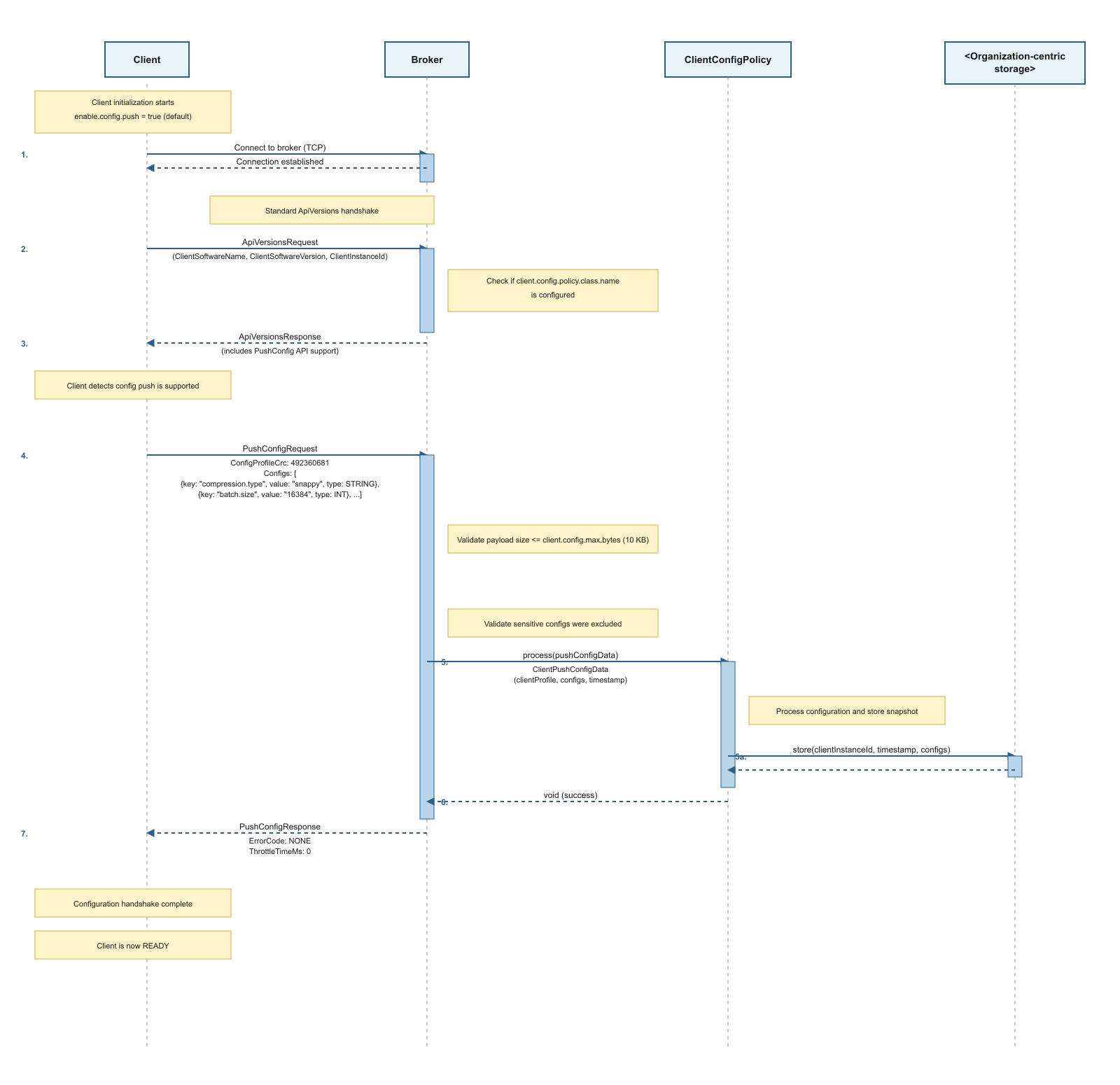
The flow includes the following steps:
...
After receiving ApiVersionsResponse, the client collects the configuration values and sends them in a PushConfigRequest. The client typically sends this request once during bootstrap, before invoking client APIs. Retries use retry.backoff.ms, retry.backoff.max.ms, and default.api.timeout.ms, similar to ApiVersions.
The ConfigType field is an integer that maps to the ClientConfigType enum, defined above.
...
Error Code | Description | Client Action |
|---|---|---|
| Client sent a request in which the | Log the error in |
| The | Log the error in |
Proposed Changes
Disabling the Feature
This feature can be disabled on the broker and the client. For the broker, remove client.configs.policy.class.name or set its value to null. When this configuration is missing, the ApiVersions response will not include support for the feature, so the client doesn’t send configuration. For the client, set enable.configs.push to false, in which case the client skips the entire configuration handshake.
Broker Behavior
If a broker is configured with client.configs.policy.class.name, the ApiVersions response advertises support for the PushConfig RPC. Whenever a client sends a PushConfig request, the broker calls the policy with the client configuration for observability.
Configuration Payload Size Enforcement
As described below, client implementations should not attempt to send a payload that is too large in the first place. But as a backup means of preventing the client from sending too much data, the broker checks the new configuration client.configs.max.bytes prior to invoking the policy. If the size of the PushConfig request exceeds client.configs.max.bytes, the broker returns the CONFIG_TOO_LARGE error to the client.
After analyzing the different Java clients’ configuration, a default of 10 KB for client.configs.max.bytes provides more than sufficient capacity:
Client | Number of Non-sensitive Configuration Keys | Total Request Size |
|---|---|---|
| ~25 | < 1 KB |
| ~50 configs | < 2 KB |
| ~45 configs | < 2 KB |
| ~55 configs (without producer, consumer, admin) | ~2 KB |
A default 10 KB limit provides ~5x headroom for the largest expected use case, while preventing abuse from malicious or errant clients.
Excluding Sensitive Configuration
As explained in the concepts section, the ClientConfigPolicy implementation may also provide logic to ensure that clients do not send sensitive configuration. Clients across the Apache Kafka ecosystem do not have a consistent naming convention. As a result, brokers cannot determine sensitivity based on the configuration key name and rely on the incoming ConfigType field. When the ClientConfigPolicy detects sensitive configuration, it includes a description of the violation in the RPC response.
Metrics
This KIP does not introduce any new broker metrics.
Client Behavior
Handshake
A client that supports this configuration interface will identify a node that supports the API using ApiVersions. The client performs a handshake by collecting the values for its configuration issuing a PushConfig RPC to submit the configuration to the broker node. The client sends the RPC after authentication (if any) and before the client starts to use the connection for requests. Similar to the ApiVersions handshake, the PushConfig RPC specifies a fixed timeout of default.timeout.ms. If the RPC exhausts its retries, the client logs the error, but continues execution.
Here’s the sequence:
Client connects to broker
Send
ApiVersionsrequest (internal, automatic)Receive
ApiVersionsresponse to determine which features broker supportsIf
enable.configs.pushis set and configuration push is supported by the brokerCollect requested client configuration values
Send
PushConfigwith configurationReceive
PushConfigresponse
User requests can now be sent
The client chooses a randomly selected node for its configuration handshake, in the same way as GetTelemetrySubscriptions. The client configuration is only sent once, not for each broker. The “handshake” is performed on a per-client basis, not for each connection. As connections are closed due to disconnects or aging out, no new configuration handshake is performed. This operation is executed once for each distinct client instance.
The handshake is performed on a best-effort basis. Network or other transient errors that occur when transmitting the configuration data must not prevent the client from functioning.
Blocking Behavior
From the user’s perspective, the client blocks when a client API is invoked until the handshake completes.
For example:
| Code Block |
|---|
// KafkaProducer constructor returns immediately KafkaProducer<String, String> producer = new KafkaProducer<>(props); // ✓ Non-blocking // First send() blocks until connection is ready (including configuration handshake) producer.send(record); // ← Blocks up to max.block.ms waiting for READY state |
Excluding Sensitive Configuration
The configuration entries sent in the PushConfig request should exclude any sensitive information. Which configuration keys are considered sensitive is determined by the client library.
Including Configuration Data Types
Depending on the server-side implementation, preserving the data types enables more compact storage, reduces redundant conversion, reduce cognitive overhead in downstream use, and eliminate invalid data (e.g. storing a value of “hi!” in a boolean). It’s also important because the server is not aware of all the different clients and their respective configuration, so providing the name, type, and value, though at times redundant, allows for wider client compatibility.
Metrics
This KIP does not introduce any new client metrics.
Compatibility, Deprecation, and Migration Plan
- What impact (if any) will there be on existing users?
- If we are changing behavior how will we phase out the older behavior?
- If we need special migration tools, describe them here.
- When will we remove the existing behavior?
Test Plan
Describe in few sentences how the KIP will be tested. We are mostly interested in system tests (since unit-tests are specific to implementation details). How will we know that the implementation works as expected? How will we know nothing broke?
Rejected Alternatives
...
Impact on Existing User
Broker
No policy configured: Feature is effectively disabled
No new RPCs are advertised in
ApiVersionsIf client sends requests, broker throws an error
No performance or behavioral impact
Policy configured: Feature is enabled
New RPCs are advertised in
ApiVersionsBroker receives and processes config pushes from supporting clients
Older clients (no support) are unaffected
Minimal resource overhead
Upgrade path: Rolling upgrade safe
Old brokers: don't advertise config push APIs, clients skip handshake
New brokers: advertise APIs, clients perform handshake if enabled
No cross-version issues
Client
Older clients (no support): No impact
Don't check for config push APIs
Behavior identical to pre-KIP
Newer clients with feature disabled: No impact
enable.configs.push=falseHandshake skipped
Behaviorally identical to older clients
Newer clients with feature enabled (default): Minor impact
Additional RTT during connection setup (
PushConfig)Estimated 10-50ms added latency to first user request (depends on network RTT)
One-time cost per client instance lifetime
Migration
This is a purely additive feature and requires no migration.
Before KIP: No client configuration visibility
After KIP: Incremental visibility as clients upgrade
Breaking changes: n/a
Deprecation: n/a
Test Plan
Integration Tests
Happy Path
Test complete handshake with success
Client Startup
Test producer, consumer, admin, and Kafka Streams client with
enable.configs.pushset totrueperforms handshakeTest producer, consumer, admin, and Kafka Streams client with
enable.configs.pushset tofalseskip handshake entirelyTest Kafka Streams does not perform separate handshake for embedded producer/consumer/admin clients
Broker Configuration
Test broker with
client.configs.policy.class.nameset advertises APIs inApiVersionsTest broker without policy (
null) does not advertise config push APIsTest broker with policy invokes
process()on successfulPushConfig
Mixed Broker Versions (Rolling Upgrade)
Test old brokers (no config push support) don't advertise APIs
Test new brokers advertise APIs
Test clients detect support via
ApiVersionsand only handshake with new brokersTest clients work correctly when connecting to mix of old and new brokers
Retries
Test client retries
PushConfigonUNKNOWN_CONFIG_PROFILETest client does not retry on
CONFIG_TOO_LARGEorINVALID_CONFIGTest exponential backoff is applied correctly
Timeout Handling
Test handshake respects
default.api.timeout.msTest client continues if handshake times out (best-effort feature)
Test timeout does not block subsequent operations
Throttling
Test client waits for
ThrottleTimeMsbefore retrying if throttled
System Tests
Multiple Client Types
Test Java
KafkaProducer,KafkaConsumer,AdminClient, andKafkaStreamsapplication and verify each client type sends appropriate configs based on the type of client
Large Payloads
Test config payload near
client.configs.max.byteslimitTest config payload exceeding
client.configs.max.bytesreturnsCONFIG_TOO_LARGE
Policy
Test custom
ClientConfigPolicyrejects configs viaInvalidConfigExceptionTest client receives
INVALID_CONFIGerror with an appropriate message
Rejected Alternatives
Exclusion of Default Values
The number of configuration entries is getting larger with each release, the vast majority of which use default settings. The question arises: how should we handle configuration entries that use a default value? Here are some options for the client:
Send all configuration entries to the cluster, including those with default values.
Omit any configuration entries that use their respective default values.
Send all configuration entries, but omit the value value and demarcate those that use default values.
It’s redundant to send configuration with known default values. Preparing and sending the name, type, and value for scores of configuration could add up to a couple of KB in network transit. Additionally, that then means that the server side node that receives the handshake request then has to handle requests that consist mostly of entries with default values. It’s easy to argue that the defaults are superfluous and not include them.
Whether or not to include configuration entries with default values somewhat depends on what the ClientConfigPolicy implementation plans to do with those entries. Also, keep in mind that the server receiving the handshakes may service many different clients from different languages and versions. Even though the client knows when the configuration entry’s value is the default value, the broker handling the handshake may have no idea that, for example, topic.compression.level=low from the 2.5.2 version of the Visual Basic Kafka client is the default value for that client. Requiring each implementor of ClientConfigPolicy to maintain a listing of all the default values across all available Kafka clients and their respective versions seems like overkill.
The stance of this KIP is that there is no need to exclude default configuration, based on the following:
The configuration handshake only occurs once during the lifetime of a client.
The configuration handshake request size is negligible compared with the amount of network traffic over the course of the lifetime of a client.
The server node handling the incoming configuration handshake can drop any entries that come in with a default value.
Requiring that broker know a priori the default values (to fill in the missing information) is a maintenance problem.
Including Configuration Storage Detail
Storage and retention of the configuration data is outside the scope of this KIP. The ClientConfigPolicy implementation is responsible for managing the storage, if any, of the configuration payload once the broker invokes it.