DUE TO SPAM, SIGN-UP IS DISABLED. Goto Selfserve wiki signup and request an account.
...
Cluster Mirroring addresses these operational challenges by integrating cross-cluster replication directly into Kafka brokers, providing a simpler and more robust solution for cross-cluster replication. Producers write to the source cluster and receive acknowledgments based on the source cluster's replication requirements (e.g. acks=all ensures replication to all in-sync replicas within the source cluster). Data is then asynchronously replicated to destination clusters with no impact on producer latency or throughput. While Cluster Mirroring is optimized for geo-replication, DR and migration use cases where a single source cluster replicates to one or more destination clusters, it also provides a foundation for more complex topologies.
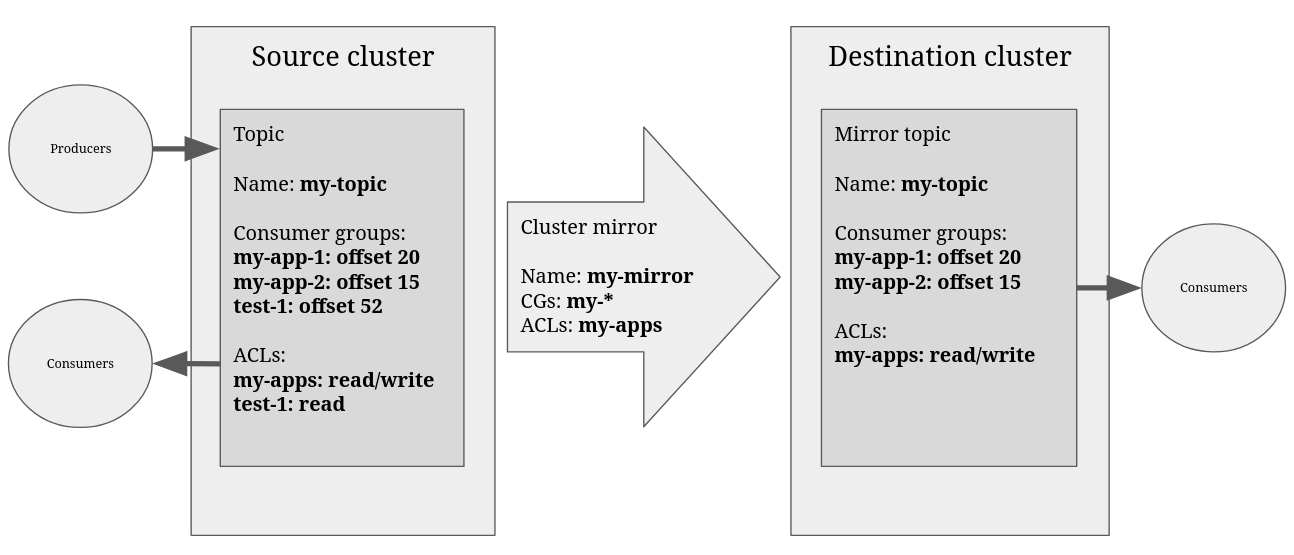
- Integrated Architecture: Replication logic runs within broker processes, eliminating external dependencies and reducing the operational footprint.
- Simplified Configuration: Creating a cluster mirror requires a single command-line invocation or Admin API call with bootstrap servers and security credentials.
- Metadata Synchronization: Topic configurations, consumer group offsets, and ACLs are periodically synchronized from source to destination cluster without additional configuration.
- Unified Monitoring: Cluster Mirroring metrics are exposed through standard Kafka broker JMX metrics alongside existing replication metrics. Operators use familiar tools and dashboards to monitor cross-cluster replication.
- Faster Failover: The failover operation is simplified because metadata synchronization is continuous and automatic. Consumer applications can resume processing immediately after switching clusters without any offset translation.
- Delta Failback: Destination leader acts as a follower with regards to source leader, so it will always fetch from the local log end offset to catch up with the leader, making it possible to mirror only the delta when failing back (reverse mirroring).
- Version Compatibility: For migration or DR use cases where failback is not required, this proposal supports source brokers up to version 2.1.0 included, leveraging the client/broker forward compatibility introduced in v4.0.
- ULE Support: Cluster Mirroring can detect and reconcile unclean leader elections with additional configuration, ensuring consistency across clusters.
...
Stretched clusters are not suitable for DR scenarios because they provide no protection against software failures, configuration errors, and accidental topic deletions. Vendors that recommend stretched cluster deployments typically position them for high availability (HA) rather than DR, and notably, most do not offer stretched clusters as a managed service option, further underscoring the operational challenges and limited DR effectiveness of this architecture.
Proposed Changes
Cluster Mirroring introduces a coordinator-based architecture integrated into Kafka brokers for managing A cluster mirror is a named, unidirectional replication channel from a remote source cluster to the local destination cluster. It is created by specifying a unique mirror name along with the source cluster's bootstrap servers and security credentials. Once a mirror is created, individual topics on the source cluster can be started, stopped, or paused for replication within it. Each mirror is a first-class entity managed through the Admin API and the kafka-mirrors.sh CLI tool, with its state persisted in a new Kafka's internal coordinator that manages cross-cluster replication.
The design architecture consists of three primary components that work together to provide automatic metadata synchronization and data replication. The following diagram illustrates how these components are wired together. For the sake of clarity, some internal APIs are excluded from the overview diagram.
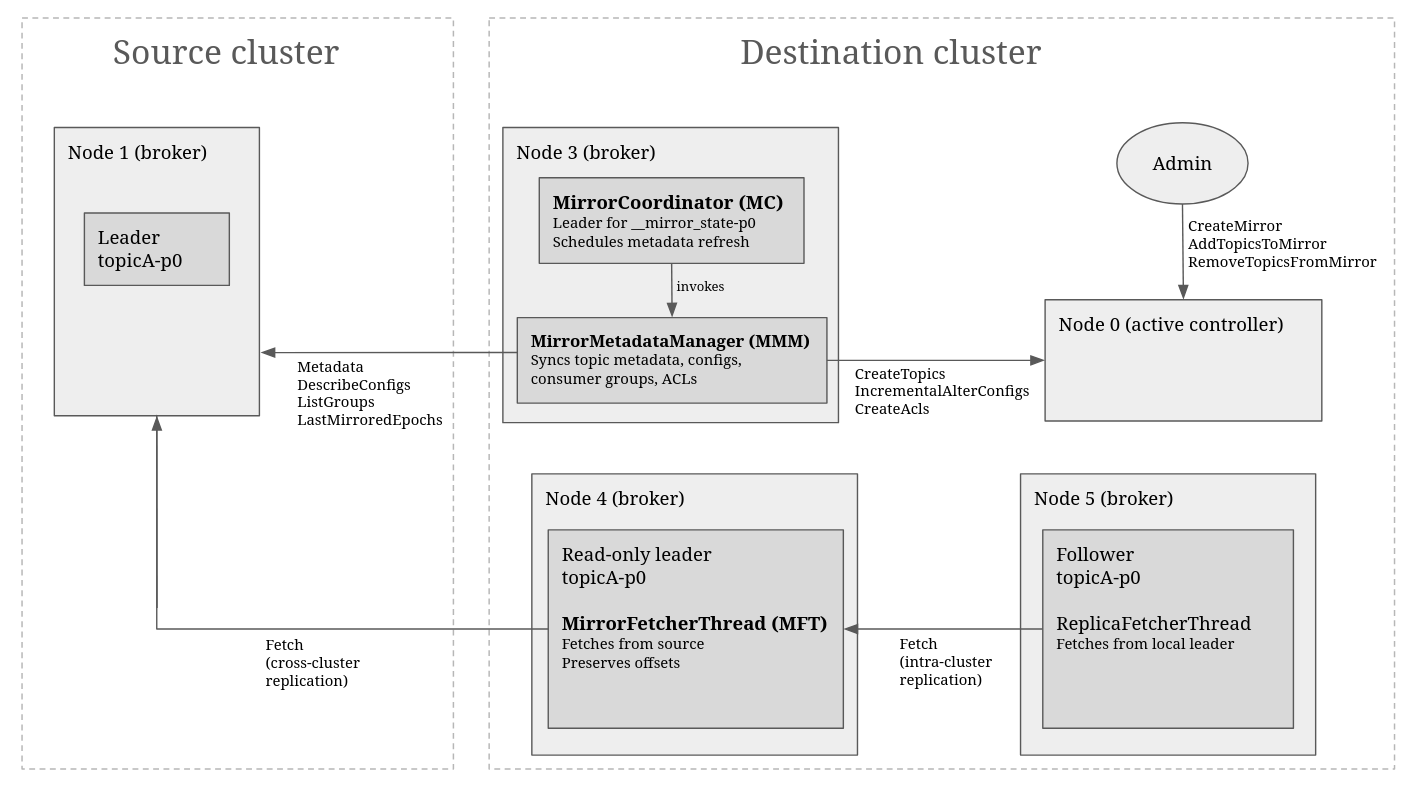
The mirror name is stored as a topic-level internal configuration called mirror.name that has the same validation rules of topic names, and propagates through Kafka's metadata log as configuration change records. When topics are added to a mirror, the controller generates configuration metadata records that are replicated to all brokers through the standard metadata update mechanism. Brokers monitor these configuration changes to detect when partitions they lead belong to a mirror, triggering the creation of mirror fetchers and enforcement of read-only semantics. This design ensures that mirror associations are visible, auditable, and manageable through standard Kafka tools while maintaining strict control over how mirroring relationships are established and modified.
...