DUE TO SPAM, SIGN-UP IS DISABLED. Goto Selfserve wiki signup and request an account.
...
- Implement
requiresTopologyPushas a non-blocking, efficient call, since it is invoked frequently. - Expire and clean up stored topology descriptions for inactive groups and superseded topology epochs internally. Incoming
requiresTopologyPushcalls can be used as an implicit keep-alive. - Decide and enforce a maximum stored description size. Reject pushes that exceed it by completing the
setTopologyfuture withTopologyDescriptionTooLargeException, and stop returningrequiresTopologyPush=truefor the same(groupId, topologyEpoch)pair once that pair has been confirmed too large. - Throttle re-solicitation without relying on the heartbeat interval. For each
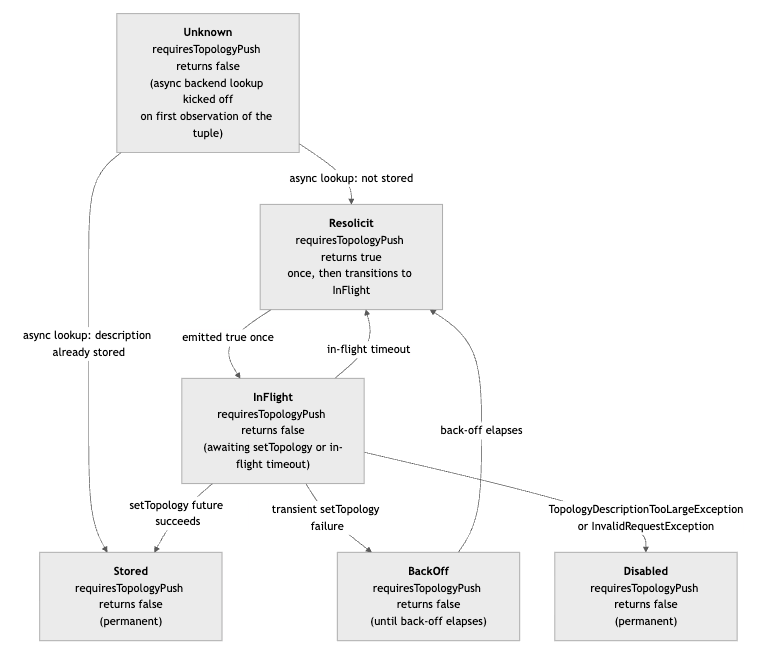
(groupId, groupCreationTimeMs, topologyEpoch)tuple the plugin should track (i) whether a push is currently in flight and (ii) the time of the lastrequiresTopologyPush=true. While a push is in flightrequiresTopologyPushreturnsfalse. Once the push has completed successfully it returnsfalsepermanently for that tuple. On a transientsetTopologyfailure the plugin arranges forrequiresTopologyPushto returntrueagain after a self-driven back-off (e.g. exponential, starting at 1s) — this is the client re-solicitation mechanism, and it is the only retry pathway: the wire-levelTOPOLOGY_DESCRIPTION_UPDATE_FAILEDis terminal from the client's perspective and pairs with this plugin-side re-solicitation. On permanent failure (TOPOLOGY_DESCRIPTION_TOO_LARGEor plugin-semanticINVALID_REQUEST) the plugin returnsfalsepermanently for the tuple and logs. - Not request repeated pushes from stable groups that have already pushed their topology at the current epoch.
See the appendix for an example state machine for managing the lifecycle of a topology description.
Security Considerations
The topology description contains user-defined processor names, state-store names, and topic names. This KIP does not treat these as inherently sensitive and does not introduce any client-side redaction. Operators who consider node, store, or topic names sensitive should scope DESCRIBE ACLs on the GROUP resource accordingly: the same ACL that guards StreamsGroupDescribe guards the TopologyDescription field on the response. The UpdateStreamsGroupTopologyDescription path is guarded by READ on the GROUP, identical to the existing heartbeat ACL.
...
KIP-714 supports compression (ZStd, LZ4, GZip, Snappy) for telemetry payloads because metrics are pushed repeatedly at high frequency. Topology descriptions are pushed infrequently (only on topology epoch changes) and the wire payload is expected to fit comfortably for typical applications. The Kafka protocol's flexible versions already provide efficient serialization. Adding compression would add complexity without meaningful benefit for this use case.
Appendix: Example plugin lifecycle
Appendix: Example RPC payload
...