DUE TO SPAM, SIGN-UP IS DISABLED. Goto Selfserve wiki signup and request an account.
...
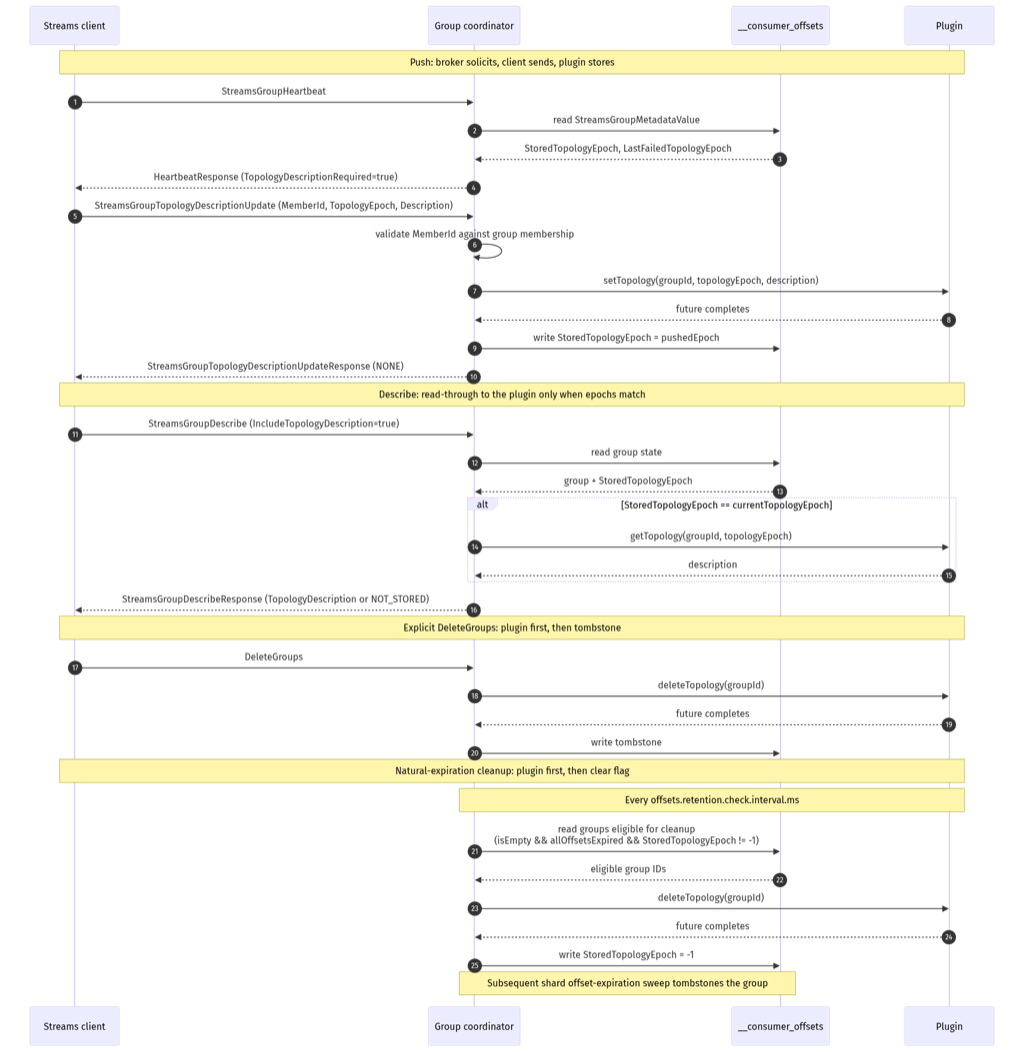
The sequence below traces the four user-visible interactions — a successful push, a describe, an explicit DeleteGroups, and broker-driven cleanup of a naturally-expired group. Plugin calls return CompletableFutures; the broker awaits them asynchronously.
View file
Broker Side
The plugin is instantiated at broker startup if
group.streams.topology.description.plugin.classis configured. A broker without a plugin returnsUNSUPPORTED_VERSIONforStreamsGroupTopologyDescriptionUpdateand never setsTopologyDescriptionRequired, so the RPC is only sent against a plugin-configured broker.After a successful
StreamsGroupHeartbeat, the broker decides whether to setTopologyDescriptionRequired=truepurely from the group's persisted state — no plugin RPC is involved. Members withSTALE_TOPOLOGYstatus are skipped. For all other members the broker sets the flag iffStoredTopologyEpoch != currentTopologyEpochANDLastFailedTopologyEpoch != currentTopologyEpochAND no per-group back-off is in its window. The back-off is in-memory state (keyed bygroupId, carryingtopologyEpoch+nextAttemptMs) that arms or extends every time the flag is set and additionally on a transientsetTopologyfailure; consecutive arms double the window from 30 s up to 1 h. It clears on a successful push, on a permanent failure (whereLastFailedTopologyEpochratchets), and implicitly on any topology-epoch advance. The same mechanism covers unresponsive plugins and clients that never push (for example, withtopology.description.push.enabled=false).On
StreamsGroupTopologyDescriptionUpdate, the broker checks theREADACL on the group and that a plugin is configured, then validates theMemberId: an emptyMemberIdis rejected withINVALID_REQUEST, a non-existing streams group withGROUP_ID_NOT_FOUND, and aMemberIdnot matching any current member withUNKNOWN_MEMBER_ID. The broker enforces no size limit; the plugin decides what it is willing to store. The broker then callssetTopologyon the plugin. On success it writes a metadata record settingStoredTopologyEpoch = pushedEpochand the response carriesNONE. OnInvalidRequestExceptionorStreamsTopologyDescriptionTooLargeExceptionit writesLastFailedTopologyEpoch = pushedEpochso subsequent heartbeats at the same epoch do not re-solicit. Any other exception maps toSTREAMS_TOPOLOGY_DESCRIPTION_UPDATE_FAILED, is logged at WARN, and is treated as transient — no metadata record is written and the next heartbeat re-solicits. If the plugin call succeeds but the metadata-record write fails, the next heartbeat sees the drift, re-solicits, and the idempotent re-push closes the gap.On
DeleteGroups, the broker callsdeleteTopologyon the plugin before writing the group tombstone, for each requested streams group withStoredTopologyEpoch != -1. On plugin success the group is tombstoned and the per-groupErrorCodeisNONE. On plugin failure the group is not tombstoned and the per-groupErrorCodeis set toSTREAMS_TOPOLOGY_DESCRIPTION_DELETE_FAILED(the plugin's exception is logged at WARN on the broker); the operator retries the request once the plugin recovers, or unsets the plugin config to bypass it. Other groups in the same batch are unaffected — the failure is reported per group. This ordering matches the natural-expiration cleanup below, which also defers tombstoning untilplugin.deleteTopologysucceeds.- On
StreamsGroupDescribewithIncludeTopologyDescription=true, the broker callsgetTopologyon the plugin only whenStoredTopologyEpoch == currentTopologyEpochfor that group; otherwise it reportsNOT_STOREDwithout making a plugin call. Calls across groups run in parallel. Authorization is unchanged — the existingDESCRIBEACL on the GROUP resource covers the topology description.DescribedGroup.ErrorCodeis never modified by topology-related outcomes; theTopologyDescriptionStatusfield carries the reason whenTopologyDescriptionis null (NOT_REQUESTED,NOT_STORED, orERROR; the last is also logged at WARN). With no plugin configured the broker returnsNOT_STORED. AgetTopologycall returningnull(plugin-side data loss) surfaces asNOT_STOREDand is logged at WARN; subsequent describes keep returningNOT_STOREDuntil the topology epoch advances or an operator clears plugin state. - When a plugin is configured, the broker runs a periodic topology-description cleanup every
offsets.retention.check.interval.ms. Each fire fans out a read-only query across the broker's hosted__consumer_offsetspartitions to identify streams groups eligible for cleanup:isEmpty && allOffsetsExpired && StoredTopologyEpoch != -1. This is the same eligibility predicate the shard's offset-expiration sweep uses to delete consumer/share groups, with the additionalStoredTopologyEpoch != -1filter. For each eligible group, the broker callsplugin.deleteTopology(groupId)and, on success, writes a metadata record settingStoredTopologyEpoch = -1. Plugin failures leave the field set; the same group is retried on the next cycle. OnceStoredTopologyEpoch = -1, the shard's offset-expiration sweep tombstones the (now flag-cleared) group on a subsequent cycle. When no plugin is configured, the periodic cleanup does not run and the shard's offset-expiration sweep expires streams groups normally, ignoringStoredTopologyEpoch; operators that disable a previously-configured plugin are responsible for cleaning up plugin-side state out-of-band.
...