...
Currently the 1000v series and the VSG are supported on VMWare hypervisors.
This would be the deployment model with CloudStack: 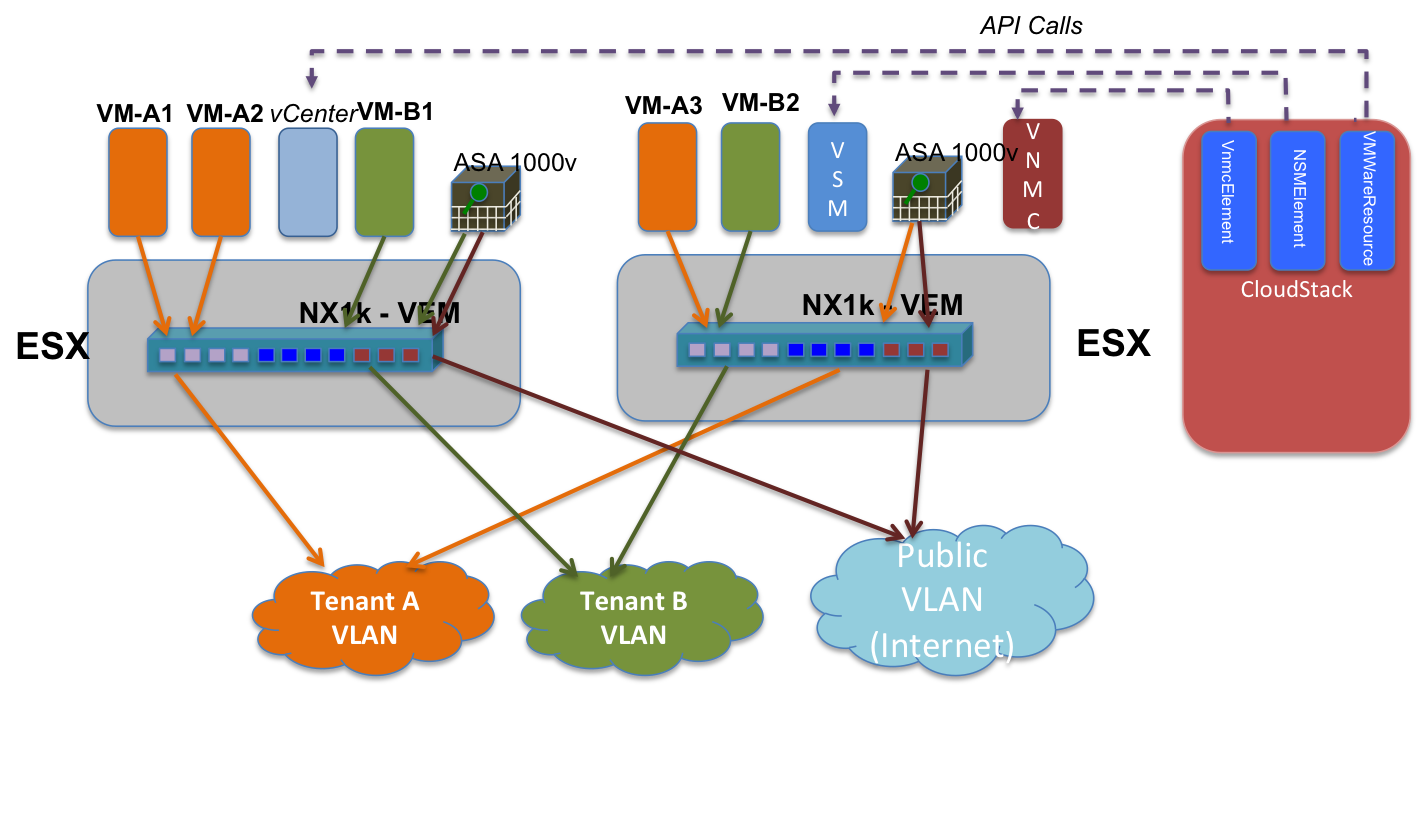
Use Cases / Flow
For 4.2
- Cloud operator adds VNMC as a network element using admin API addCiscoVnmcControlleraddCiscoVnmcResource, specifying username and password
- Cloud operator adds ASA1000v appliances (one per guest network) using admin API addCiscoAsa1000vResource.
- Cloud operator creates isolated guest network offering with source nat using ASA1000v as the service provider for firewall, source nat, port forwarding and static NAT. CloudStack system vm is used for DHCP, userdata and metadata, password server
Beyond 4.2
- Cloud operator creates VPC network offering with source nat using ASA1000v as the service provider for firewall, source nat, port forwarding, ACL and routing. CloudStack system vm is used for DHCP, userdata and metadata, password server.
- Network offerings as above, but using VXLAN as the isolation technologyNetwork offerings as above, with LB added, and using Cloudstack System VM as LB provider
- Network offerings as above, with LB added, and using Netscaler VPX as LB provider
...
The resource translates abstract network configuration commands such as SetStaticNatRule into concrete XML api calls to the VNMC controller
CiscoVnmcElementService
The service is a pluggable service that allows the cloud operator to provision the VNMC controller URL and credentials into CloudStack
CiscoVnmcManager
The manager implements the CiscoVnmcElementService. It also pre-creates and manages a pool of ASA1000v appliances. The pool is created with an initial capacity and is expanded as demand grows. As networks are de-provisioned, the appliances are returned to the pool.
CiscoVnmcElement
The network element participates in L2 orchestration by extending NetworkElement. When a network is created, the element needs to
- create a tenant and tenant vdc in VNMC if not already created
- create the following policies / objects if not already created inside the tenant VDC
- Edge Static static route policy
- Edge static route
- Source NAT pool
- Edge security profile to deny all incoming traffic
- Create an edge firewall
- Associate an unused ASA1000v appliance to the edge firewall
The Cisco ASA1000v can function as a DHCP server, however it cannot guarantee a specific ip<->mac address mapping. Therefore the CloudStack systemvm will be used for this purpose.
The CiscoVnmcElement also implement the IpDeployer and various service provider interfaces to satisfy the requirements of the network offering.
...
VXLAN isolation
...
VXLAN isolation needs to be added as an isolation method, with a specific Guru managing allocation of the VXLAN network identifier (VNI)
...
VSG interaction
...
Additionally the following are also provided:
- Allows cloud operator to provision the VNMC controller into CloudStack
- Allows cloud operator to register ASA1000v appliances into CloudStack
Nexus 1000v + VNMC + ASA 1000v deployment model
Prereqs
- Nexus 1000v appliance is setup and configured in CS (when adding Vmware cluster)
- VNMC appliance is configured and added to CS (separate lifecycle commands will be provided)
...
- . A single VNMC is sufficient for managing the ASA1000v appliances
- ASA1000v appliances are setup/configured outside of CS and then added to CS (separate lifecycle commands will be provided)
Deployment
...
model
In current CS there is a 1:1 mapping between Vmware cluster and n1kv switch. This can model will be used by one or more asa1kv appliances in asa1kv appliances as well as they also need n1kv. There can be multiple asa1kv appliances associated with the same Vmware cluster (and corresponding n1kv).
There will be a 1:1 mapping between guest network and asa1kv appliance. Now if this network spans multiple clusters then some book-keeping needs to be done as to which n1kv VSM should be used for configuring ASAs and guest VMs. To simplify things I am currently making the assumption that there will be a single Vmware cluster in the zone where ASA support is required. This can be changed later on. Moreover the This guest network can span multiple Vmware clusters (multiple n1kv switches). (Note: The scenario where a guest network spans multiple Vmware clusters ( with n1kv ) is not a supported tested scenario currently.
Also the network can have guest VMs on the Vmware cluster only as n1kv is not available on other HVs.
ASA setup and configuration
Spin up an ASA instance in standalone mode (do we need to support HA mode?)
Following configuration needs to be provided:
)
HV limitation
Since asa1kv works with n1kv and this is available only for Vmware HV, guest networks with asa1kv will only be supported on Vmware only.
VNMC setup (external to CS)
VNMC appliance needs to be setup externally and then registered with CS using admin API.
ASA setup (external to CS)
ASA1000v appliance needs ot be setup externally and then registered with CS using admin API. Typically admin will create a pool of ASA1000v appliances and register them with CS.
Following inputs to be provided for setting up ASA:
- ESX host
- Standalone/HA mode
- Port
- ESX host
- Specify port profiles for mgmt. and ha n/w interfaces (pre-created on n1kv switch, can be same or different)
- Specify port Port profiles for inside/outside n/w interfaces (pre-created on n1kv switch, updated appropriately while implementing guest n/w)
- Mgmt. IP for ASA, specify g/w such that VNMC IP is reachable
- Admin password
- VNMC IP and other parameters
Inside port profile configuration on Nexus1000v
- in_port_profile
port-profile type vethernet %asa-in-port-profile%
vmware port-group
switchport mode access
no shutdown
state enabled
Outside port profile configuration on Nexus1000v
- out_port_profile
port-profile type vethernet %asa-out-port-profile%
vmware port-group
switchport mode access
switchport access vlan %vlanid-of-outside%
no shutdown
state enabled
After the ASA instance is powered on the VNMC needs to be registered from ASA console
- ASA1000V(config)# vnmc policy-agent
- ASA1000V(config-vnmc-policy-agent)# registration host vnmc_ip_address
- ASA1000V(config-vnmc-policy-agent)# shared-secret key where key is the shared secret for authentication of the ASA 1000V connection to the Cisco VNMC
ASA limitation
- ASA inside and outside interfaces cannot act as trunk interfaces to support multiple VLANs. What this mean for CS is that multiple guest networks cannot be trunked to the inside interface. So in order to support VPC, some alternate needs to be thought out for deploying ASA. The same applies to outside interface as well implying that a single public subnet can be used with ASA deployments. See http://goo.gl/rZPFx
- ASA outside interface ip cannot be used in any NAT rule. This means that source NAT ip allocated to a guest network in CS cannot be used as ASA outside ip.
Guest network implement() logic
...
- VirtualRouterElement creates the VR for DHCP, userdata and metadata, password server
- CiscoVNMCElement::implement() does the following:
- Create tenant /edge_security_profile/logical_edge_firewall and policies in VNMC. There will be helper methods in VnmcResource class for all these operations (currently assuming one VNMC appliance per zone).
- Tenant creation - tenantName format vlan-%vlanid%
- Edge device profile - name format edsp-%tenantName%. This will have the routing policies. Static routes will be configured for all gateways specified along with public IP ranges associated with the zone.
- Edge security profile - name format esp-%tenantName%. This will have the NAT, PF and ACL policies.
- Logical edge firewall - name format efw-%tenantName%
- Create vservice_node and update in_inside port _ profile for ASA in n1kv VSM for the Vmware cluster. This is again done using VnmcResource class (internally will call VsmCommand)
- vservice_node (below commands for doing it on CLI)
vservice node ASA-%vlanid% type asa
ip address 10.1.1.1
adjacency l2 vlan %vlanid%
fail-mode close - in_port_profile
port-profile type vethernet %asa-in-port-profile%
vmware port-group
switchport mode access
switchport access vlan %vlanid%
no shutdown
state enabled
- Associate ASA ASA1000v appliance with logical_ edge _ firewall (in VNMC). IP address of ASA is required for this. This is again done using VnmcResource.
...
Create port profile for guest VM and associate edge _ security _profileprofile created as part of implement() of network element
- guest_port_profile
port-profile type vethernet Guest-%vlanid%
vmware port-group
switchport mode access
switchport access vlan %vlanid%
org root/%tenant%
vservice node ASA-%vlanid% profile %edge_security_profile%
no shutdown
state enabled
...
VNMC lifecycle APIs
- addCiscoVNMCResource
- Request parameters
- physical n/w id (required) - id of the physical n/w
id, mgmt. ip, username, password) - deleteCiscoVNMCResource (resource UUID)
- to which VNMC is associated with; validation - check that physical network id is valid
- mgmt. ip (required) - IP address for connecting to VNMC; check ip address format is valid
- username (required) - Username for connecting to VNMC; no validation
- password (required) - Password for the above username; no validation
- Response
- resource id
- physical n/w id
- provider name
- resource name
- deleteCiscoVNMCResource
- Request parameters
- resource id (required) - unique id of VNMC; validation - check that resource id is valid. Deletion would fail if there are one or more ASA appliances attached to the physical network to which this VNMC belongs.
- Response
- boolean (success/failure)
- listCiscoVNMCResources
- Request parameters
- resource id (optional) - unique id of VNMC
- physical n/w id (optional) - id of physical n/w to which VNMC is associated with
- Response
- resource id
- physical n/w id
- provider name
- resource name
listCiscoVNMCResources
ASA lifecycle 1000v APIs
Typically lifecycle of ASA is tied to the associated guest network. But since ASA setup requires some license check, CLI configuration configurations it is not possible to spin it up as part of guest network creation. One option is to pre-create a pool of ASA appliancesThe list of ASA1000v appliances needs to be provisioned into CloudStack using admin APIs. During network creation available ASA instance is assigned to it from the pool list and released when the network is gets destroyed. The pool will be created using lifecycle APIs
- addCiscoASA1000vResource
- Request parameters
- physical n/w id (required) - id of the physical n/w to which ASA1000v is associated with; validation - check that physical network id is valid
- mgmt. ip of ASA (required) - IP address for connecting to ASA; check ip address format is valid
- cluster id (required) - CS cluster id (Vmware cluster only) this appliance is tied to; validation - check that cluster id is valid and Vmware cluster
- inside port profile name (required) - name of Nexus port profile associated with ASA inside interface; no validation
- Response
- resource id
- physical n/w id
- mgmt. ip
- inside port profile name
- guest n/w id
- deleteCiscoASA1000vResource
- Request parameters
- resource id (required) - unique id of ASA; validation - check that id is valid. Deletion would fail if the appliance
- createASA1000vResource (mgmt. IP of ASA, inside port profile)
- deleteCiscoASA1000vResource (resource UUID), deletion would fail if the device
- is associated with a guest network. Association will be removed when the network gets destroyed.
- Response
- boolean (success/failure)
- listCiscoASA1000vResources
- Request parameters
- resource id (optional) - unique id of ASA1000v
- physical n/w id (optional) - id of physical n/w to which ASA1000v appliance is associated with
- Response
- resource id
- physical n/w id
- mgmt. ip
- inside port profile name
- guest n/w id
As part of response, if the ASA is associated with a guest network, the uuid for the same is also returned. From this the cloud operator can find out if the appliance is available or not.
DB changes
- table for storing VNMC details.
_CREATE TABLE `cloud`.`external_cisco_vnmc_devices` (
`id` bigint unsigned NOT NULL AUTO_INCREMENT COMMENT 'id',
`uuid` varchar(255) UNIQUE,
`physical_network_id` bigint unsigned NOT NULL COMMENT 'id of the physical network in to which cisco vnmc device is added',
`provider_name` varchar(255) NOT NULL COMMENT 'Service Provider name corresponding to this cisco vnmc device',
`device_name` varchar(255) NOT NULL COMMENT 'name of the cisco vnmc device',
`host_id` bigint unsigned NOT NULL COMMENT 'host id coresponding to the external cisco vnmc device',
PRIMARY KEY (`id`),
CONSTRAINT `fk_external_cisco_vnmc_devices__host_id` FOREIGN KEY (`host_id`) REFERENCES `host`(`id`) ON DELETE CASCADE,
CONSTRAINT `fk_external_cisco_vnmc_devices__physical_network_id` FOREIGN KEY (`physical_network_id`) REFERENCES `physical_network`(`id`) ON DELETE CASCADE
) ENGINE=InnoDB DEFAULT CHARSET=utf8;_
- table for storing asa1kv details.
_CREATE TABLE `cloud`.`external_cisco_asa1000v_devices` (
`id` bigint unsigned NOT NULL AUTO_INCREMENT COMMENT 'id',
`uuid` varchar(255) UNIQUE,
`management_ip` varchar(255) NOT NULL COMMENT 'mgmt. ip of cisco asa1kv device',
`cluster_id` bigint unsigned NOT NULL COMMENT 'id of the Vmware cluster to which cisco asa1kv device is attached (cisco n1kv switch)',
`in_port_profile` varchar(255) NOT NULL COMMENT 'inside port profile name of cisco asa1kv device',
PRIMARY KEY (`id`)
) ENGINE=InnoDB DEFAULT CHARSET=utf8;_
...
A new provider needs to be added for Cisco VNMC (similar to SRX). This will provide services for firewall, source nat, port forwarding and static nat. Rest of the services will be provided by VR.
There will be APIs to manage lifecycle of VNMC appliances (add, delete, list). These also needs to be plugged to the UI. Also there will be APIs to manage lifecycle of ASA appliances.
TODO:
Open items (for future support if required)
VSG
The VSG can be used to provide security group isolation.
There is an alternate feature proposal where SG isolation for Vmware will be done using PVLANs. Needs to be re-visited if there is no need for VSG integration.
VXLAN support
VXLAN based network isolation.Currently ASA is manually setup and configured. Need to see if this can be automatically provisioned?
Links
http://www.cisco.com/en/US/docs/security/asa/quick_start/asa1000V/setup_vnmc.html
