DUE TO SPAM, SIGN-UP IS DISABLED. Goto Selfserve wiki signup and request an account.

...
Allows the user to extract values from a server response using a Perl-type regular expression. As a post-processor, this element will execute after each Sample request in its scope , applying the regular expression, extracting the requested values, generate the template string, and store the result into the given variable name.
Control Panel
http://jakarta.apache.org/jmeter/images/screenshots/regex_extractor.png
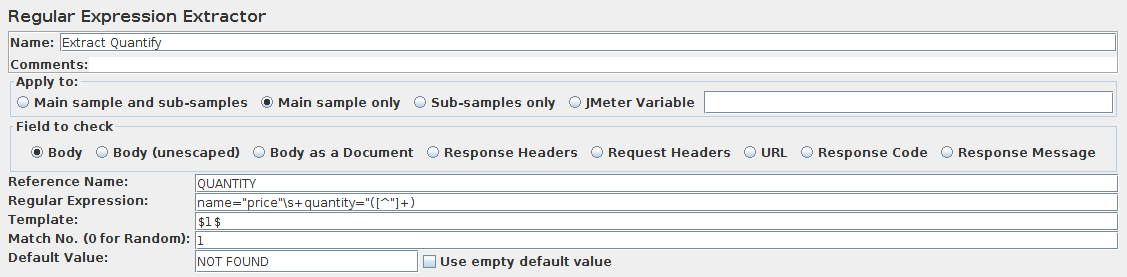
Parameters
Attribute | Description | Required | ||
Name | Descriptive name for this element that is shown in the tree. | No | ||
<ac:structured-macro ac:name="unmigrated-wiki-markup" ac:schema-version="1" ac:macro-id="e8fbd341271378b3-6858b4bf-49d1479a-8e9da7e0-733ec2ca2f4f84b28e7895ad"><ac:plain-text-body><![CDATA[ | Reference Name | The name of the JMeter variable in which to store the result. Also note that each group is stored as refname]_g#, where [refname] is the string you entered as the reference name, and # is the group number, where group 0 is the entire match, group 1 is the match from the first set of parentheses, etc. | Yes | ]]></ac:plain-text-body></ac:structured-macro> |
Regular Expression | The regular expression used to parse the response data. This must contain at least one set of parentheses "()" to capture a portion of the string, unless using the group $0$. | Yes | ||
Template | The template used to create a string from the matches found. This is an arbitrary string with special elements to refer to groups within the regular expression. The syntax to refer to a group is: '$1$' to refer to group 1, '$2$' to refer to group 2, etc. $0$ refers to whatever the entire expression matches. | Yes | ||
<ac:structured-macro ac:name="unmigrated-wiki-markup" ac:schema-version="1" ac:macro-id="2b1ce949-b2d7-40e5-9c99-f5f422eff65b"><ac:plain-text-body><![CDATA[ | Match No. | Indicates which match to use. The regular expression may match multiple times. [BR][BR] |
* Use a value of zero to indicate JMeter should choose a match at random.
...
* A positive number N means to select the nth match.
...
* Negative numbers are used in conjunction with the
...
...
- see below.
...
Yes
...
| Yes |
Default Value | If no matches are found, the default value is stored in the variable. | No |
...