DUE TO SPAM, SIGN-UP IS DISABLED. Goto Selfserve wiki signup and request an account.
| Table of Contents |
|---|
Status
Current state: Under Discussion
Discussion thread: here [Change the link from the KIP proposal email archive to your own email thread]
JIRA: here
Motivation
Checkpointing is a useful feature in the context of a failover: consumers can minimize duplicated message processing due to checkpoints. This is all that can be achieved in the context of a single replication flow.
...
This KIP aims to resolve this issue in bidirectional replications by allowing the checkpointing to create "reverse" checkpoints from downstream topics to upstream topics. This will help in minimizing the level of reprocessing by providing the same fine tuning options as checkpointing has, instead of having an unbounded window of reprocessing which is defined by the lag of the consumer group compared to the replication.
Public Interfaces
New configuration configurations for MirrorCheckpointConnector:
- reverse.checkpointing.enabled (false) - Enables the new reverse checkpointing feature. Reverse checkpointing requires that there is an opposite, active flow.
- reverse.checkpointing.topic.filter.class (null) - Optional topic filter used to specify which topics should be reverse checkpointed. When not configured, all replica topics originating from the target cluster will be reverse checkpointed.
- reverse.checkpointing.topic.filter. - Configuration prefix to pass overrides to the reverse checkpointing topic filter.
Proposed Changes
Currently, MirrorCheckpointConnector uses the offset-syncs of the same flow to generate checkpoints for downstream topics. This mechanism only allows translating offsets from upstream to downstream, and only applies to topics being replicated in the flow.
In the context of a bidirectional replication, a reverse checkpoint can be created by using the offset-syncs of the opposite flow. The upstream:downstream offset pairs of the opposite flow can be used to implement the reverse mappings.
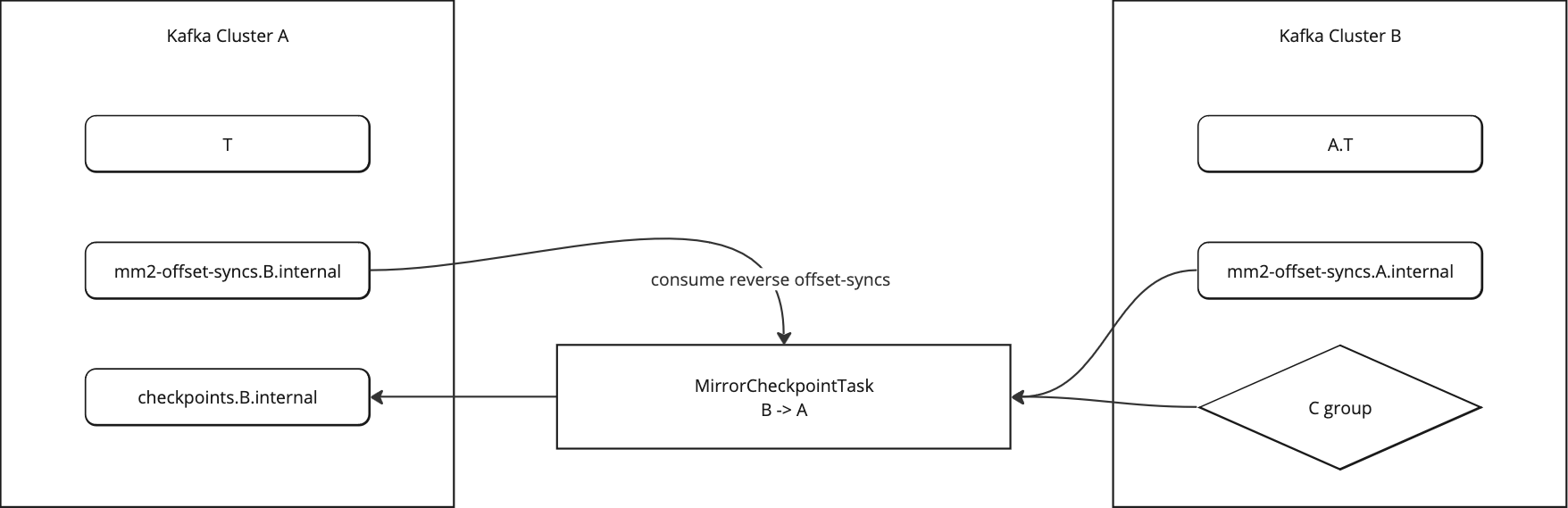
Changes to implement:
- Update OffsetSyncStore to be able to track reverse offsets. (subclass/flag)
- Update MirrorCheckpointTask to instantiate an OffsetSyncStore for the reverse checkpointing, consuming from the offset-syncs topic of the opposite flow. (i.e. if the offset syncs of the current flow are located in the source, the offset sync of the opposite flow will be in the target)
- Update MirrorCheckpointTask to optionally instantiate the configured TopicFilter class.
- Update MirrorCheckpointTask to generate reverse checkpoints - i.e. in the B -> A flow, identify topics in B which were replicated from A detect reverse-checkpointable topics, transform the topic name back to the upstream name (with DefaultReplicationPolicy, all topics strip the starting with "A."), and generate a reverse checkpoint.
- Detecting reverse-checkpointable topics:
- If the reverse checkpointing topic filter was configured, use
- the topic filter to decide.
- If the reverse checkpointing topic filter was not configured, use the ReplicationPolicy.topicSource method, and include the topic if it was replicated from the current target. (e.g. in the B->A flow, topicSource("A.T") = "A", which matches the target alias).
With the above changes, all current features and guarantees of MirrorCheckpointConnector become available for reverse checkpoints: sync groups offsets, monotonic checkpoints, offset translation based on historical offset syncs.
Based on the previous points, there are 2 hard requirements for this feature to work:
- An opposite, active flow exists - i.e. this feature only works in a bi-directional replication.
- The ReplicationPolicy has to be able to correctly transform a replica topic name to the upstream topic name (i.e. has a correct upstreamTopic implementation) - this is true for both DefaultReplicationPolicy and IdentityReplicationPolicy.
Based on the ReplicationPolicy implementation, the following has to be configured by the user:
- If the ReplicationPolicy can correctly identify the source cluster of a topic (e.g. DefaultReplicationPolicy), the reverse checkpointing topic filter can be omitted, and all replica topics originating from the target will be reverse-checkpointed.
- If the ReplicationPolicy cannot correctly identify the source cluster of a topic (e.g. IdentityReplicationPolicy), the reverse checkpointing filter has to be configured, and users need to manually specify which topics should be reverse-checkpointed.
Compatibility, Deprecation, and Migration Plan
- Since the feature is activated with a flag, which is false by default, this change is fully backward compatible, and does not require migration.
Test Plan
Integration testing on a bidirectional replication, with a failover and failback described in the Motivation section - expectation is that reprocessing will be minimal after failback.
Rejected Alternatives
- Instead of automatically creating reverse checkpoints on all replica topics from the target cluster, a new adding the "reverse.checkpointing.topic.filter.class" configuration can be added, with which users can specify which , only rely on the ReplicationPolicy to identify which topics should be reverse-checkpointed. While this would allow for fine grained control over the new feature, it does not seem to be useful in many cases. Additionally, in the dedicated MM2 mode, the topics filter is the same across MirrorSourceConnector and MirrorCheckpointConnector, meaning that the original checkpointing does not allow limiting the checkpointed topics to a subset of the replicated topics - adding the new reverse topic filter would introduce asymmetry between the original and the reverse checkpointingis a simpler solution (fewer configs and changes), it does not allow the feature to work with some ReplicationPolicy implementations, such as IdentityReplicationPolicy.