DUE TO SPAM, SIGN-UP IS DISABLED. Goto Selfserve wiki signup and request an account.

This page describes how to build Impala from source and how to configure and run Impala in a single node development enviornmentenvironment.
Prerequisites and Requirements
Hardware Requirements
- CPU (processor must support at least SSSE3)
- Minimum Memory: 8GBmemory: 16GB
- Hard disk space: 120GB (for the test data)
Supported Operating Systems
Linux
- Ubuntu 14.04, 16.04, 18.04, 1520.04
- CentOS 7
- See bootstrap_development.sh for other supported versions (this wiki page may be stale).
OS X
Not supported
Windows
Not supported
Installing and Configuring Impala
Install prerequisites
Option 1 - Building Impala (for developing Impala)
This will also load all the test data, i.e. on HDFS, Kudu and HBase and for all formats (text/parquet/orc) and compressions (none/gzip/snappy etc.) which usually takes hours. If you just need some simple test data (e.g. TPCH data set), try Option 2 below.
| Code Block |
|---|
...
git clone https:// |
...
gitbox.apache.org/repos/asf/impala.git ~/Impala
cd ~/Impala
export IMPALA_HOME=`pwd`
bin/bootstrap_development.sh |
Option 2 - Building Impala without Test Data (for manually testing Impala)
If you have some test data in hand, or you just need a subset of the test data (e.g. TPCH tables in parquet format), you can try this.
| Code Block |
|---|
Clone the Impala git repo and change to the new Impala directory.
...
git clone https:// |
...
gitbox.apache.org/repos/asf/ |
...
impala.git ~/Impala cd |
...
Set the following environment variables in your `.bashrc` or elsewhere:
...
| language | bash |
|---|---|
| theme | Emacs |
...
~/Impala export IMPALA_HOME= |
...
Build Impala.
...
| language | bash |
|---|---|
| theme | Emacs |
...
`pwd` bin/bootstrap_system.sh source ./bin/impala-config.sh # |
...
Format |
...
the |
...
test |
...
cluster |
...
and |
...
start |
...
Impala and dependent services ./buildall.sh -noclean -notests - |
...
format - |
...
start_ |
...
Start supporting services.
| Code Block | ||||
|---|---|---|---|---|
| ||||
# This script starts a full set of local services including HDFS, HBase,
# Hive and ZooKeeper, amongst other things. If you have trouble starting
# this script, check the log files in ${IMPALA_HOME}/cluster_logs/ for clues.
${IMPALA_HOME}/testdata/bin/run-all.sh |
...
Start the Impala cluster.
| Code Block | ||||
|---|---|---|---|---|
| ||||
# The following command will start an Impala cluster with 3 Impala demons, one
# Statestore and one Catalog demon.
${IMPALA_HOME}/bin/start-impala-cluster.py |
...
Check that everything works correctly.
| Code Block | ||||
|---|---|---|---|---|
| ||||
impala-shell.sh -q "SELECT version()"
Starting Impala Shell without Kerberos authentication
Connected to localhost:21000
Server version: impalad version 2.2.0-INTERNAL DEBUG (build 47c90e004aecb928a37b926080098d30b96b4330)
Query: select version()
+---------------------------------------------------------------------------------------+
| version()                                                                             |
+---------------------------------------------------------------------------------------+
| impalad version 2.2.0-INTERNAL DEBUG (build 47c90e004aecb928a37b926080098d30b96b4330) |
| Built on Sun, Mar 22 15:22:57 PDT 2015                                                |
+---------------------------------------------------------------------------------------+
Fetched 1 row(s) in 0.05s |
...
Recompile and restart the Impala cluster for your changes to take effect.
minicluster -start_impala_cluster

# Load some test data (skip this if you don't need them)
# Example 1: Load functional test data in parquet format. Note that you need the text tables since parquet tables are generated from them.
bin/create_testdata.sh
bin/load-data.py -e core -w functional-query --table_formats=text/none,parquet/none
# Example 2: Load TPCH test data in parquet format.
bin/load-data.py -e core -w tpch --table_formats=text/none,parquet/none
# Example 3: Load TPCDS test data in parquet format.
bin/load-data.py -e core -w tpcds --table_formats=text/none,parquet/none |
Rebuilding after initial build
| Code Block | ||||
|---|---|---|---|---|
| ||||
# Rebuild both backend and frontend
${IMPALA_HOME}/buildall.sh -skiptests - |
...
noclean # Rebuild with optimized release binaries ${IMPALA_HOME}/buildall.sh -skiptests -noclean -release # Incremental builds source ${IMPALA_HOME}/bin/ |
...
impala-config.sh # If you didn't already source impala-config.sh in this shell # Optional: |
...
Rebuild the |
...
impala |
...
binary only |
...
make -j$IMPALA_BUILD_THREADS impalad # Optional: Build the Java-side frontend only make -j$IMPALA_BUILD_THREADS java # Restart the Impala cluster ${IMPALA_HOME}/bin/start-impala-cluster.py |
...
See Tips for Faster Impala Builds for more tips on how to do incremental builds.
FAQ
Q: The build is stuck at 100% progress for a while (as the screenshot shows). What's going on there?
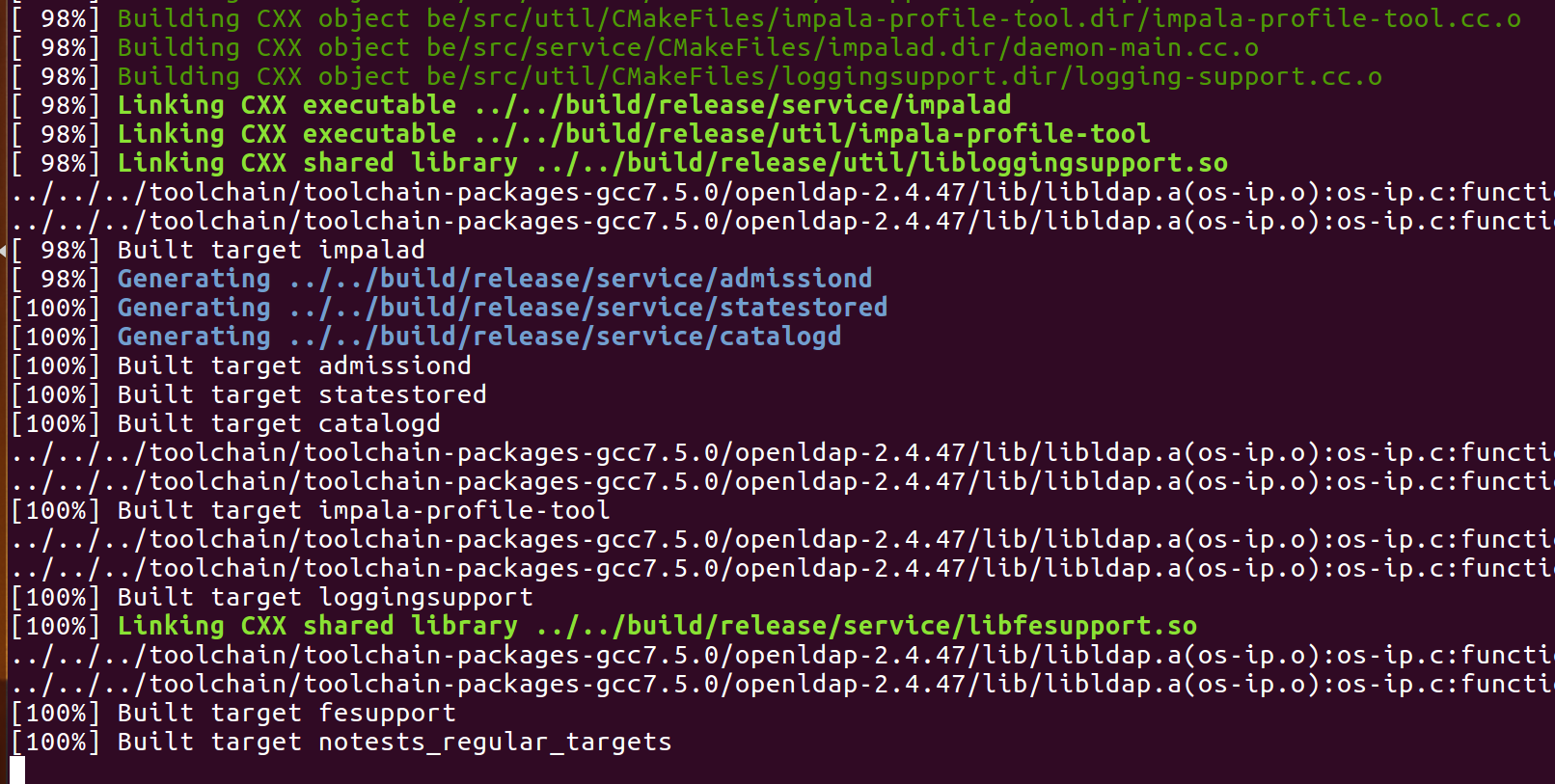
A: Usually the FE compilation is still running. Maven downloads a lot of artifacts. So you will see slow progress there if your internet connection is slow. You can check the logs at ${IMPALA_HOME}/logs/mvn/mvn.log