DUE TO SPAM, SIGN-UP IS DISABLED. Goto Selfserve wiki signup and request an account.
...
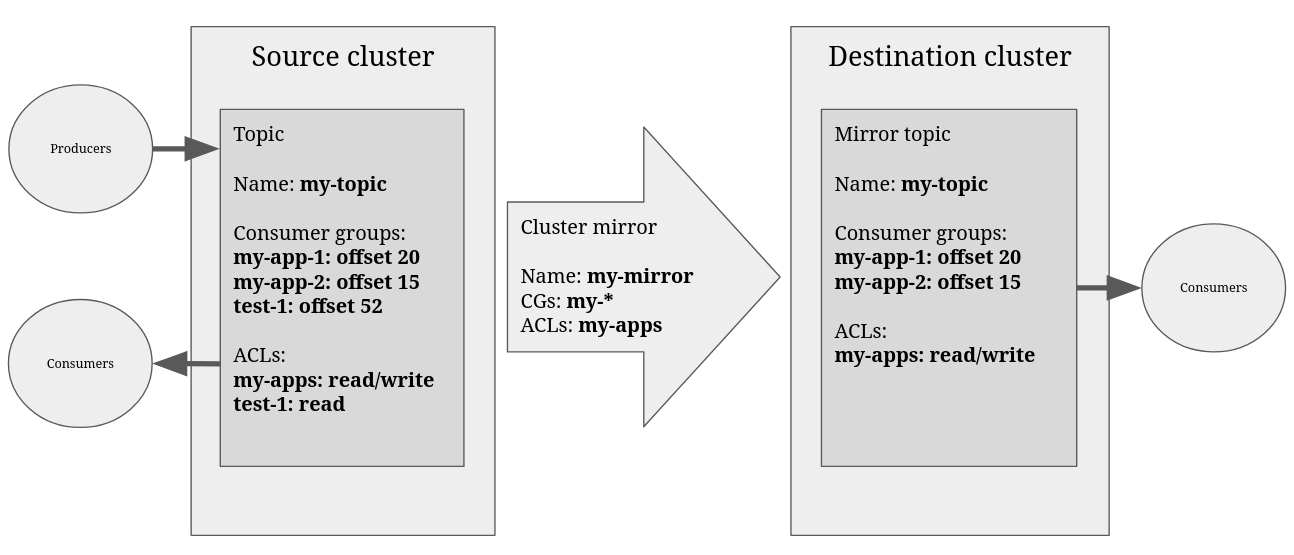
A cluster mirror is a named, unidirectional replication channel from a remote source cluster to the local destination cluster. It is created by specifying a unique mirror name along with the source cluster's bootstrap servers and security credentials. Once a mirror is created, individual topics on the source cluster can be started, stopped, or paused for replication within it. Each mirror is a first-class entity managed through the Admin API and the kafka-cluster-mirrors.sh CLI tool, with its state persisted in a coordinator that manages cross-cluster replication.
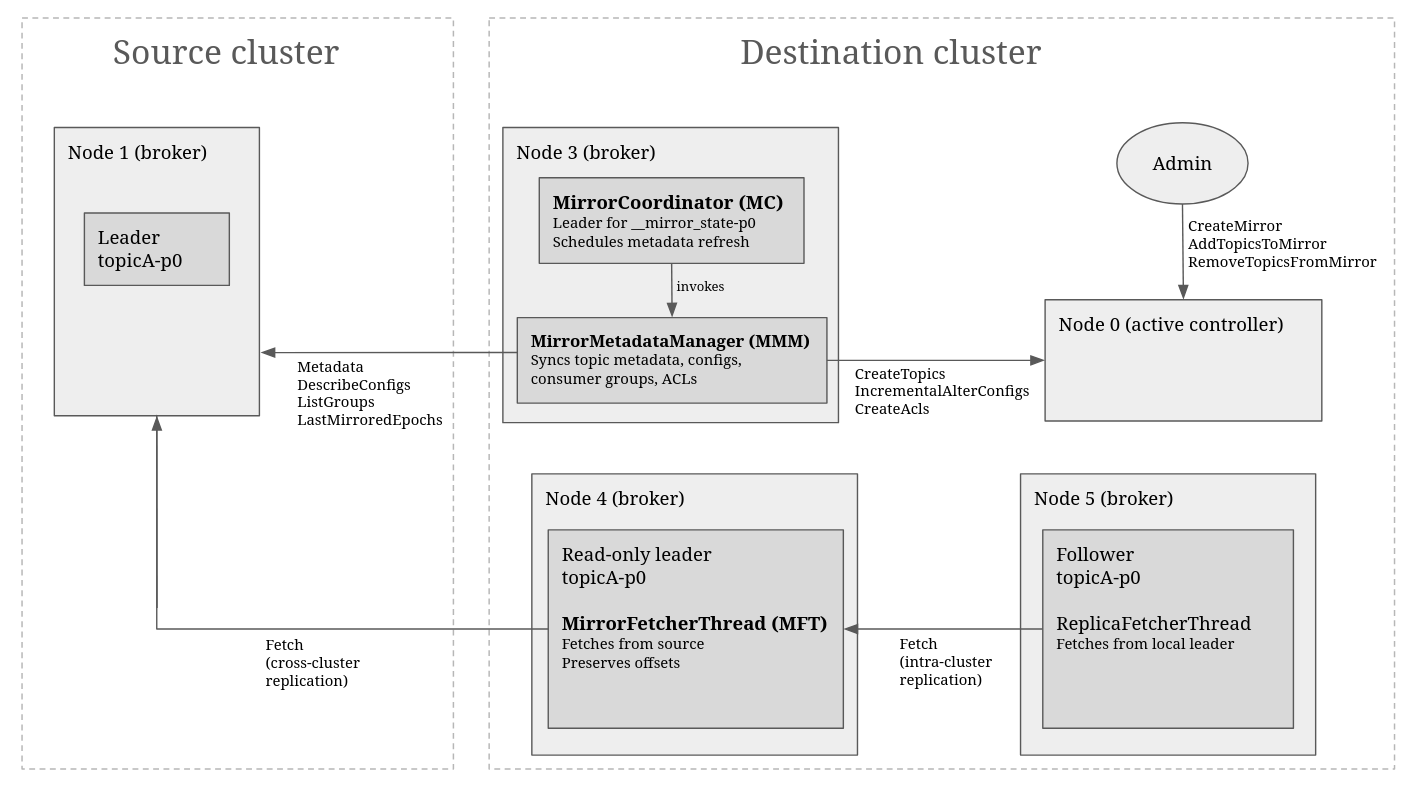
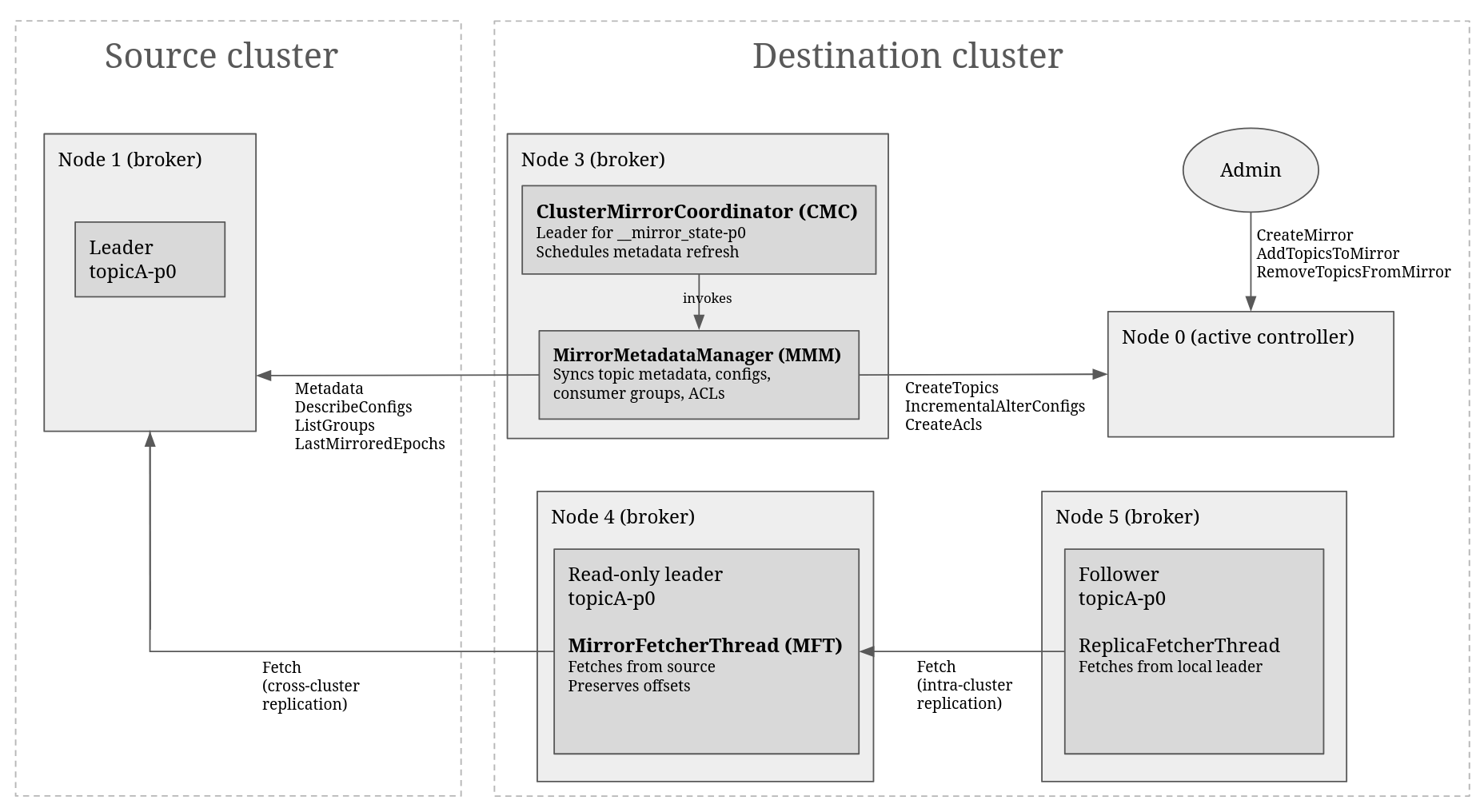
The architecture consists of three main components that work together to provide automatic metadata synchronization and data replication. The following diagram illustrates how these components are wired together. For the sake of clarity, some internal APIs are excluded.
The mirror name is stored as a topic-level internal configuration called mirror.name that has the same validation rules of topic names, and propagates through Kafka's metadata log as configuration change records. When topics are added to a mirror, the quorum controller generates configuration metadata records that are replicated to all brokers through the standard metadata update mechanism. Brokers monitor these configuration changes to detect when partitions they lead belong to a mirror, triggering the creation of mirror fetchers and enforcement of read-only semantics. This design ensures that mirror associations are visible, auditable, and manageable through standard Kafka tools while maintaining strict control over how mirroring relationships are established and modified.
Main Components
...
ClusterMirrorCoordinator
The ClusterMirrorCoordinator (MCCMC) manages Cluster Mirroring state using a partitioned coordinator partitioned coordinator pattern similar to the group and transaction coordinators.
...
- State Management: Mirror partition states and control records are stored in __mirror_state internal topic. The coordinator loads these metadata on startup and partition leadership changes.
- Partition Assignment: Mirror partitions are distributed evenly to coordinators across all brokers and allows for horizontal scaling. The number of coordinator partitions is configurable via via mirror.state.topic.num.partitions.
- Leader Election: When a broker becomes the leader for a __mirror_state partition, it loads the mirror metadata for all mirrors assigned to that partition and begins coordinating those mirrors. On resignation, it clears its in-memory state to avoid stale metadata.
- Metadata Refresh Scheduling: The coordinator schedules periodic metadata refresh operations by invoking a metadata manager every 30 seconds by default. This ensures that configuration updates and group offset commits in the source cluster are continuously propagated to the destination cluster. The refresh interval is configurable via mirror.metadata.refresh.interval.ms.
- State Transitions: The coordinator manages asynchronous state transitions for mirror partitions. Each partition is an independent replication unit with its own state. When the coordinator is the leader for a mirror partition, it writes the state updates directly to __mirror_state topic, otherwise it reads and writes the state via new internal RPCs, enabling distributed coordination across the cluster.
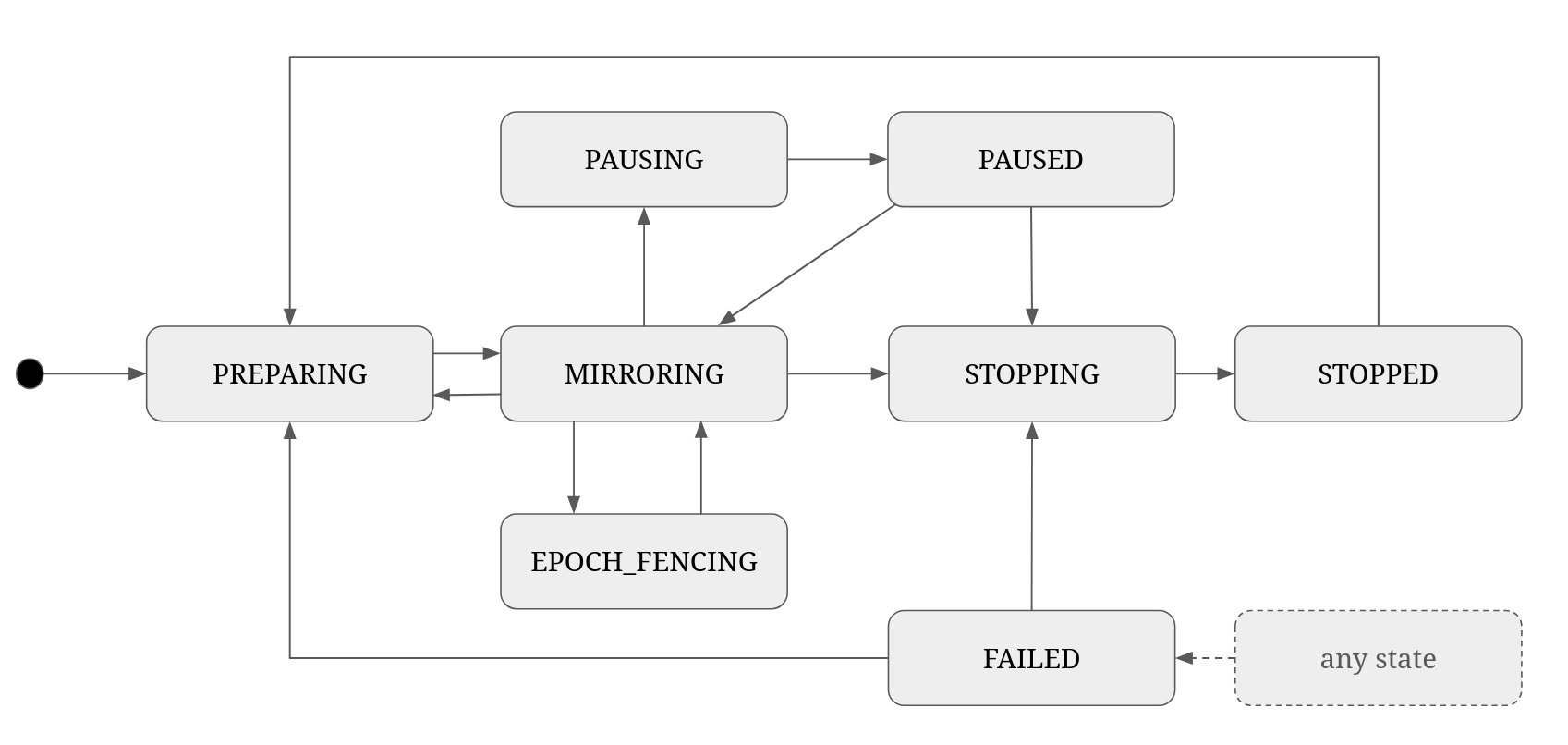
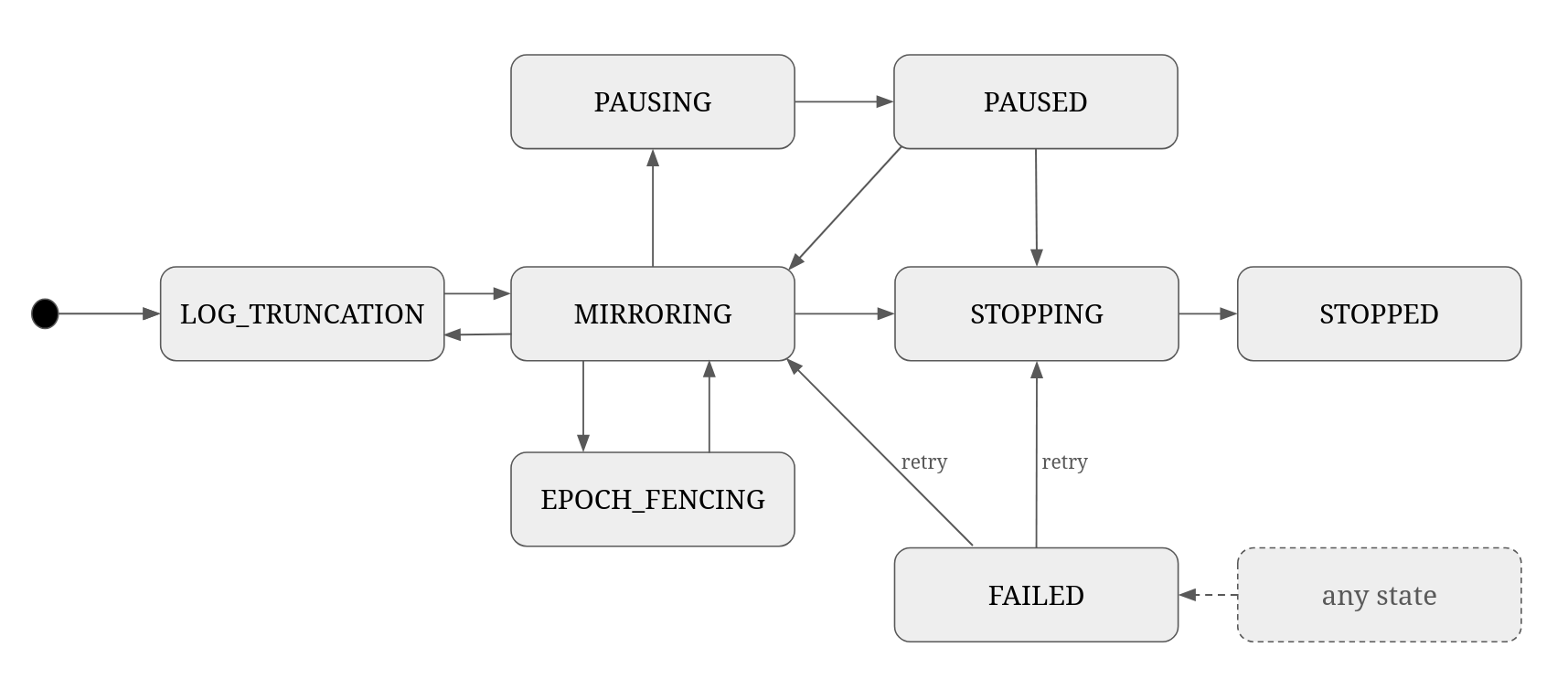
State descriptions:
- UNKNOWN: The partition has no cached state (broker just became leader, state not loaded yet). Not an explicit API-driven state, just the absence of state.
- PREPARINGLOG_TRUNCATION: The coordinator for this partition detects via onMetadataUpdate that it leads a mirror partition. It fetches last mirror epoch from the source cluster and truncates to align the local log with the source.
- MIRRORING: All ISR set members have completed truncation. A mirror fetcher thread is started to continuously replicate records from the source cluster.
- EPOCH_FENCING: The destination leader epoch needs to be bumped. A BumpLeaderEpochs request is sent to the controller. On success, the partition transitions to MIRRORING.
- PAUSING: Triggered by the pause operation. The system removes fetchers for the affected partitions.
- PAUSED: Fetchers have been removed. The partition stays read-only with no active fetchers and no metadata synchronization. On resume, transitions directly to MIRRORING.
- STOPPING: The mirror fetcher is removed, the leader epoch is bumped, ABORT markers are appended for all ongoing transactions, last mirror epochs are persisted, and a MIRROR_PID_RESET record appended.
- STOPPED: The topic becomes writable on the destination cluster. The mirror fetcher is removed and the read-only flag is cleared.
- FAILED: An error occurred during mirroring or stopping. The operator that wants to restart a failed mirror partition can restart topic mirroring. More sophisticated recovery strategies can be added later with a follow-up KIPcoordinator tries to recover the mirror partition and then fail permanently. The operator can still use the CLI tool or admin API to manually recover.
MirrorMetadataManager
The MirrorMetadataManager (MMM) implements periodic metadata synchronization between source and destination clusters. It maintains persistent network connections to all source clusters. During periodic metadata refresh, the broker validates that the source cluster ID has not changed. If a mismatch is detected, metadata synchronization for that mirror is halted and an error is logged. This prevents silent data corruption in case of misconfiguration or unintended source cluster replacement.
...
When a destination consumer initializes a partition, it retrieves the last committed offset along with its leader epoch from the group coordinator. If the committed leader epoch originates from the source cluster and is greater than the local leader epoch, the consumer's Metadata.updateLastSeenEpochIfNewer accepts it, causing all subsequent metadata updates from the destination cluster to be filtered out. The partition enters AWAIT_VALIDATION but requests cannot be sent because the partition has no known leader node. This creates an infinite loop of metadata refreshes that never resolves.
Enforcing the guarante guarantee that committed offsets from the source cluster always carry an epoch lower than or equal to the destination's current epoch, so destination consumers can validate positions normally. Before appending mirrored data, the destination sets DLE = SLE + LEADER_EPOCH_BUMP_INCREMENT whenever SLE > DLE − LEADER_EPOCH_BUMP_THRESHOLD. The chosen increment is 10 and the threshold is 3, which provides a window of 7 source leader elections before the next bump. These two constants are a tradeoff: larger values mean fewer epoch bumps but faster epoch consumption, smaller values mean more bumps but slower epoch growth.
...
RPC | Component | ACL Operation | ACL Resource | Purpose |
| Fetch | MFT | Read | Topic | Data replication |
| Metadata | MMM | Describe | Topic | Topic discovery and leader tracking |
| DescribeConfigs | MMM | DescribeConfigs | Topic | Topic configuration sync |
| ListGroups | MMM | Describe | Group | Consumer group offset sync |
| OffsetFetch | MMM | Describe | Group | Consumer group offset sync |
| DescribeAcls | MMM | Describe | Cluster | ACL synchronization |
| DescribeMirrorsDescribeClusterMirrors | MC | Read | ClusterClusterMirror | Log truncation when preparing |
| ApiVersions | MMM | Feature negotiation | ||
| ListOffsets | MFT | Describe | Topic | Offset bounds discovery |
| OffsetsForLeaderEpoch | MFT | Describe | Topic | Leader epoch validation for truncation |
...
RPC | Component | ACL Operation | ACL Resource | Purpose |
| CreateMirrorCreateClusterMirror | Controller | Create | ClusterMirror | New cluster mirror creation |
| StartMirrorTopics | Controller | Alter | ClusterMirror | Mirror topics creation |
| StartMirrorTopics | Controller | AlterConfigs | Topic | Mirror topics creation |
| StopMirrorTopics | Controller | Alter | ClusterMirror | Mirror topics removal (failover) |
| StopMirrorTopics | Controller | AlterConfigs | Topic | Mirror topics removal (failover) |
| PauseMirrorTopics | Controller | Alter | ClusterMirror | Mirror topics pause |
| PauseMirrorTopics | Controller | AlterConfigs | Topic | Mirror topics pause |
| ResumeMirrorTopics | Controller | Alter | ClusterMirror | Mirror topics resume |
| ResumeMirrorTopics | Controller | AlterConfigs | Topic | Mirror topics resume |
| DeleteMirrorDeleteClusterMirror | Controller | Alter | ClusterMirror | Delete a cluster mirror |
| ListMirrorsListClusterMirrors | Broker | Describe | ClusterMirror | Mirror topic listing |
| DescribeMirrorsDescribeClusterMirrors | Broker | Describe | ClusterMirror | Mirror topic describe (state, lag) |
| DescribeConfigs | Broker | DescribeConfigs | ClusterMirror | Mirror configuration describe |
| WriteMirrorStates | MC | ClusterAction | Cluster | Mirror partition state write |
| ReadMirrorStates | MC | ClusterAction | Cluster | Mirror partition state read |
| BumpLeaderEpochs | MC | ClusterAction | Cluster | Leader epoch bump when stopping |
| FindCoordinator | Broker | ClusterAction | Cluster | Mirror coordinator location |
| CreateTopics | MMM | Create | Topic | Topic creation |
| CreatePartitions | MMM | Alter | Topic | Partitions scaling |
| IncrementalAlterConfigs | MMM | AlterConfigs | ClusterMirror | Mirror configuration update |
| OffsetCommit | MMM | Read | Topic | Source CG offsets commit |
| OffsetCommit | MMM | Read | Group | Source CG offsets commit |
| CreateAcls | MMM | Alter | Cluster | Source ACLs creation |
| DeleteAcls | MMM | Alter | Cluster | Source ACLs removal |
...
In a follow-up KIP we will add source-side throttling that allows source cluster leaders to limit bandwidth served to all mirror fetchers, similar to how leader.replication.throttled.rate controls intra-cluster replication. This provides independent control over mirror catch-up traffic without impacting local replication or consumer workloads. Combined with destination-side throttling, operators gain complete bidirectional bandwidth control for mirror traffic.
Tiered Storage
Mirror topics in the destination cluster currently only replicate data from local storage on the source broker. Integrating with tiered storage would allow mirroring to handle data that has been offloaded to remote storage (e.g., S3, HDFS), enabling full replication of topics with long retention periods without requiring all data to reside in local broker storage. During the LOG_TRUNCATION state, the mirror truncates the local log to the LME. This operation does not support tiered storage on the destination cluster because LME may be moved to remote segments.
When tiered storage is enabled locally for a mirror topic, its partitions transition to FAILED state. This limitation applies only to the destination cluster during log truncation phase, and will be removed once tiered storage truncation will be fully supported. A detailed design of the metadata synchronization protocol, API schema, and state management will be provided in a follow-up KIP.
...
Active-active topology is not initially supported in Cluster Mirroring, though it could potentially be achieved through topic prefixing and removing the reliance on topic ID for mirroring. This is a candidate for a future improvement KIP. Instead, bidirectional mirroring is supported, but only when mirroring different topics between clusters, allowing records produced to either cluster to be consumed from both. Unlike MirrorMaker 2, Cluster Mirroring does not need special cycle detection or prevention logic because the read-only enforcement inherently blocks the conditions that would create infinite replication loops.
Synchronous Mirroring
Streams Applications
Stateful Kafka Streams rely on internal topics (changelogs, repartition topics, offset tracking) that are tightly coupled through atomic transactions. A single EOS transaction spans input offset commits, state store mutations written to changelog topics, and intermediate records written to repartition topics. Cluster mirroring replicates topics asynchronously and independently, so it cannot preserve these transactional boundaries. This means internal topics on the destination cluster can end up at inconsistent points in time relative to each other, making state store recovery produce incorrect results. The synchronous mirroring extension would preserve these guarantees. For this reason, mirroring of Kafka Streams internal topics is not supported.
Synchronous Mirroring
Currently, mirroring is Currently, mirroring is asynchronous. The source cluster acknowledges the producer without waiting for the destination to replicate the data. Synchronous mirroring would guarantee that records are replicated to the destination cluster before the source acknowledges the produce request, providing stronger durability guarantees at the cost of higher latency. This would be useful for workloads where zero data loss across clusters is a strict requirement.
...
| Code Block | ||
|---|---|---|
| ||
# 9091 (source) -----> 9094 (destination) # in case of disaster, the operator can failover by running the following command bin/kafka-mirrorcluster-mirrors.sh --bootstrap-server :9094 --stop --topic .* --mirror my-mirror # 9091 (source) --x--> 9094 (destination) # now all mirror topics are detached from the source cluster and accept writes (the two clusters are allowed to diverge) |
...
Failback enables mirroring to be reversed after a failover, allowing the original source cluster to become the destination and vice versa. This is critical for scenarios where you want to fail back to the original cluster after recovering from an outage or planned maintenance. When failback is initiated on the old source cluster, it needs to determine where to truncate its log before starting to fetch from the new source cluster. If the new API is supported, the broker sends a LastMirrorEpochs request to the new source cluster asking for the LME, and then truncates its local log to the last offset of the returned epoch. If the new LastMirrorEpochs API is not supported, the broker truncates to zero and starts mirroring from scratch.
Before transitioning a mirror partition from PREPARING to LOG_TRUNCATION to MIRRORING, the MirrorCoordinator must ensure that all in-sync replicas in the destination cluster have truncated their logs to the correct offset. If less than min ISR are available, we will skip and retry in the following fetch. This coordination step validates that every ISR member has completed truncation before the partition is allowed to begin actively fetching from the source cluster. Without it, the mirror leader could start appending new data from the source while local followers still hold divergent log segments, causing inconsistencies within the destination cluster. After truncation, reverse mirroring begins normally. Note that the log truncation on everse reverse mirroring may cause the data loss if there are records that didn't get mirrored to the old destination cluster.
| Code Block | ||
|---|---|---|
| ||
# when the source cluster is back, the operator can failback by creating a mirror with the same name echo "bootstrap.servers=localhost:9094" > /tmp/my-mirror.properties bin/kafka-cluster-mirrors.sh --bootstrap-server :9091 --create --mirror my-mirror --mirror-config /tmp/my-mirror.properties bin/kafka-cluster-mirrors.sh --bootstrap-server :"9091 --start --topic .* --mirror my-mirror # 9091 (destination) <----- 9094 (source) |
Create Mirror
- The user sends CreateMirror CreateClusterMirror requests to any broker with the mirror name and mirror related properties (bootstrap servers, security settings, etc.).
- The broker forwards the request to the active controller.
- The controller saves the properties into the metadata log as ConfigRecord entries with type MIRROR.
- If this is the first mirror being created, the controller also auto creates the __mirror_state internal topic.
- All brokers receive the metadata update and the MirrorMetadataManager registers the new mirror configuration.
...
- User sends StartMirrorTopicsRequest with mirror name, topics, and optional include/exclude patterns.
- Controller persists include/exclude patterns as ConfigRecord entries on the MIRROR resource in the metadata log.
- For each topic, the controller creates it on the destination if it does not already exist, and sets mirror.name=<mirrorName> on the TOPIC resource config. Both operations are written in a single metadata record batch.
- Brokers receive the metadata update. The MirrorMetadataManager detects the new mirror.name config (without .stopped or .paused suffix) and queries the coordinator for the current partition state.
- Partitions transition from UNKNOWN to PREPARINGLOG_TRUNCATION. During PREPARINGthis state, LME truncation runs and waits for all ISR members (or all replicas if ULE is enabled).
- Partitions transition to MIRRORING. A MirrorFetcherThread is created and begins fetching from the source cluster.
- Partition state is persisted to __mirror_state.
- On subsequent metadata refresh cycles, the MirrorMetadataManager discovers new source topics matching the persisted include/exclude patterns and repeats steps 3-7 for each.
Stop Mirror Topics
- User sends StopMirrorTopicsRequest StopMirrorTopics request with mirror name, topics, and optional patterns.
- If patterns are provided, the controller removes matching entries from mirror.topics.include and adds them to mirror.topics.exclude on the MIRROR resource in the metadata log. Any currently mirroring topic that matches the updated exclude is also stopped.
- For each topic, the controller writes a ConfigRecord updating mirror.name=<mirrorName>.stopped on the TOPIC resource.
- Brokers receive the metadata update. The MirrorMetadataManager detects the .stopped suffix and transitions partitions to STOPPING.
- During STOPPING, the following operations execute sequentially:
- Fetcher threads are removed for the affected partitions stopping replication.
- The current leader epoch is collected and persisted as LME in __mirror_state.
- The partition's leader epoch is bumped to draw a boundary between mirrored and locally produced records.
ABORT markers are appended for all ongoing transactions using the new leader epoch.
A MIRROR_PID_RESET control record is written to expire all producer state entries.
- Partitions transition to STOPPED and becomes writable.
...
- User sends PauseMirrorTopics request with topics and mirror name.
- The controller validates each topic belongs to the specified mirror and is currently in MIRRORING state. It appends updates the .paused suffix to the mirror name config, e.g. to mirror.name=my-mirror<mirrorName>.paused, generating a ConfigRecord.
- When the MirrorMetadataManager in the partition leader node gets notified, it detects the .paused suffix . It and transitions the state to PAUSING.
- During PAUSING, the MirrorFetcherManager removes the fetcher threads for the affected partitions. No more data is replicated.
- The state transitions from PAUSING to PAUSED. The partition remains read only. Metadata synchronization (configs, groups, ACLs) is also halted paused for the paused these topics.
- The partition state change is persisted to the __mirror_state topic.
...
- User sends ResumeMirrorTopics request with topics and mirror name.
- The controller validates the topic is currently paused (has .paused suffix). It removes the .paused suffix, restoring the original mirror name , e.g. mirror.name=cluster1, and generating a ConfigRecord.
- When the MirrorMetadataManager in the partition leader node gets notified, it detects that mirror.name no longer has the .paused suffix.
- The state transitions directly from PAUSED to MIRRORING. No log truncation is needed because the partition is already at the correct offset from before the pause.
- New MirrorFetcherThread instances are created and resume replication from the current log end offset.
- Metadata synchronization (configs, groups, ACLs) also resumes.
Delete Mirror
- The user sends a DeleteMirror DeleteClusterMirror request with the mirror name.
- The controller validates that the mirror is empty (no topics assigned) or all its partitions are in STOPPED state.
- If valid, the controller tombstones the mirror configuration in the cluster metadata log, removing all ConfigRecord entries for the mirror.
- The mirror state records in __mirror_state internal topic are also tombstoned.
- Any remaining coordinator state is shut down, source cluster connections are closed, and the mirror name becomes available for reuse.
- After deletion, failback using this mirror configuration is no longer possible.
List Mirrors
The user sends ListMirrorsRequest ListClusterMirrors request to any broker (no parameters required).
- The broker handler gets all configured mirror partitions from, which reads from the in memory metadata cache.
- For each authorized mirror, the broker returns: mirror name, source cluster ID, source bootstrap servers, and topic count.
- No metadata records are written. This is a read only operation against the local metadata cache.
Describe Mirrors
- The user sends DescribeMirrorsRequest DescribeClusterMirrors request with optional mirror names (empty means all mirrors).
The broker handler queries two sources:
The ReplicaManager which provides source offset, destination offset, and lag for each partition.
- The MirrorCoordinator which provides the current partition state from the metadata manager cache.
The request is forwarded to each broker that only reports partitions for which it has lag information or is the partition leader. This avoids duplicate reporting across brokers.
- For each partition, the response includes: mirror name, topic name, partition ID, source offset, destination offset, lag, current state, and LME.
- No metadata records are written. This is a read only operation.
...
| Code Block | ||
|---|---|---|
| ||
$ bin/kafka-dump-log.sh --mirror-state-decoder --files /tmp/server*/data/__mirror_state-1/00000000000000000000.log
Dumping /home/fvaleri/Documents/kafka/build/test/server4/data/__mirror_state-0/00000000000000000000.log
Log starting offset: 0
baseOffset: 0 lastOffset: 0 count: 1 baseSequence: -1 lastSequence: -1 producerId: -1 producerEpoch: -1 partitionLeaderEpoch: 0 isTransactional: false isControl: false deleteHorizonMs: OptionalLong.empty position: 0 CreateTime: 1771239071191 size: 98 magic: 2 compresscodec: none crc: 3314855113 isvalid: true
| offset: 0 CreateTime: 1771239071191 keySize: 13 valueSize: 17 sequence: -1 headerKeys: [] key: {"type":"2","data":{"mirrorName":"my-mirror"}} payload: {"version":"0","data":{"topicName":"my-topic","partition":0,"state":0}}
baseOffset: 1 lastOffset: 1 count: 1 baseSequence: -1 lastSequence: -1 producerId: -1 producerEpoch: -1 partitionLeaderEpoch: 0 isTransactional: false isControl: false deleteHorizonMs: OptionalLong.empty position: 98 CreateTime: 1771239071219 size: 98 magic: 2 compresscodec: none crc: 3968746657 isvalid: true
| offset: 1 CreateTime: 1771239071219 keySize: 13 valueSize: 17 sequence: -1 headerKeys: [] key: {"type":"2","data":{"mirrorName":"my-mirror"}} payload: {"version":"0","data":{"topicName":"my-topic","partition":0,"state":1}} |
A new command-line tool kafka-mirrors.sh provides administrative operations for managing cluster mirrorsAlternatively, you can use the new message formatter to consume from the internal metadata topic:
| Code Block | ||
|---|---|---|
| ||
$ bin/kafka-mirrorsconsole-consumer.sh --bootstrap-server :9094 --topic __mirror_state --from-beginning \ --formatter org.apache.kafka.tools.consumer.MirrorStateMessageFormatter {"key":{"type":2,"data":{"mirrorName":"my-mirror"}},"value":{"version":0,"data":{"topicName":"my-topic","partition":0,"state":0}}} {"key":{"type":2,"data":{"mirrorName":"my-mirror"}},"value":{"version":0,"data":{"topicName":"my-topic","partition":0,"state":2}}} |
A new command-line tool kafka-cluster-mirrors.sh provides administrative operations for managing cluster mirrors:
| Code Block | ||
|---|---|---|
| ||
$ bin/kafka-cluster-mirrors.sh --help Create cluster mirrors and manage mirror topics. Optionhelp Create cluster mirrors and manage mirrored topics. Option Description ------ ----------- --bootstrap-server <String: server to REQUIRED: The destination KafkaDescription server connect to> ------ ----------- --bootstrap-server <String: server to REQUIRED: The destination Kafka server connect to> to connect to. --command-config <String: command Property file containing configs to be config property file> passed to Admin Client. --create Create a new cluster mirror from a source cluster. --delete Delete a cluster mirror. --describe Describe a cluster mirror including partition lag and state. --exclude <String: exclude patterns> Comma-separated list of topic names or regex patterns to exclude from mirroring. Only valid with --start. --help Print usage information. --json Output description in JSON format --list List all cluster mirrors. --mirror <String: mirror> The name of the cluster mirror. --mirror-config <String: mirror config Property file containing source property file> cluster configs for mirroring. --pause Pause mirroring for topics matching the given patterns. --resume Resume mirroring for previously paused topics matching the given patterns. --start Start mirroring topics matching the given patterns. --stop Stop mirroring topics matching the given patterns. --topics <String: topics> Comma-separated list of topic names or regex patterns (e.g., 'my-topic, orders-.*,payments'). --version Display Kafka version. |
...
| Code Block | ||
|---|---|---|
| ||
$ echo "bootstrap.servers=localhost:9092" >/tmp/mirror.properties $ bin/kafka-cluster-mirrormirrors.sh --bootstrap-server :9094 --create --mirror my-mirror --mirror-config /tmp/mirror.properties Created mirror my-mirror |
Start mirroring a topic or set of topics (the topic --topics flag accepts regex expression):
| Code Block | ||
|---|---|---|
| ||
$ bin/kafka-cluster-mirrors.sh --bootstrap-server :9094 --start \
  --topics 'orders-.*' --exclude 'orders-internal' --mirror my-mirror
Started 2 mirror topic(s) in mirror my-mirror: [orders-us, orders-eu] |
...
| Code Block | ||
|---|---|---|
| ||
$ bin/kafka-cluster-mirrors.sh --bootstrap-server :9094 --stop --topics 'orders-us' --mirror my-mirror
Stopped mirroring for 1 topic(s) in mirror my-mirror: [orders-us] |
...
| Code Block | ||
|---|---|---|
| ||
$ bin/kafka-cluster-mirrors.sh --bootstrap-server :9094 --delete --mirror my-mirror
Deleted mirror my-mirror |
...
| Code Block | ||
|---|---|---|
| ||
$ bin/kafka-cluster-mirrors.sh --bootstrap-server :9094 --pause --topictopics my-topic --mirror my-mirror Paused mirroring for 1 topic(s) in mirror my-mirror: [my-topic] |
...
| Code Block | ||
|---|---|---|
| ||
$ bin/kafka-cluster-mirrors.sh --bootstrap-server :9094 --resume --topictopics my-topic --mirror my-mirror Resumed mirroring for 1 topic(s) in mirror my-mirror: [my-topic] |
...
| Code Block | ||
|---|---|---|
| ||
$ bin/kafka-cluster-mirrors.sh --bootstrap-server :9094 --list
MIRROR                         TOPICS     CLUSTER-ID                 BOOTSTRAP-SERVER
my-mirror                      2          lBq12jYZRp-9wF3M9MPopg     localhost:9091,localhost:9092
new-mirror 1 lBq12jYZRp-9wF3M9MPopg localhost:9091,localhost:9092 |
Describe configured mirrors to check their lag compared to their source topics (use --mirror flag to filter other partitionsonly show partitions from a specific mirror):
| Code Block | ||
|---|---|---|
| ||
$ bin/kafka-cluster-mirrors.sh --bootstrap-server :9094 --describe
MIRROR                         TOPIC                                    PARTITION  SOURCE-OFFSET   DESTINATION-OFFSET LAG      STATE
my-mirror                      bar                                      0          -               -                  -        STOPPED
my-mirror                      foo                                      0          69              66                 3        MIRRORING
my-mirror                      foo                                      1          94              84                 10       MIRRORING
my-mirror                      foo                                      2          94              90                 4        MIRRORING
new-mirror                     baz                                      0          -               -                  -        PAUSED
new-mirror baz 1 - - - PAUSED |
...
| Code Block | ||
|---|---|---|
| ||
$ bin/kafka-configs.sh --bootstrap-server :9094 --entity-type cluster-mirrors --entity-name my-mirror \
    --alter --add-config 'bootstrap.servers=localhost:9092'
Completed updating config for mirror my-mirror. |
...
| Code Block | ||
|---|---|---|
| ||
/** * Create a new cluster mirror. * * @param mirrorName The name of the cluster mirror * @param configs Configuration for the cluster mirror, including bootstrap servers and security settings * @param options Options for the create mirror operation * @return The CreateMirrorResultCreateClusterMirrorResult */ CreateMirrorResultCreateClusterMirrorResult createMirrorcreateClusterMirror(String mirrorName, Map<String, String> configs, CreateMirrorOptionsCreateClusterMirrorOptions options);/** * Create a new cluster mirror. * * @param mirrorName The name of the cluster mirror * @param configs Configuration for the cluster mirror, including bootstrap servers and security settings * @param options Options for the create mirror operation * @return The CreateMirrorResultCreateClusterMirrorResult */ CreateMirrorResultCreateClusterMirrorResult createMirrorcreateClusterMirror(String mirrorName, Map<String, String> configs, CreateMirrorOptionsCreateClusterMirrorOptions options); /** * Start mirroring for the specified topics. * * When topics are started in a mirror, they become read-only on the destination cluster and start * replicating data from the source cluster. This operation marks the specified topics with the * mirror name, preventing local writes and enabling the MirrorFetcherThread to begin replication. * * @param mirrorName The cluster mirror name * @param topics Set of topic names to start mirroring * @param options Options for the start mirror topics operation * @return The StartMirrorTopicsResult containing futures for each topic */ StartMirrorTopicsResult startMirrorTopics(String mirrorName, Set<String> topics, StartMirrorTopicsOptions options); /** * Options for {@link Admin#startMirrorTopics(String, Set, StartMirrorTopicsOptions)}. */ public class StartMirrorTopicsOptions extends AbstractOptions<StartMirrorTopicsOptions> { private List<String> includePatterns = List.of(); private List<String> excludePatterns = List.of(); private Map<String, StartMirrorTopicsRequestData.TopicData> topicMetadata = Map.of(); public StartMirrorTopicsOptions includePatterns(List<String> patterns) { this.includePatterns = patterns; return this; } public StartMirrorTopicsOptions excludePatterns(List<String> patterns) { this.excludePatterns = patterns; return this; } public StartMirrorTopicsOptions topicMetadata(Map<String, StartMirrorTopicsRequestData.TopicData> metadata) { this.topicMetadata = metadata; return this; } public List<String> includePatterns() { return includePatterns; } public List<String> excludePatterns() { return excludePatterns; } public Map<String, StartMirrorTopicsRequestData.TopicData> topicMetadata() { return topicMetadata; } } /** * Stop mirroring for the specified topics. * * This operation is typically used during failover scenarios when the destination cluster needs to * be promoted from passive (read-only mirror) to active (accepting writes). Stopping mirror topics * clears the mirrorName field from partition metadata, which allows producers to write * to these partitions. * * @param mirrorName The cluster mirror name * @param topics Set of topic names to stop mirroring * @param options Options for the stop mirror topics operation * @return The StopMirrorTopicsResult containing futures for each topic */ StopMirrorTopicsResult stopMirrorTopics(String mirrorName, Set<String> topics, StopMirrorTopicsOptions options); /** * Options for {@link Admin#stopMirrorTopics(String, Set, StopMirrorTopicsOptions)}. */ public class StopMirrorTopicsOptions extends AbstractOptions<StopMirrorTopicsOptions> { private List<String> patterns = List.of(); public StopMirrorTopicsOptions patterns(List<String> patterns) { this.patterns = patterns; return this; } public List<String> patterns() { return patterns; } } /** * Pause mirroring for the specified topics. * * Paused topics remain read-only on the destination cluster but stop fetching new data from the * source cluster. The mirror fetcher threads are removed for these partitions, preserving the * current replicated state. Mirroring can be resumed later with {@link #resumeMirrorTopics}. * * @param mirrorName The cluster mirror name * @param topics Set of topic names to pause mirroring * @param options Options for the pause mirror topics operation * @return The PauseMirrorTopicsResult containing futures for each topic */ PauseMirrorTopicsResult pauseMirrorTopics(String mirrorName, Set<String> topics, PauseMirrorTopicsOptions options); /** * Resume mirroring for previously paused topics. * * Resumed topics restart fetching data from the source cluster, picking up from where they * left off. New mirror fetcher threads are created and the partitions transition back to the * MIRRORING state. * * @param mirrorName The cluster mirror name * @param topics Set of topic names to resume mirroring * @param options Options for the resume mirror topics operation * @return The ResumeMirrorTopicsResult containing futures for each topic */ ResumeMirrorTopicsResult resumeMirrorTopics(String mirrorName, Set<String> topics, ResumeMirrorTopicsOptions options); /** * Delete a cluster mirror including its configuration. * * The mirror must be empty (no topics) or all its topics must have been removed (in STOPPED * state). After deletion, all mirror metadata are tombstoned and failback is no longer possible. * * @param mirrorName The cluster mirror name * @param options Options for the delete mirror operation * @return The DeleteMirrorResultDeleteClusterMirrorResult */ DeleteMirrorResultDeleteClusterMirrorResult deleteMirrordeleteClusterMirror(String mirrorName, DeleteMirrorOptionsDeleteClusterMirrorOptions options); /** * List the cluster mirrors available in the cluster. * * @param options The options to use when listing the mirrors. * @return The ListMirrorsResultListClusterMirrorsResult. */ ListMirrorsResultListClusterMirrorsResult listMirrorslistClusterMirrors(ListMirrorsOptionsListClusterMirrorsOptions options); /** * Describe cluster mirrors. * * This operation retrieves detailed information about cluster mirrors including: * - Topics being mirrored * - Partition-level lag information (source offset vs destination offset) * - Mirroring state for each partition (INITIALIZING, PREPARING, MIRRORING, etc.) * * @param mirrorNames The names of the mirrors to describe * @param options The options to use when describing mirrors * @return The DescribeMirrorsResultDescribeClusterMirrorsResult */ DescribeMirrorsResultDescribeClusterMirrorsResult describeMirrorsdescribeClusterMirrors(Collection<String> mirrorNames, DescribeMirrorsOptionsDescribeClusterMirrorsOptions options); |
Protocol Changes
...
- This topic ID is not used by other topics in the current destination cluster.
- The replicas for the partition assignment are all active and not in fenced or controlled shutdown. This is to make sure when a topic gets deleted and re-created with the same topic ID, the stale offline log dir won’t be treated as the active log dir after it becomes online (KAFKA-16234).
...
| Code Block |
|---|
// new request field in FetchPartition type
{ "name": "MirrorLeaderEpoch", "type": "int32", "versions": "19+", "default": "-1", "taggedVersions": "19+", "tag": 2, "ignorable": true,
  "about": "The latest known mirror leader epoch." }

// new response field in PartitionData type
{ "name": "MirrorLeaderEpoch", "type": "int32", "versions": "19+", "default": "-1", "taggedVersions": "19+", "tag": 3, "ignorable": true,
  "about": "The latest known mirror leader epoch." },
|
...
CreateClusterMirror
Allows users to create a mirror and supply its configuration. The broker validates that the mirror name is not already in use, contains only permitted characters, and does not end with .stopped or .paused suffix. Once validated, the request is forwarded to the controller, which persists the configuration in the metadata log.
| Code Block |
|---|
{
  "apiKey": TBD,
  "type": "request",
  "listeners": ["broker", "controller"],
  "name": "CreateMirrorRequestCreateClusterMirrorRequest",
  // Version 0 is the initial version.
  "validVersions": "0",
  "flexibleVersions": "0+",
  "fields": [
    { "name": "MirrorName", "type": "string", "versions": "0+", "entityType": "mirrorName",
      "about": "The cluster mirror name."},
    { "name": "Config", "type": "[]MirrorConfigClusterMirrorConfig", "versions": "0+",
      "about": "The cluster mirror configurations.",  "fields": [
      { "name": "Name", "type": "string", "versions": "0+", "mapKey": true,
        "about": "The configuration key name." },
      { "name": "Value", "type": "string", "versions": "0+", "nullableVersions": "0+",
        "about": "The value to set for the configuration key."}
    ]}
  ]
}

{
  "apiKey": TBD,
  "type": "response",
  "name": "CreateMirrorResponseCreateClusterMirrorResponse",
  // Version 0 is the initial version.
  "validVersions": "0",
  "flexibleVersions": "0+",
  "fields": [
    { "name": "ThrottleTimeMs", "type": "int32", "versions": "0+",
      "about": "The duration in milliseconds for which the request was throttled due to a quota violation, or zero if the request did not violate any quota." },
    { "name": "ErrorCode", "type": "int16", "versions": "0+",
      "about": "The error code, or 0 if there was no error." },
    { "name": "ErrorMessage", "type": "string", "versions": "0+", "nullableVersions": "0+",
      "about": "The error message, or null if there was no error." }
  ]
} |
...
Stop mirroring for the specified topics. The broker validates that all target topic partitions are in either PREPARING LOG_TRUNCATION or MIRRORING state. Once validated, the request is forwarded to the controller, which appends the .stopped suffix to the mirror.name topic config to mark the topics as no longer mirrored.
| Code Block |
|---|
{
  "apiKey": TBD,
  "type": "request",
  "listeners": ["broker", "controller"],
  "name": "StopMirrorTopicsRequest",
  // Version 0 is the initial version.
  "validVersions": "0",
  "flexibleVersions": "0+",
  "fields": [
    { "name": "MirrorName", "type": "string", "versions": "0+",
 "entityType": "mirrorName",
       "about": "The cluster mirror name." },
    { "name": "Topics", "type": "[]TopicData", "versions": "0+", "about": "The data for the topics.",
      "fields": [
        { "name": "TopicId", "type": "uuid", "versions": "0+", "about": "The unique topic ID."},
        { "name": "TopicName", "type": "string", "versions": "0+", "mapKey": true, "entityType": "topicName",
          "about": "The topic name." }
      ]},
    { "name": "Patterns", "type": "[]string", "versions": "0+",
      "about": "Patterns to update in mirror.topics.include/exclude." }
  ]
}

{
  "apiKey": TBD,
  "type": "response",
  "name": "StopMirrorTopicsResponse",
  // Version 0 is the initial version.
  "validVersions": "0",
  "flexibleVersions": "0+",
  "fields": [
    { "name": "ThrottleTimeMs", "type": "int32", "versions": "0+",
      "about": "The duration in milliseconds for which the request was throttled due to a quota violation, or zero if the request did not violate any quota." },
    { "name": "ErrorCode", "type": "int16", "versions": "0+",
      "about": "The error code, or 0 if there was no error." },
    { "name": "ErrorMessage", "type": "string", "versions": "0+", "nullableVersions": "0+", "default": "null",
      "about": "The top-level error message, or null if there was no error." },
    { "name": "MirrorName", "type": "string", "versions": "0+", "entityType": "mirrorName",
      "about": "The cluster mirror name." },
    { "name": "Topics", "type": "[]TopicResult", "versions": "0",
      "about": "The results for the topics.", "fields": [
      { "name": "Name", "type": "string", "versions": "0", "entityType": "topicName",
        "about": "The topic name." },
      { "name": "ErrorCode", "type": "int16", "versions": "0",
        "about": "The error code, or 0 if there was no error." }
    ]}
  ]
} |
...
| Code Block |
|---|
{
  "apiKey": TBD,
  "type": "request",
  "listeners": ["broker", "controller"],
  "name": "PauseMirrorTopicsRequest",
  // Version 0 is the initial version.
  "validVersions": "0",
  "flexibleVersions": "0+",
  "fields": [
    { "name": "MirrorName", "type": "string", "versions": "0+",
 "entityType": "mirrorName",
       "about": "The mirror name to pause the topics for." },
    { "name": "Topics", "type": "[]TopicData", "versions": "0+", "about": "The data for the topics.",
      "fields": [
        { "name": "TopicId", "type": "uuid", "versions": "0+", "about": "The unique topic ID."},
        { "name": "TopicName", "type": "string", "versions": "0+", "mapKey": true, "entityType": "topicName",
          "about": "The topic name." }
      ]}
  ]
}

{
  "apiKey": TBD,
  "type": "response",
  "name": "PauseMirrorTopicsResponse",
  // Version 0 is the initial version.
  "validVersions": "0",
  "flexibleVersions": "0+",
  "fields": [
    { "name": "ThrottleTimeMs", "type": "int32", "versions": "0+",
      "about": "The duration in milliseconds for which the request was throttled due to a quota violation, or zero if the request did not violate any quota." },
    { "name": "ErrorCode", "type": "int16", "versions": "0+",
      "about": "The error code, or 0 if there was no error." },
    { "name": "ErrorMessage", "type": "string", "versions": "0+", "nullableVersions": "0+", "default": "null",
      "about": "The top-level error message, or null if there was no error." },
    { "name": "MirrorName", "type": "string", "versions": "0+", "entityType": "mirrorName",
      "about": "The cluster mirror name." },
    { "name": "Topics", "type": "[]TopicResult", "versions": "0",
      "about": "The results for the topics.", "fields": [
      { "name": "Name", "type": "string", "versions": "0", "entityType": "topicName",
        "about": "The topic name." },
      { "name": "ErrorCode", "type": "int16", "versions": "0",
        "about": "The error code, or 0 if there was no error." }
    ]}
  ]
} |
...
| Code Block |
|---|
{
  "apiKey": TBD,
  "type": "request",
  "listeners": ["broker", "controller"],
  "name": "ResumeMirrorTopicsRequest",
  // Version 0 is the initial version.
  "validVersions": "0",
  "flexibleVersions": "0+",
  "fields": [
    { "name": "MirrorName", "type": "string", "versions": "0+",
 "entityType": "mirrorName",
       "about": "The cluster mirror name." },
    { "name": "Topics", "type": "[]TopicData", "versions": "0+", "about": "The data for the topics.",
      "fields": [
        { "name": "TopicId", "type": "uuid", "versions": "0+", "about": "The unique topic ID."},
        { "name": "TopicName", "type": "string", "versions": "0+", "mapKey": true, "entityType": "topicName",
          "about": "The topic name." }
      ]}
  ]
}

{
  "apiKey": TBD,
  "type": "response",
  "name": "ResumeMirrorTopicsResponse",
  // Version 0 is the initial version.
  "validVersions": "0",
  "flexibleVersions": "0+",
  "fields": [
    { "name": "ThrottleTimeMs", "type": "int32", "versions": "0+",
      "about": "The duration in milliseconds for which the request was throttled due to a quota violation, or zero if the request did not violate any quota." },
    { "name": "ErrorCode", "type": "int16", "versions": "0+",
      "about": "The error code, or 0 if there was no error." },
    { "name": "ErrorMessage", "type": "string", "versions": "0+", "nullableVersions": "0+", "default": "null",
      "about": "The top-level error message, or null if there was no error." },
    { "name": "MirrorName", "type": "string", "versions": "0+", "entityType": "mirrorName",
      "about": "The cluster mirror name." },
    { "name": "Topics", "type": "[]TopicResult", "versions": "0",
      "about": "The results for the topics.", "fields": [
      { "name": "Name", "type": "string", "versions": "0", "entityType": "topicName",
        "about": "The topic name." },
      { "name": "ErrorCode", "type": "int16", "versions": "0",
        "about": "The error code, or 0 if there was no error." }
    ]}
  ]
} |
...
DeleteClusterMirror
Permanently deletes a cluster mirror, including its configuration. The mirror must be empty (no topics) or all its partitions must be in STOPPED state. After deletion, all metadata are tombstoned, making failback impossible. This is an irreversible operation.
| Code Block |
|---|
{
  "apiKey": TBD,
  "type": "request",
  "listeners": ["broker", "controller"],
  "name": "DeleteMirrorRequestDeleteClusterMirrorRequest",
  // Version 0 is the initial version.
  "validVersions": "0",
  "flexibleVersions": "0+",
  "fields": [
    { "name": "MirrorName", "type": "string", "versions": "0+", "entityType": "mirrorName",
      "about": "The cluster mirror name to delete."}
  ]
}

{
  "apiKey": TBD,
  "type": "response",
  "name": "DeleteMirrorResponseDeleteClusterMirrorResponse",
  // Version 0 is the initial version.
  "validVersions": "0",
  "flexibleVersions": "0+",
  "fields": [
    { "name": "ThrottleTimeMs", "type": "int32", "versions": "0+",
      "about": "The duration in milliseconds for which the request was throttled due to a quota violation, or zero if the request did not violate any quota." },
    { "name": "ErrorCode", "type": "int16", "versions": "0+",
      "about": "The error code, or 0 if there was no error." },
    { "name": "ErrorMessage", "type": "string", "versions": "0+", "nullableVersions": "0+",
      "about": "The error message, or null if there was no error." }
  ]
} |
...
ListClusterMirrors
Returns the current mirror names and their associated topic counts in the cluster. It also includes source cluster ID and bootstrap server.
| Code Block |
|---|
{
  "apiKey": TBD,
  "type": "request",
  "listeners": ["broker"],
  "name": "ListMirrorsRequestListClusterMirrorsRequest",
  // Version 0 is the initial version.
  "validVersions": "0",
  "flexibleVersions": "0+",
  "fields": []
}

{
  "apiKey": TBD,
  "type": "response",
  "name": "ListMirrorsResponseListClusterMirrorsResponse",
  // Version 0 is the initial version.
  "validVersions": "0",
  "flexibleVersions": "0+",
  "fields": [
    { "name": "ThrottleTimeMs", "type": "int32", "versions": "0+",
      "about": "The duration in milliseconds for which the request was throttled due to a quota violation, or zero if the request did not violate any quota." },
    { "name": "ErrorCode", "type": "int16", "versions": "0+",
      "about": "The error code, or 0 if there was no error." },
    { "name": "ErrorMessage", "type": "string", "versions": "0+", "nullableVersions": "0+", "default": "null",
      "about": "The top-level error message, or null if there was no error." },
    { "name": "Mirrors", "type": "[]ListedMirror", "versions": "0+",
      "about": "Each mirror in the response.", "fields": [
      { "name": "MirrorName", "type": "string", "versions": "0+", "entityType": "mirrorName",
        "about": "The cluster mirror name." },
      { "name": "SourceBootstrap", "type": "string", "versions": "0+",
        "about": "The source cluster bootstrap servers." },
      { "name": "SourceClusterId", "type": "string", "versions": "0+", "default": "",
        "about": "The source cluster ID, or empty if not yet resolved." },
      { "name": "TopicCount", "type": "int32", "versions": "0+", "default": "0",
        "about": "The number of topics configured for this mirror. 0 indicates an empty mirror with no topics." }
    ]}
  ]
} |
...
DescribeClusterMirrors
Returns the current mirroring status, state, and configuration for the specified mirror topics on the destination cluster. Allows destination cluster partition leaders to query the LME from the source cluster.
| Code Block |
|---|
{
  "apiKey": TBD,
  "type": "request",
  "listeners": ["broker"],
  "name": "DescribeMirrorsRequestDescribeClusterMirrorsRequest",
  // Version 0 is the initial version.
  "validVersions": "0",
  "flexibleVersions": "0+",
  "fields": [
    { "name": "MirrorNames", "type": "[]string", "versions": "0+", "entityType": "mirrorName",
      "about": "The names of the mirrors to describe. Null or empty array means all mirrors." },
    { "name": "IncludeAuthorizedOperations", "type": "bool", "versions": "0+", "default": "false",
      "about": "Whether to include authorized operations." }
  ]
}

{
  "apiKey": TBD,
  "type": "response",
  "name": "DescribeMirrorsResponseDescribeClusterMirrorsResponse",
  // Version 0 is the initial version.
  "validVersions": "0",
  "flexibleVersions": "0+",
  "fields": [
    { "name": "ThrottleTimeMs", "type": "int32", "versions": "0+",
      "about": "The duration in milliseconds for which the request was throttled due to a quota violation, or zero if the request did not violate any quota." },
    { "name": "ErrorCode", "type": "int16", "versions": "0+",
      "about": "The error code, or 0 if there was no error." },
    { "name": "ErrorMessage", "type": "string", "versions": "0+", "nullableVersions": "0+", "default": "null",
      "about": "The top-level error message, or null if there was no error." },
    { "name": "Mirrors", "type": "[]DescribedMirror", "versions": "0+",
      "about": "Each described mirror.", "fields": [
      { "name": "ErrorCode", "type": "int16", "versions": "0+",
        "about": "The error code, or 0 if there was no error." },
      { "name": "MirrorName", "type": "string", "versions": "0+", "entityType": "mirrorName",
        "about": "The cluster mirror name." },
      { "name": "AuthorizedOperations", "type": "int32", "versions": "0+", "default": "-2147483648",
        "about": "32-bit bitfield to represent authorized operations for this mirror." },
      { "name": "Topics", "type": "[]TopicPartitions", "versions": "0+",
        "about": "Each topic in the mirror.", "fields": [
        { "name": "TopicName", "type": "string", "versions": "0+",
          "about": "The topic name." },
        { "name": "Partitions", "type": "[]PartitionDetail", "versions": "0+",
          "about": "Each partition detail.", "fields": [
          { "name": "PartitionIndex", "type": "int32", "versions": "0+",
            "about": "The partition index." },
          { "name": "SourceOffset", "type": "int64", "versions": "0+", "default": "-1",
            "about": "The high watermark offset from the source cluster leader, or -1 if not yet available." },
          { "name": "DestinationOffset", "type": "int64", "versions": "0+", "default": "-1",
            "about": "The log end offset on the destination cluster, or -1 if not yet available." },
          { "name": "Lag", "type": "int64", "versions": "0+", "default": "-1",
            "about": "The lag (source offset - destination offset), or -1 if not yet available." },
          { "name": "State", "type": "string", "versions": "0+",
            "about": "The partition state." },
          { "name": "", "type": "int32", "versions": "0+", "default": "-1",
            "about": "The last mirror leader epoch, or -1 if not available." }
        ]}
      ]}
    ]}
  ]
} |
...
| Code Block |
|---|
{
  "apiKey": TBD,
  "type": "request",
  "listeners": ["broker", "controller"],
  "name": "ReadMirrorStatesRequest",
  // Version 0 is the initial version.
  "validVersions": "0",
  "flexibleVersions": "0+",
  "fields": [
    { "name": "MirrorName", "type": "string", "versions": "0+", "entityType": "mirrorName",
      "about": "The cluster mirror name." },
    { "name": "Topics", "type": "[]TopicData", "versions": "0",
      "about": "The data for the topics.", "fields": [
      { "name": "Name", "type": "string", "versions": "0", "entityType": "topicName",
        "about": "The topic name." },
      { "name": "Partitions", "type": "[]PartitionData", "versions": "0",
        "about": "The data for the partitions.", "fields": [
        { "name": "PartitionIndex", "type": "int32", "versions": "0",
          "about": "The partition index." }
        ]}
      ]}
  ]
}

{
  "apiKey": TBD,
  "type": "response",
  "name": "ReadMirrorStatesResponse",
  // Version 0 is the initial version.
  "validVersions": "0",
  "flexibleVersions": "0+",
  "fields": [
    { "name": "ThrottleTimeMs", "type": "int32", "versions": "0+",
      "about": "The duration in milliseconds for which the request was throttled due to a quota violation, or zero if the request did not violate any quota." },
    { "name": "ErrorCode", "type": "int16", "versions": "0+",
      "about": "The error code, or 0 if there was no error." },
    { "name": "ErrorMessage", "type": "string", "versions": "0+", "nullableVersions": "0+", "default": "null",
      "about": "The top-level error message, or null if there was no error." },
      { "name": "Topics", "type": "[]TopicResult", "versions": "0",
      "about": "The read results for the topics.", "fields": [
      { "name": "Name", "type": "string", "versions": "0", "entityType": "topicName",
        "about": "The topic name." },
      { "name": "Partitions", "type": "[]PartitionResult", "versions": "0",
        "about": "The results for the partitions.", "fields": [
        { "name": "PartitionIndex", "type": "int32", "versions": "0",
          "about": "The partition index." },
        { "name": "LastMirrorEpoch", "type": "int32", "versions": "0", "default": "-1",
          "about": "The last mirrormirrored leader epoch, or -1 if not available." },
            { "name": "State", "type": "int8", "versions": "0+",
          "about": "The mirror partition state." },
        { "name": "ErrorCode", "type": "int16", "versions": "0",
          "about": "The error code, or 0 if there was no error." },
      ]}
    ]}
  ]
} |
WriteMirrorStates
Internal API that persists mirror partition state transitions to the internal __mirror_state topic on the destination cluster.
| Code Block |
|---|
{
  "apiKeyname": TBD"PreviousState",
  "type": "requestint8",
  "listenerstaggedVersions": ["broker0+", "controllertag"]: 0,
  "namedefault": "WriteMirrorStatesRequest"16,
  // Version 0 is the initial version.
  "validVersionsabout": "0",
  "flexibleVersions": "0+"The mirror partition state before the last transition; UNKNOWN if not recorded." },
  "fields": [
      { "name": "MirrorNameRetryAttempt", "type": "stringint16", "versionstaggedVersions": "0+", "entityTypetag": 1, "mirrorNamedefault": 0,
          "about": "The mirror name." }, number of automatic retry attempts while in FAILED state." }
      ]}
    ]}
  ]
} |
WriteMirrorStates
Internal API that persists mirror partition state transitions to the internal __mirror_state topic on the destination cluster.
| Code Block |
|---|
{
  "nameapiKey": "Topics"TBD,
  "type": "[]TopicDatarequest",
  "versionslisteners": ["broker", "0controller"],
      "aboutname": "The data for the topics.", "WriteMirrorStatesRequest",
  // Version 0 is the initial version.
  "validVersions": "0",
  "flexibleVersions": "0+",
  "fields": [
    { "name": "MirrorName", "type": "string", "versions": "0+", "entityType": "mirrorName",
      "about": "The mirror name." },
    { "name": "Topics", "type": "[]TopicData", "versions": "0",
      "about": "The data for the topics.", "fields": [
      { "name": "Name", "type": "string", "versions": "0", "entityType": "topicName",
        "about": "The topic name." },
      { "name": "Partitions", "type": "[]PartitionData", "versions": "0",
        "about": "The data for the partitions.", "fields": [
        { "name": "PartitionIndex", "type": "int32", "versions": "0",
          "about": "The partition index." },
        { "name": "", "type": "int32", "versions": "0", "default": "-1",
          "about": "The last mirror leader epoch, or -1 if not available." },
        { "name": "State", "type": "int8", "versions": "0+",
          "about": "The mirror partition state." }
      ]}
    ]},
    { "name": "StoppedTopics", "type": "[]string", "versions": "0+", "about": "The topic names to be stopped." }
  ]
}

{
  "apiKey": TBD,
  "type": "response",
  "name": "WriteMirrorStatesResponse",
  // Version 0 is the initial version.
  "validVersions": "0",
  "flexibleVersions": "0+",
  "fields": [
    { "name": "ThrottleTimeMs", "type": "int32", "versions": "0+",
      "about": "The duration in milliseconds for which the request was throttled due to a quota violation, or zero if the request did not violate any quota." },
    { "name": "ErrorCode", "type": "int16", "versions": "0+",
      "about": "The error code, or 0 if there was no error." },
    { "name": "ErrorMessage", "type": "string", "versions": "0+", "nullableVersions": "0+", "default": "null",
      "about": "The top-level error message, or null if there was no error." },
    { "name": "Topics", "type": "[]TopicResult", "versions": "0",
      "about": "The write results for the topics.", "fields": [
      { "name": "Name", "type": "string", "versions": "0", "entityType": "topicName",
        "about": "The topic name." },
      { "name": "Partitions", "type": "[]PartitionResult", "versions": "0",
        "about": "The results for the partitions.", "fields": [
        { "name": "PartitionIndex", "type": "int32", "versions": "0",
          "about": "The partition index." },
        { "name": "ErrorCode", "type": "int16", "versions": "0",
          "about": "The error code, or 0 if there was no error." }
      ]}
    ]}
  ]
} |
...
| Code Block |
|---|
{
  "apiKey": 5,
  "type": "metadata",
  "name": "PartitionChangeRecord",
  "validVersions": "0-3",
  "flexibleVersions": "0+",
  "fields": [
    // ... existing fields ...
    {"name": "MinLeaderEpoch", "type": "int32", "versions": "3+", "default": -1,
      "about": "The minimum leader epoch requested."}
  ]
} |
Cluster Control Records
This section describes control records written to data log as part of Cluster Mirroring operations.
MirrorPidResetRecord
A control record (type MIRROR_PID_RESET) written to each partition's data log during the STOPPING transition.
...
| Code Block |
|---|
{
  "apiKey": 1,
  "type": "coordinator-key",
  "name": "LastMirrorEpochsKey",
  "validVersions": "0",
  "flexibleVersions": "none",
  "fields": [
    { "name": "MirrorName", "type": "string", "versions": "0",
      "aboutentityType": "mirrorName",
      "about": "The cluster mirror name."}
  ]
}

{
  "apiKey": 1,
  "type": "coordinator-value",
  "name": "LastMirrorEpochsValue",
  "validVersions": "0",
  "flexibleVersions": "0+",
  "fields": [
    { "name": "Topics", "type": "[]Topic", "versions": "0+",
      "about": "The mirror topics for which we want to store the last mirror epochs.",  "fields": [
      { "name": "Name", "type": "string", "versions": "0",
        "about": "The topic name." },
      { "name": "Partitions", "type": "[]Partition", "versions": "0+",
        "about": "Each partition to record the last mirror epochs.", "fields": [
        { "name": "PartitionIndex", "type": "int32", "versions": "0+",
          "about": "The partition index." },
        { "name": "", "type": "int32", "versions": "0+",
          "about": "The last mirror leader epoch for this partition." }
      ]}
    ]}
  ]
} |
...
Written on every state transition. Tracks the current state of each mirrored mirror partition.
| Code Block |
|---|
{
  "apiKey": 2,
  "type": "coordinator-key",
  "name": "MirrorPartitionStateKey",
  "validVersions": "0",
  "flexibleVersions": "none",
  "fields": [
    { "name": "MirrorName", "type": "string", "versions": "0",
       "entityType": "mirrorName",
      "about": "The cluster mirror name."}
  ]
}

{
    "apiKey": 2,
    "type": "coordinator-value",
    "name": "MirrorPartitionStateValue",
    "validVersions": "0",
    "flexibleVersions": "0+",
    "fields": [
        { "name": "TopicName", "type": "string", "versions": "0",
            "about": "The topic name."},
        { "name": "Partition", "type": "int32", "versions": "0",
            "about": "The partition index."},
        { "name": "State", "type": "int8", "versions": "0+",
            "about": "The mirror partition state." }
  ]
} |
Type Enumerations
This section lists the new values added to existing Kafka type enumerations to support Cluster Mirroring
Configuration
...
, |
...
| Code Block | ||
|---|---|---|
| ||
public enum Type { // existing types unchanged MIRROR((byte) 64{ "name": "PreviousState", "mirror"); } |
Entity
A schema-level annotation for MirrorName string fields in protocol messages. The message generator uses it to validate that mirror name fields across all request/response schemas conform to the expected type.
| Code Block | ||
|---|---|---|
| ||
public enum EntityType {
    // existing types unchanged
    @JsonProperty("mirrorName")
    MIRROR_NAME(FieldType.StringFieldType.INSTANCE);
} |
Resource
An ACL resource type that represents a cluster mirror as a securable object. Authorization checks use this type with the mirror name as the resource name.
| Code Block | ||
|---|---|---|
| ||
public enum ResourceType {
    // existing types unchanged
CLUSTER_MIRROR((byte) 8); |
Coordinator
type": "int8",  "versions": "0+", "default": 16,
      "about": "The mirror partition state before this transition; UNKNOWN if not recorded." },
    { "name": "RetryAttempt", "type": "int16", "versions": "0+", "default": "0",
      "about": "The number of automatic retry attempts while in FAILED state." },
  ]
} |
Type Enumerations
This section lists the new values added to existing Kafka type enumerations to support Cluster Mirroring
Config
A CLI/user-facing entity type string used by kafka-configs.shA coordinator type for locating the broker responsible for a given mirror name. The coordinator partition is determined by hashing the mirror name across __mirror_state topic partitions.
| Code Block | ||
|---|---|---|
| ||
public enum CoordinatorTypeConfigType { // existing types unchangedunchanged MIRROR((byte) 3)CLUSTER_MIRRORS("cluster-mirrors"); } |
Configuration
This section describes new configurations introduced by Cluster Mirroring.
Broker
Set via broker config. Stored in server.properties or dynamic broker config.
...
Key
...
Description
...
Default
...
mirror.topic.num.partitions
...
Number of partitions for __mirror_state internal topic.
...
50
...
mirror.topic.replication.factor
...
Replication factor for __mirror_state internal topic.
...
3
...
mirror.num.replica.fetchers
...
Number of fetcher threads per mirrored source broker,
...
1
...
mirror.metadata.refresh.interval.ms
...
The interval in milliseconds at which the coordinator refreshes metadata from source clusters. This controls how frequently the coordinator polls source clusters to detect new topics and metadata changes.
...
30000
...
mirror.replication.throttled.rate
...
A long representing the upper bound (bytes/sec) on replication traffic for mirrored follower node enumerated in the property “mirror.replication.throttled.replicas” (for each topic). This property can be only set dynamically. It is suggested that the limit be kept above 1MB/s for accurate behaviour.
...
request.timeout.ms
...
Maximum amount of time in milliseconds the client will wait for the response of a request.
...
30000
Config Resource
The resource type that represents the cluster mirror configuration in the metadata log. This is used in Admin API requests (DescribeConfigs, IncrementalAlterConfigs, etc.).
| Code Block | ||
|---|---|---|
| ||
public final class ConfigResource
    // ...
    public enum Type {
        // existing types unchanged
        CLUSTER_MIRROR((byte) 64);
} |
Schema Field
The schema-level annotation for MirrorName string fields in protocol messages. The message generator uses it to validate that mirror name fields across all request/response schemas conform to the expected type.
| Code Block | ||
|---|---|---|
| ||
public enum EntityType {
    // existing types unchanged
    @JsonProperty("mirrorName")
    MIRROR_NAME(FieldType.StringFieldType.INSTANCE);
} |
ACL Resource
An ACL resource type that represents a cluster mirror as a securable object. Authorization checks use this type with the mirror name as the resource name.
| Code Block | ||
|---|---|---|
| ||
public enum ResourceType {
    // existing types unchanged
CLUSTER_MIRROR((byte) 8); |
Coordinator
The coordinator type for locating the broker responsible for a given mirror name. The coordinator partition is determined by hashing the mirror name across __mirror_state topic partitions.
| Code Block | ||
|---|---|---|
| ||
public enum CoordinatorType {
    // existing types unchanged
    CLUSTER_MIRROR((byte) 3);
} |
Configuration
This section describes new configurations introduced by the Cluster Mirroring feature.
Broker
Set via broker config. Stored in server.properties or dynamic broker config
...
socket.*
...
Socket connection configurations.
...
replica.*
...
Fetcher threads configurations.
Mirror
Set via CreateMirror or IncrementalAlterConfigs. Stored in cluster metadata records.
Key | Description | Default |
|---|---|---|
mirror.state.topic.num.partitions | Number of partitions for __mirror_state internal topic. | 50 |
mirror.state.topic.replication.factor | Replication factor for __mirror_state internal topic. | 3 |
mirror.num.replica.fetchers | Number of fetcher threads per mirrored source broker, | 1 |
mirror.metadata.refresh.interval.ms | The interval in milliseconds at which the coordinator refreshes metadata from source clusters. This controls how frequently the coordinator polls source clusters to detect new topics and metadata changes. | 30000 |
mirror.replication.throttled.rate | A long representing the upper bound (bytes/sec) on replication traffic for mirrored follower node enumerated in the property “mirror.replication.throttled.replicas” (for each topic). This property can be only set dynamically. It is suggested that the limit be kept above 1MB/s for accurate behaviour. | MAX_LONG |
request.timeout.ms | Maximum amount of time in milliseconds the client will wait for the response of a request. | 30000 |
socket.* | Socket connection configurations. | |
replica.* | Fetcher threads configurations. |
Mirror
Set via CreateClusterMirror or IncrementalAlterConfigs. Stored in cluster metadata records.
Key | Description | Default | ||
|---|---|---|---|---|
bootstrap.servers | A list of host/port pairs to use for establishing the initial connection to the source cluster. | |||
mirror.topic.properties.exclude | A comma-separated list of topic config property names to exclude from synchronization. Properties in this list will not be replicated from the source cluster. The mirror.name property is always excluded regardless of this setting. | follower.replication.throttled.replicas, leader.replication.throttled.replicas, message.timestamp.difference.max.ms, log.message.timestamp.before.max.ms, log.message.timestamp.after.max.ms, message.timestamp.type, unclean.leader.election.enable, min.insync.replicas, mirror.name | bootstrap.servers | A list of host/port pairs to use for establishing the initial connection to the source cluster. |
mirror.topic.properties.exclude | A comma-separated list of topic config property names to exclude from synchronization. Properties in this list will not be replicated from the source cluster. The mirror.name property is always excluded regardless of this setting. | follower.replication.throttled.replicas, leader.replication.throttled.replicas, message.timestamp.difference.max.ms, log.message.timestamp.before.max.ms, log.message.timestamp.after.max.ms, message.timestamp.type, unclean.leader.election.enable, min.insync.replicas, mirror.name | ||
mirror.topics.include | A comma-separated list of regex patterns for topic names to include in mirroring. Topics on the source cluster whose names match at least one of the patterns will be automatically discovered and mirrored.
| |||
mirror.topics.exclude | A comma-separated list of regex patterns for topic names to exclude from mirroring. Topics matching the exclude pattern are not mirrored even if they match mirror.topics.include. Internal topics are always excluded. Exclude always wins over include. By default internal topics (starting with __ ) are excluded. | |||
mirror.groups.include | A comma-separated list of regex patterns for group IDs to include in offset synchronization. Only groups whose IDs match at least one of the patterns will have their offsets replicated from the source cluster. | |||
| mirror.groups.exclude | A comma-separated list of regex patterns for group IDs to exclude from offset synchronization. Groups matching the exclude pattern are not replicated even if they match mirror.groups.include. | |||
mirror.acl.include | A comma-separated list of ACL include rules. Each rule uses semicolon-separated fields: resourceType;resourceName;operation;permissionType;principal. Use '*' as wildcard for any field. The resourceName field supports regex patterns. Trailing wildcard fields can be omitted. See AclRule javadoc for examples. Examples: TOPIC;orders.* (all ACLs for topics matching orders.*) *;*;*;*;User:alice (all ACLs for principal User:alice) *;*;*;*;User:app-.* (all ACLs for principals matching User:app-.*) TOPIC;*;READ;ALLOW (all topic READ/ALLOW ACLs) GROUP;consumer-.*;READ;ALLOW;User:bob (READ/ALLOW ACLs on groups matching consumer-.* for User:bob) TOPIC;orders.*,*;*;*;*;User:alice (sync all topic ACLs for orders.* topics and all ACLs for User:alice) | * | ||
mirror.failed.retry.initial.backoff.ms | The initial backoff time in milliseconds before retrying a mirror partition in FAILED state. The actual delay uses full jitter: a uniform random value in [0, backoff].
| 1000 | ||
mirror.failed.retry.max.backoff.ms | The maximum backoff time in milliseconds for retrying a mirror partition in FAILED state. | 300000 | ||
mirror.failed.retry.max.attempts | The maximum number of automatic retry attempts for a mirror partition in FAILED state. After this limit is reached, manual intervention is required via the start-mirror-topics command. Set to 0 for unlimited retries.
| 10 | ||
security.protocol | Protocol for source cluster communication (PLAINTEXT, | security.protocol | Protocol for source cluster communication (PLAINTEXT, SSL, SASL_PLAINTEXT, SASL_SSL). | |
security.providers | A list of configurable creator classes each returning a provider implementing security algorithms for Cluster Mirror SSL Connections. These classes should implement the org.apache.kafka.common.security.auth.SecurityProviderCreator interface.
| |||
sasl.* | SASL configuration properties. | |||
ssl.* | SSL configuration properties. |
...
Name | Type | Group | Tags | Description | JMX Bean |
|---|---|---|---|---|---|
MaxLag | MirrorFetcherManager | kafka.server.mirror | clientId=MirrorReplica | Max lag in messages between destination leader and source leader replicas. | kafka.server.mirror:type=MirrorFetcherManager,name=MaxLag,clientId=MirrorReplica |
MinFetchRate | MirrorFetcherManager | kafka.server.mirror | clientId=MirrorReplica | The min fetch rate between destination leader and source leader replicas. | kafka.server.mirror:type=MirrorFetcherManager,name=MirrorReplica |
ConsumerLag | FetcherLagMetrics | kafka.server | clientId=MirrorFetcherThread-{sourceBroker.id}-{fetcherId}-{mirrorName},topic=([-.\w]+),partition=([0-9]+) | Lag in messages per remote leader replica. | kafka.serverr:type=FetcherLagMetrics,name=ConsumerLag,clientId=MirrorFetcherThread-{sourceBroker.id}-{fetcherId}-{mirrorName},topic=([-.\w]+),partition=([0-9]+) |
DeadThreadCount | MirrorFetcherManager | kafka.server.mirror | clientId=MirrorReplica | Number of dead mirror fetcher threads. | kafka.server,mirror:type=MirrorFetcherManager,name=DeadThreadCount,clientId=MirrorReplica |
FailedPartitionsCount | MirrorFetcherManager | kafka.server.mirror | clientId=MirrorReplica | Total count for failed partitions for any reason like auth, authorization, failed network with source. | kafka.serve.mirror:type=MirrorFetcherManager,name=FailedPartitionsCount,clientId=MirrorReplica |
BytesPerSec | FetcherStats | kafka.server | clientId=MirrorFetcherThread-{sourceBroker.id}-{fetcherId}-{mirrorName},brokerHost={host},brokerPort={port} | Extend kafka.server.FetcherStats to report mirror fetcher threads. | kafka.server:type=FetcherStats,name=BytesPerSec,clientId=MirrorFetcherThread-{sourceBroker.id}-{fetcherId}-{mirrorName},brokerHost={host},brokerPort={port},mirror-name={mirrorName} |
RequestsPerSec | FetcherStats | kafka.server | clientId=MirrorFetcherThread-{sourceBroker.id}-{fetcherId}-{mirrorName},brokerHost={host},brokerPort={port} | Extend kafka.server.FetcherStats to report mirror fetcher threads. | kafka.server:type=FetcherStats,name=RequestsPerSec,cclientId=MirrorFetcherThread-{sourceBroker.id}-{fetcherId}-{mirrorName}, brokerHost={host},brokerPort={port},mirror-name={mirrorName} |
LocalTimeMs, MessageConversionsTimeMs, RemoteTimeMs, RequestBytes, RequestQueueTimeMs, ResponseQueueTimeMs, ResponseSendTimeMs, TemporaryMemoryBytes, TotalTimeMs | RequestMetrics | kafka.network | request=[mirror_requests] | Extend kafka.network:type=RequestMetrics to list cluster mirror requests. | kafka.network:type=RequestMetrics,name=*, request=* |
ErrorsPerSec | RequestMetrics | kafka.network | request=[mirror_requests],error=* | Extend kafka.network:type=RequestMetrics to list cluster mirror requests. | kafka.network:type=RequestMetrics,name=ErrorsPerSec, request=*, error=* |
RequestsPerSec | RequestMetrics | kafka.network | request=[mirror_requests],version=* | Extend kafka.network:type=RequestMetrics to list cluster mirror requests. | kafka.network:type=RequestMetrics,name=RequestsPerSec, request=*, version=* |
connection-close-rate, connection-close-total, connection-count, connection-creation-rate, connection-creation-total, failed-authentication-rate, failed-authentication-total, failed-reauthentication-rate, failed-reauthentication-total, incoming-byte-rate, incoming-byte-total, network-io-rate, network-io-total, outgoing-byte-rate, outgoing-byte-total, reauthentication-latency-avg, reauthentication-latency-max, request-rate, request-size-avg, request-size-max, request-total, response-rate, response-total, select-rate, select-total, successful-authentication-no- reauth-total, successful-authentication-rate, successful-authentication-total, successful-reauthentication-rate, successful-reauthentication-total | mirror-broker-{DestinationBroker.id}-fetcher-{fetcherId}-mirror-{mirrorName}-metrics | kafka.server | broker-id={sourceBroker.id},fetcher-id={fetcherId} | Fetcher requests in the cluster mirror metrics. | kafka.server:type=mirror-broker-{sourceBroker.id}-fetcher-{fetcherId}-mirror-{mirrorName}-metrics,broker-id={sourceBroker.id},fetcher-id={fetcherId} |
MetadataRefreshError | MirrorMetadataManager | kafka.server.mirror | Number of topic metadata refresh sync errors. | kafka.server.mirror:type=MirrorMetadataManager,name=aclSyncError | |
TopicConfigMetadataSyncError | MirrorMetadataManager | kafka.server.mirror | Number of topic configuration sync errors. | ||
ConsumerGroupOffsetSyncError | MirrorMetadataManager | kafka.server.mirror | Number of CGs sync errors. | ||
ShareGroupOffsetSyncError | MirrorMetadataManager | kafka.server.mirror | Number of SGs sync errors. | ||
AclSyncError | MirrorMetadataManager | kafka.server.mirror | Number of ACLs sync errors. | kafka.server.mirror:type=MirrorMetadataManager,name=aclSyncError | |
ByteRate | MirrorReplication | kafka.server | Bandwidth quota metrics. Indicates the throttled data mirror replication rate of the broker in bytes/sec. | kafka.server:type=MirrorReplication | |
FailedPartitionState | MirrorMetadataManager | kafka.server.mirror | Number of partitions in failed state. | kafka.server.mirror:type=MirrorMetadataManager,name=FailedPartitionState | |
StoppedPartitionState | MirrorMetadataManager | kafka.server.mirror | Number of partitions in a stopped state. | kafka.server.mirror:type=MirrorMetadataManager,name=StoppedPartitionState | |
StoppingPartitionState | MirrorMetadataManager | kafka.server.mirror | Number of partitions in stopping state. | kafka.server.mirror:type=MirrorMetadataManager,name=StoppingPartitionState | |
MirroringPartitionState | MirrorMetadataManager | kafka.server.mirror | Number of partitions in mirroring state. | kafka.server.mirror:type=MirrorMetadataManager,name=MirroringPartitionState | |
PreparingPartitionStateLogTruncationPartitionState | MirrorMetadataManager | kafka.server.mirror | Number of partitions in preparing log truncation state. | kafka.server.mirror:type=MirrorMetadataManager,name=PreparingPartitionState |
Errors
LogTruncationPartitionState | |||||
EpochFencingPartitionState | MirrorMetadataManager | kafka.server.mirror | Number of partitions in epoch fencing state. | kafka.server.mirror:type=MirrorMetadataManager,name=EpochFencingPartitionState |
Errors
List of protocol-level errors returned by List of protocol-level errors returned by the new RPCs:
| Code | Name | Message | Used By |
|---|---|---|---|
| 3 | UNKNOWN_TOPIC_OR_PARTITION | The topic does not exist on the target cluster | StopMirrorTopics, PauseMirrorTopics, ResumeMirrorTopics |
| 15 | COORDINATOR_NOT_AVAILABLE | The mirror coordinator is not active | WriteMirrorStates, ReadMirrorStates |
| 31 | CLUSTER_AUTHORIZATION_FAILED | The client is not authorized to perform the mirror operation | WriteMirrorStates, ReadMirrorStates |
| 35 | UNSUPPORTED_VERSION | Cluster mirroring is disabled (mirror.version=0) | CreateMirrorCreateClusterMirror, StartMirrorTopics, StopMirrorTopics, PauseMirrorTopics, ResumeMirrorTopics, ListMirrorsListClusterMirrors, DescribeMirrorsDescribeClusterMirrors, DeleteMirrorDeleteClusterMirror |
| TBD | READ_ONLY_TOPIC | The topic is read-only because it is a mirror topic on the target cluster | Produce |
| TBD | INVALID_CLUSTER_MIRROR_NAME | The cluster mirror name does not meet the naming rules | CreateMirrorCreateClusterMirror |
| TBD | CLUSTER_MIRROR_ALREADY_EXISTS | The cluster mirror already exists | CreateMirrorCreateClusterMirror |
| TBD | UNKNOWN_CLUSTER_MIRROR | The topic is not assigned to any cluster mirror | StopMirrorTopics, PauseMirrorTopics, ResumeMirrorTopics |
| TBD | TOPIC_ALREADY_IN_CLUSTER_MIRROR | The topic is already assigned to a cluster mirror | StartMirrorTopics |
| TBD | TOPIC_NOT_IN_CLUSTER_MIRROR | The topic does not belong to the specified cluster mirror | StopMirrorTopics, PauseMirrorTopics, ResumeMirrorTopics |
| TBD | MIRROR_TOPIC_ALREADY_PAUSED | The mirror topic is already paused | PauseMirrorTopics |
| TBD | MIRROR_TOPIC_NOT_PAUSED | The mirror topic is not paused | ResumeMirrorTopics |
| TBD | MIRROR_TOPIC_BEING_STOPPED | The mirror topic is being stopped | ResumeMirrorTopics |
| TBD | CLUSTER_MIRROR_NOT_EMPTY | The cluster mirror still has active or non-removed topics | DeleteMirrorDeleteClusterMirror |
| TBD | CLUSTER_MIRROR_AUTHORIZATION_FAILED | Mirror Cluster mirror authorization failed | CreateMirrorCreateClusterMirror, StartMirrorTopics, StopMirrorTopics, PauseMirrorTopics, ResumeMirrorTopics, DeleteMirrorDeleteClusterMirror |
Compatibility, Deprecation, and Migration Plan
Cluster Mirroring will be introduced through a phased rollout across multiple Kafka releases to ensure stability and gather community feedback.
Release Phases
Early
...
Access
Cluster Mirroring is introduced as an early access feature, disabled by default to prevent accidental production usage. To enable it, all cluster nodes (controllers and brokers) must explicitly enable unstable API versions (unstable.api.versions.enable=true) and unstable feature versions (unstable.feature.versions.enable=true) in all configuration files. After starting the cluster with a minimum metadata version, operators can dynamically enable the mirror version feature to activate Cluster Mirroring (bin/kafka-features.sh --bootstrap-server :9092 upgrade --feature mirror.version=1). This stage is intended for testing and evaluation in non-production environments only, as the new APIs and metadata record formats may change in subsequent releases without backward compatibility guarantees.
...
In a future release, Cluster Mirroring will transition to preview status with frozen protocol and metadata schemas. The feature will still require explicit enablement via dynamic feature upgrades but will no longer require the unstable API and feature configuration. The feature remains disabled by default to ensure operators consciously opt-in, but the upgrade path from early access clusters will be officially supported with compatibility guarantees. This stage is suitable for pre-production testing and pilot deployments where API stability is required but production-grade maturity is not yet needed.
General Availability
When Cluster Mirroring reaches general availability, the feature will be enabled by default to ensure operators consciously opt-in, but the upgrade path from early access clusters will be officially supported with compatibility guarantees. This stage is suitable for pre-production testing and pilot deployments where API stability is required but production-grade maturity is not yet needed.
General availability
...
when clusters reach the corresponding production metadata version. All new APIs will become stable production APIs with all unstable markers removed from their definition. No special configuration flags or explicit feature enablement will be required beyond setting an appropriate metadata version, and the feature will be fully supported for mission-critical production workloads under Kafka's standard compatibility guarantees. Clusters using Cluster Mirroring in preview can upgrade seamlessly to GA releases without migration steps. Downgrade is also supported, but it would require manual cleanup of the internal topic.
Compatibility Matrix
Note that some features require support from the source cluster.
Feature | Source Cluster Requirement | Destination Cluster Requirement | Notes |
|---|---|---|---|
Core mirroring and failover | 2.1 | 4.x | Kafka 4 is compatible with old clients versions up to 2.1 included. |
Failback (reverse mirroring) | 4.x | 4.x | Requires LME tracking on both sides, otherwise it will fallback and truncate to zero, effectively mirroring from scratch. |
Share Groups | 4.x | 4.y | If the source doesn't support share groups, mirroring continues but share group offsets won't be synchronized. |
Additional notes:
- Sources older than Kafka 2.7 (pre-KIP-595) do not support Fetch API v12+, which introduced the lastFetchedEpoch field for truncation-on-fetch. When mirroring from these sources, the fetcher omits lastFetchedEpoch from fetch requests once the negotiated API version is known. Truncation-on-fetch mode remains enabled to avoid falling back to OffsetsForLeaderEpoch, which does not work cross-cluster. This means divergence detection is effectively disabled for pre-2.7 sources, but data replication works correctly.
- Sources older than Kafka 2.8 (pre-KIP-516) do not support topic IDs and return ZERO_UUID in metadata responses. In this case, the destination controller assigns a new topic ID, so topic identity is not preserved across clusters. Topic matching falls back to name-based lookup. Partition scaling and topic creation work correctly, but the source and destination will have different topic IDs for the same topic.
- Share groups were introduced in Kafka 4.0 (KIP-932). When mirroring from older sources, share group offset sync is automatically skipped because the source Admin client does not support the share group listing API. A warning is logged but does not affect other sync operations.
Migration From MirrorMaker 2
...
MM2 and Cluster Mirroring use different internal topic structures and naming conventions for storing metadata and offsets. The two systems track and store consumer offsets differently, making it impossible to seamlessly transition between them.
Follow this process to switch from MirrorMaker 2 to Cluster Mirroring:
- Stop MM2 replication
- Delete mirror topics on destination cluster, including MM2 internal topics
- Start fresh with Cluster Mirroring
Compatibility Matrix
Note that some features require support from the source cluster.
...
Feature
...
Source Cluster Requirement
...
Destination Cluster Requirement
...
Notes
...
Core mirroring and failover
...
2.1
...
4.x
...
Kafka 4 is compatible with old clients versions up to 2.1 included.
...
Failback (reverse mirroring)
...
4.x
...
4.x
...
Requires LME tracking on both sides, otherwise it will fallback and truncate to zero, effectively mirroring from scratch.
...
Share Groups
...
4.x
...
4.y
...
and store consumer offsets differently, making it impossible to seamlessly transition between them.
Follow this process to switch from MirrorMaker 2 to Cluster Mirroring:
- Stop MM2 replication.
- Delete mirror topics on destination cluster, including MM2 internal topics.
- Start fresh with Cluster Mirroring.
Performance Considerations
...
- CLI Workflow: Create mirror with kafka-cluster-mirrors.sh, start mirroring, verify log convergence
- Basic Replication: Create mirror via API, start mirroring, verify log convergence
- Metadata Sync: Modify topic config in source, verify automatic sync to destination
- Partition Expansion: Add partitions to source topic, verify destination expands
- Consumer Groups: Commit offsets in source, verify replication to destination
- ACL Replication: Create ACL in source, verify creation in destination
- Leader Changes: Trigger leader election in source, verify fetcher reconnects
- Broker Failures: Stop destination broker, verify replication continues after recovery
...
System tests will validate behavior under realistic production conditions:
- Log Convergence: Check log convergence after a series of leader elections in source and destination clusters.
- Failover Test: Simulate source cluster failure, measure consumer recovery time.
- Security Validation: Test all authentication mechanisms (SASL PLAIN, SCRAM, Kerberos, mTLS).
- Migration Test: Test migration from older Kafka versionsPerformance Benchmark: Measure replication throughput and latency across WAN.
- Scalability Test: Replicate 1000 topics with 100,000 partitions across clusters.
- Failover Test: Simulate source cluster failure, measure consumer recovery time.
- Long-Running Stability: Run continuous replication for 7 days, verify no memory leaks or performance degradation.
- Security Validation: Test all authentication mechanisms (SASL PLAIN, SCRAM, Kerberos, mTLS) via kafka-mirrors.sh config filesPerformance Benchmark: Measure replication throughput and latency across WAN.
Rejected Alternatives
Keep Using MirrorMaker 2
...