DUE TO SPAM, SIGN-UP IS DISABLED. Goto Selfserve wiki signup and request an account.
...
This page is meant as a template for writing a KIP. To create a KIP choose Tools->Copy on this page and modify with your content and replace the heading with the next KIP number and a description of your issue. Replace anything in italics with your own description.
Status
Current state: Under Discussion Voting
Discussion thread: here
JIRA: [KAFKA-19883](
| Jira | ||||||
|---|---|---|---|---|---|---|
|
Please keep the discussion on the mailing list rather than commenting on the wiki (wiki discussions get unwieldy fast).
1 Motivation
Today, the Producer's sendOffsetsToTransaction(offsets, consumerGroupMetadata) allows EOS in read-process-write topologies that consume from
regular consumer groups. With In the current KIP-932 implementation, Share Group acknowledgments are immediate and irrevocable.
If a processing framework (Flink, Spark, etc.) crashes after acknowledging a record but before committing its own state, that record is lost.
...
Current State: ACKNOWLEDGED is a terminal state; there is no way to revert to AVAILABLE for redelivery.
introducing share groups, the equivalent capability is missing for share-group consumers.
This blocks share-group adoption in:
1. MirrorMaker and other Kafka-to-Kafka mirroring/forwarding pipelines.
2. Kafka Streams stateless topologies that want to use share groups for parallelism beyond partition count.
3. Atomic DLQ write in different connectors
...
The Goal: Atomic "Read-Process-Write"
Enable Exactly-Once Semantics (EOS) by making acknowledgments part of a Kafka transaction.
Either the output is produced AND the source record is acknowledged, or neither happens. This KIP is scopred for Kafka producer write AND consumes from a share group.
1.1 Background: Share Groups
...
AVAILABLE: Ready for delivery.
ACQUIRED: Locked by a consumer.
- RENEW
ACKNOWLEDGED / ARCHIVED: Terminal states; records are never redelivered.
AVAILABLE (Released): Returned to the pool for redelivery.
...
Implicit: Automatic ack on the subsequent
poll().Explicit: Manual ack via
acknowledge(record, type)followed bycommitSync()
1.2 Why Existing Consumer-Group Exactly-Once Doesn't Apply
Traditional Consumer Groups rely on replayability, which Share Groups lack:
Consumer Groups: Frameworks like Flink save offsets in their own state. On failure, they use
seek(offset)to replay data. In this model, Kafka offset commits are "cosmetic" (non-critical) because Flink is the source of truth.Share Groups: There is no
seek()functionality. The broker manages delivery; once a record is acknowledged, it is removed from the delivery pipeline.The Conflict: Because records cannot be replayed, the acknowledgment itself must be the transactional boundary. It must stay "pending" until the entire processing transaction is confirmed.
1.3 Existing Pattern: sendOffsetsToTransaction()
| Feature | Traditional Consumer Groups | Share Groups (Proposal) |
| Commit Method | sendOffsetsToTransaction() | sendShareAcksToTransaction() |
| Storage | __consumer_offsets | __share_group_state |
| Atomic Fate | Records + Offsets commit together | Records + Acknowledgment commit together |
| On Abort | Consumer re-reads from old offset | Broker reverts records to AVAILABLE |
2. Use Cases
2.1 Consume-Transform-Produce (CTP)
Ensures that output records and source acknowledgments are committed as a single atomic unit within a Kafka-to-Kafka pipeline.
The Flow:
beginTransaction()→send(output)→sendShareAcksToTransaction()→commitTransaction().Result: Output is visible and source records are finalized only if both operations succeed.
2.2 Source-Only Frameworks (No Kafka Producer)
For applications writing to external systems (Databases, S3) that require transactional acknowledgments coordinated with their own internal checkpoints.
The Flow: Aggregates acks and commits them via a background transaction once the external sink confirms the write.
2.3 End-to-End Exactly-Once (Flink/Spark/OLAP)
Integrates Share Groups into the two-phase commit (2PC) lifecycle of streaming engines.
Pre-commit: Sink records are flushed and share acks are added to the transaction.
Snapshot: Transactional metadata is saved to the framework state.
Commit: On checkpoint completion, the transaction is finalized.
Recovery: If the framework fails, the transaction is aborted; output is rolled back, and the broker automatically reverts share records to
AVAILABLEfor redelivery.
3 Public Interfaces
A new method is added to KafkaProducer to mirror traditional offset commits:
Method:sendShareAcksToTransaction(Map<TopicPartition, ShareAcknowledgements>, ShareGroupMetadata)Why a new method? Unlike offsets, share acks target.__share_group_state(not__consumer_offsets) and are managed by theShareCoordinator(not theGroupCoordinator)
KIP-1310: General Transaction Session#4.5Custom2PCCoordinators
...
2 Public Interfaces
Public API additions:
- Producer.sendShareAcknowledgementsToTransaction(Map<TopicIdPartition, List<AcknowledgementBatch>>, ShareGroupMetadata).
- ShareGroupMetadata class (groupId, memberId, memberEpoch, optional groupInstanceId).
- ShareConsumer.shareGroupMetadata() to obtain the above.
| Code Block |
|---|
Producer (clients module)

public interface Producer<K, V> {

    /**
     * Sends a list of share-group acknowledgements to the consumer-coordinator and marks
     * them for atomic commit alongside the records produced in this transaction.
     *
     * The acknowledgements are staged on the broker in a TX_PENDING state until the
     * transaction is committed or aborted. On commit, ACCEPT records transition to
     * ACKNOWLEDGED and REJECT records transition to ARCHIVING/ARCHIVED. On abort,
     * all staged records revert to ACQUIRED and remain owned by the original consumer
     * until either the consumer re-acknowledges them or the acquisition lock expires.
     *
     * @param acknowledgements Per-partition list of acknowledgement batches. Only
     *                         AcknowledgeType.ACCEPT (1) and AcknowledgeType.REJECT (3)
     *                         are valid inside a transaction. RELEASE (2), RENEW (4),
     *                         and GAP (0) are rejected with InvalidRecordStateException.
     * @param groupMetadata    Snapshot of the share consumer's group identity, obtained
     *                         from ShareConsumer.shareGroupMetadata().
     *
     * @throws IllegalStateException if no transaction is in progress, or if the producer
     *                               is not transactional.
     * @throws ProducerFencedException if another producer with the same transactionalId
     *                                 has fenced this one.
     * @throws UnsupportedVersionException if the cluster does not advertise apiKey 93
     *                                     (TxnShareAcknowledge) via ApiVersions.
     * @throws GroupAuthorizationException if the configured principal cannot Write to
     *                                     the share group.
     * @throws InvalidProducerEpochException if the producer's epoch is stale.
     * @throws KafkaException for other non-fatal errors that may be retried by aborting
     *                        the transaction and retrying the entire read-process-write
     *                        loop.
     *
     * Threading: Returns immediately after enqueuing the request for the producer's
     *	background Sender thread. The broker has NOT processed it yet.
     * 	Any error is reported when commitTransaction() or abortTransaction() is later called.
     */
    void sendShareAcknowledgementsToTransaction(
        Map<TopicIdPartition, List<AcknowledgementBatch>> acknowledgements,
        ShareGroupMetadata groupMetadata
    ) throws ProducerFencedException;
} |
| Code Block |
|---|
ShareConsumer (clients module)

public interface ShareConsumer<K, V> {

    /**
     * Returns an immutable snapshot of this consumer's share-group identity for use
     * with Producer.sendShareAcknowledgementsToTransaction.
     *
     * The snapshot captures groupId, memberId, and memberEpoch atomically; if a
     * rebalance changes the memberEpoch between the snapshot and the producer call,
     * the broker will reject the staging request with STALE_MEMBER_EPOCH and the
     * user must abort the transaction and retry the read-process-write loop.
     *
     * @throws UnsupportedVersionException if the cluster does not support KIP-1289.
     * @throws TimeoutException if the snapshot cannot be obtained within the
     *                          configured default.api.timeout.ms.
     *
     * Threading: thread-safe; safe to call concurrently with poll() and acknowledge().
     */
    ShareGroupMetadata shareGroupMetadata();
} |
| Code Block |
|---|
ShareGroupMetadata (new class in clients module, package o.a.k.clients.consumer)

/* Thread-safe, Immutable, Concurrent with poll/acknowledge */
public final class ShareGroupMetadata {
    public ShareGroupMetadata(String groupId, String memberId, int memberEpoch);
    public String groupId();
    public String memberId();
    public int memberEpoch();
    @Override public boolean equals(Object other);
    @Override public int hashCode();
    @Override public String toString();
} |
Wire protocol additions:
- New TxnShareAcknowledge RPC (apiKey 93 or next free).
- Schema mirrors TxnOffsetCommitRequest shape but carries AcknowledgementBatch instead of OffsetCommitInfo.
| Code Block |
|---|
New RPC: TxnShareAcknowledgeRequest (apiKey 93)
Listeners: broker.
Acknowledge type values: 0=Gap, 1=Accept, 2=Release, 3=Reject, 4=Renew.
Transactional constraint: only 1 (Accept) and 3 (Reject) are valid inside a transaction.
A batch containing any other value is rejected with INVALID_RECORD_STATE. |
| Field | Type | Notes |
|---|---|---|
| TransactionalId | string (nullable) | The producer's transactional.id. |
| GroupId | string, entityType=groupId | The share group ID. |
| ProducerId | int64, entityType=producerId | For fencing. |
| ProducerEpoch | int16 | For fencing. |
| MemberId | string, entityType=memberId | The share group member ID. |
| MemberEpoch | int32 | For share-group fencing. |
| Topics | []TxnShareAcknowledgeTopic | mapKey=true on TopicId. |
| Topics.TopicId | uuid, mapKey=true | |
| Topics.Partitions | []TxnShareAcknowledgePartition | mapKey=true on PartitionIndex. |
| Partitions.PartitionIndex | int32, mapKey=true | |
| Partitions.AcknowledgementBatches | []TxnShareAcknowledgeBatch | |
| Batch.FirstOffset | int64 | Inclusive. |
| Batch.LastOffset | int64 | Inclusive. |
| Batch.AcknowledgeTypes | []int8 | Per-offset ack type byte. Size 1 = uniform type for whole range. |
| Code Block |
|---|
New RPC: TxnShareAcknowledgeResponse (apiKey 94, v0)

Top-level supported errors:
- GROUP_AUTHORIZATION_FAILED
- TOPIC_AUTHORIZATION_FAILED
- TRANSACTIONAL_ID_AUTHORIZATION_FAILED
- TRANSACTIONAL_ID_NOT_FOUND
- INVALID_PRODUCER_EPOCH / PRODUCER_FENCED
- INVALID_PRODUCER_ID_MAPPING
- INVALID_TXN_STATE
- UNKNOWN_MEMBER_ID
- STALE_MEMBER_EPOCH
- TRANSACTION_ABORTABLE (KIP-890)
- UNKNOWN_SERVER_ERROR

Per-partition supported errors:
- UNKNOWN_TOPIC_OR_PARTITION / UNKNOWN_TOPIC_ID
- NOT_LEADER_OR_FOLLOWER (with CurrentLeader populated)
- INVALID_RECORD_STATE
- INVALID_REQUEST
- KAFKA_STORAGE_ERROR
|
| Field | Type | Notes |
|---|---|---|
| ThrottleTimeMs | int32 | |
| ErrorCode | int16 | Top-level error. |
| Responses | []TxnShareAcknowledgeTopicResponse | |
| Responses.TopicId | uuid, mapKey=true | |
| Responses.Partitions | []TxnShareAcknowledgePartitionResponse | |
| Partitions.PartitionIndex | int32 | |
| Partitions.ErrorCode | int16 | Per-partition error. |
| Partitions.ErrorMessage | string (nullable) | |
| Partitions.CurrentLeader | LeaderIdAndEpoch (tagged) | Populated on NOT_LEADER_OR_FOLLOWER. |
| NodeEndpoints | []NodeEndpoint (tagged) | Top-level: address of any new leader referenced above. |
Existing RPCs NOT changed
- WriteTxnMarkers (apiKey 27): NO schema change. The broker hooks the
existing marker arrival in KafkaApis.handleWriteTxnMarkersRequest and broadcasts
to all SharePartition instances on that broker. Per-record fencing by
(producerId, producerEpoch) filters out non-participants. This means the
TransactionCoordinator does NOT need to track share-partitions as transaction
participants explicitly — the broadcast is correct because the per-record
state filter is the source of truth.
- AddPartitionsToTxn (apiKey 24): NO schema change. KIP-1289 does NOT add share
partitions as transaction participants. The transactional output-write path
continues to use AddPartitionsToTxn for the output topics; the share-group
staging path uses TxnShareAcknowledge directly (TV2-only, single round trip).
- ApiVersions (apiKey 18): NO schema change, but the broker MUST advertise
apiKey 93 only when feature-flag share.version >= 2 (see Enablement section).
- TxnOffsetCommit (apiKey 28): NO schema change. Independent path for regular
consumer groups; share groups use the new RPC.
Internal Topic Record Schemas
__transaction_state: unchanged
share-partition participation in transactions is tracked via the existing TransactionMetadata.topicPartitions field
(mechanism: broker-internal AddPartitionsToTxn triggered by TxnShareAcknowledge handler, mirroring how __consumer_offsets-N is registered via AddOffsetsToTxn for regular consumer groups)
Flow — Regular Consumer Group
- Producer writes to output topic
- Source Component:
TransactionManager(Client) - Action: Sends
AddPartitionsToTxn("output-A-0")toTxnCoord. - State Change:
TxnCoordrecordsparticipants = {output-A-0}in__transaction_state.
- Source Component:
- Producer calls sendOffsetsToTransaction("my-group")
- Source Component:
TransactionManager(Client) &TransactionCoordinator(Broker Core) - Action: Sends
AddOffsetsToTxn("my-group")toTxnCoord. - Execution:
TxnCoordcomputeshash("my-group") = (let's say) 7. - State Change: Records
participants = {output-A-0, __consumer_offsets-7}in__transaction_state.
- Source Component:
- Producer commits
- Source Component:
TransactionCoordinator(Broker Core) - Execution: Reads participants from
__transaction_stateand resolves brokers viaMetadataCache:output-A-0— > Broker 3__consumer_offsets-7---→ Broker 4
- Action: Sends
WriteTxnMarkersto Broker 3 AND Broker 4.
- Source Component:
- Each broker writes a control batch to its log
- Source Component:
KafkaApis&GroupCoordinator(Broker Core) - Execution:
- Broker 3: Appends
COMMITbatch tooutput-A-0log (makes records visible toread_committedconsumers). - Broker 4: Appends
COMMITbatch to__consumer_offsets-7log (makes staged offsets visible toGroupCoordinator).
- Broker 3: Appends
- Source Component:
Flow — Share Group (THIS KIP)
- producer.send("output-A", record)
- Source Component:
TransactionManager(Client) - Action: Sends
AddPartitionsToTxnRequest(["output-A-0"]). - State Change: Updates local state to
TransactionMetadata.topicPartitions = {output-A-0}.
- Source Component:
- producer.sendShareAcknowledgementsToTransaction(acks, meta)
- Source Component:
TransactionManager(Client) ---→KafkaApis(Broker Core) - Action: Sends
TxnShareAcknowledgeRequestto Broker 5 (theSharePartitionleader - lets say it is broker 5). - Broker Execution:
KafkaApisintercepts the request and performs two background operations:- Resolves the state partition:
shareCoordinatorPartition = (__share_group_state, partitionFor(groupId)). - First call txnCoordinator.handleAddPartitionsToTransaction(transactionalId, producerId, producerEpoch, Set.of(shareCoordinatorPartition), callback, TV_2, requestLocal)
- Then callback → Calls
txnCoordinator.handleAddPartitionsToTransactionto dynamically register__share_group_state-Nin__transaction_state. - persists to
__transaction_stateviaTransactionLogValue:topicPartitions = {output-A-0, __share_group_state-N}
- Then callback → Calls
- Resolves the state partition:
- State Change:
TransactionMetadatanow tracks bothtopicPartitions = {output-A-0, __share_group_state-N}. - Staging Phase: Only on success,
SharePartitionManagerstages the transactional acknowledgements, transitioning the internalInFlightStatetoTX_PENDING.
- Source Component:
- producer.commitTransaction()
- Source Component: Client ------->
TransactionCoordinator(Broker Core) - Action: Sends
EndTxnRequest(COMMIT). - Execution:
TxnCoordreads the topic partitions from state and resolves the physical leaders viaMetadataCache:output-A-0--------> Broker 3__share_group_state-N-----→ Broker 5
- Action: Dispatches
WriteTxnMarkersto both brokers.
- Source Component: Client ------->
- Each broker handles the transaction markers
- Execution on Broker 3 (Output Side):
- Appends the
COMMITcontrol batch to theoutput-A-0log. - KIP-1289 hook runs (no-op since no
TX_PENDINGhere)
- Appends the
- Execution on Broker 5 (Share Side):
- Appends the
COMMITcontrol batch to the__share_group_state-Nlog. - Fires the KIP-1289 hook: Triggers
sharePartitionManager.applyTxnMarker(COMMIT). - Scans the internal
partitionCache, finds the matchingTX_PENDINGflight states, and commits them toACKNOWLEDGED.
- Appends the
- Execution on Broker 3 (Output Side):
- Transaction Completion
- Action: Both brokers return successful ACKs back to
TxnCoord. - State Change:
TxnCoordtransitions the state toCOMPLETE_COMMIT. - Result: The client-side blocking
producer.commitTransaction()call returns successfully.
- Action: Both brokers return successful ACKs back to
[Note: Only TV 2 supporting - broker-side auto-registration and proper epoch fencing, do not want to maintain TV1 code. TV2 is already default option since 4.0]
__share_group_state schema unchanged
no ShareCoordinatorShard changes; no snapshot replay changes; no compatibility risk.
Inter-broker protocol unchanged
existing handleAddPartitionsToTransaction accepts arbitrary TopicPartition; no new code path on TxnCoord side
State machine additions:
- New transient state TX_PENDING
- On WriteTxnMarkers commit: TX_PENDING(ACCEPT) → ACKNOWLEDGED; same for RELEASE and REJECT.
- On WriteTxnMarkers abort: TX_PENDING(*) → back to ACQUIRED (lock continues; consumer can retry the work).
Pseudo code
| Code Block |
|---|
// One-time setup
shareConsumer.subscribe(List.of("source-topic"));
producer.initTransactions();   // exactly once per producer instance

// CTP loop
while (running) {
    ConsumerRecords<K, V> records = shareConsumer.poll(Duration.ofSeconds(5));
    if (records.isEmpty()) continue;

    try {
        producer.beginTransaction();

        Map<TopicIdPartition, Acknowledgements> acks = new HashMap<>();

        for (ConsumerRecord<K, V> record : records) {
            V output = process(record);
            producer.send(new ProducerRecord<>("destination-topic", output));
            acks.computeIfAbsent(
                    new TopicIdPartition(record.topicId(),
                            new TopicPartition(record.topic(), record.partition())),
                    k -> Acknowledgements.empty()
                ).add(record.offset(), AcknowledgeType.ACCEPT);                  // accumulate
        }

        // Compress acks to AcknowledgementBatch wire form and stage in the txn.
        producer.sendShareAcknowledgementsToTransaction(
toBatches(acks), |
3.5 New Metrics
| Metric Name | Type | Description |
|---|---|---|
share-transaction-active | Gauge | Number of active share-group transactions |
share-transaction-prepare-time-ms | Histogram | Time to prepare share ack transaction |
share-transaction-commit-time-ms | Histogram | Time to commit share ack transaction |
share-transaction-abort-total | Counter | Total aborted share ack transactions |
share-transaction-timeout-total | Counter | Total timed-out share ack transactions |
4 Proposed Changes
4.1 Reuse of Existing 2PC Protocol
This KIP reuses Kafka's existing two-phase commit protocol. No new coordinator type or consensus protocol is introduced.
Transaction lifecycle (identical to existing):
EMPTY → ONGOING → PREPARE_COMMIT → COMPLETE_COMMIT
                → PREPARE_ABORT  → COMPLETE_ABORT
What changes is which partitions are added to the transaction:
| API Call | Partition Added to Transaction | Storage Topic |
|---|---|---|
producer.send(record) | Data topic partition | User topic |
sendOffsetsToTransaction() | __consumer_offsets partition for group | __consumer_offsets |
sendShareAcksToTransaction() (NEW) | __share_group_state partition for group+topic | __share_group_state |
The WriteTxnMarkers request dispatches commit/abort markers to all partitions in the transaction set. If only sendShareAcksToTransaction() was called, markers go only to __share_group_state. If both sendOffsetsToTransaction() and sendShareAcksToTransaction() were called in the same transaction, markers go to both. The transaction coordinator does not distinguish between these — it just tracks partition sets.
4.2 Wire Protocol Changes
New request: AddShareAcksToTxnRequest (mirrors AddOffsetsToTxnRequest)
| Code Block |
|---|
{
  "apiKey": TBD,
  "type": "request",
  "name": "AddShareAcksToTxnRequest",
  "validVersions": "0",
  "fields": [
    { "name": "TransactionalId", "type": "string", "versions": "0+" },
    { "name": "ProducerId", "type": "int64", "versions": "0+" },
    { "name": "ProducerEpoch", "type": "int16", "versions": "0+" },
    { "name": "GroupId", "type": "string", "versions": "0+" },
    { "name": "Topics", "type": "[]AddShareAcksToTxnTopic", "versions": "0+",
      "fields": [
        { "name": "Name", "type": "string", "versions": "0+" },
        { "name": "Partitions", "type": "[]int32", "versions": "0+" }
      ]
    }
  ]
} |
Purpose: Tells the TransactionCoordinator to add the __share_group_state partition(s) for the given {groupId, topicPartition} pair(s) to the producer's ongoing transaction. The partition is determined by ShareCoordinator.partitionFor(groupId, topicPartition), where topicPartition refers to the original data topic partition being acknowledged, and the function maps it to the corresponding __share_group_state internal partition that stores the state for that share-group + data-partition combination.
New request: TxnShareAcknowledgeRequest (mirrors TxnOffsetCommitRequest)
| Code Block |
|---|
{ "apiKey": TBD, "type": "request", "name": "TxnShareAcknowledgeRequest", "validVersions": "0", "fields": [ { "name": "GroupId", "type": "string", "versions": "0+" }, { "name": "TransactionalId", "type": "string", "versions": "0+" }, { "name": "ProducerId", "type": "int64", "versions": "0+" }, { "name": "ProducerEpoch", "type": "int16", "versions": "0+" }, { "name": "Topics", "type": "[]TxnShareAcknowledgeTopic", "versions": "0+", "fields": [ { "name": "TopicId", "type": "uuid", "versions": "0+" }, { "name": "Partitions", "type": "[]TxnShareAcknowledgePartition", "versions": "0+", "fields": [ { "name": "Partition", "type": "int32", "versions": "0+" }, { "name": "AcknowledgementBatches", "type": "[]AcknowledgementBatch", "versions": "0+", "fields": [ // Map<TopicIdPartition, List<AcknowledgementBatch>> { "name": "FirstOffset", "type": "int64", "versions": "0+" }, shareConsumer.shareGroupMetadata() { "name": "LastOffset", "type": "int64", "versions": "0+" }, { "name": "AcknowledgeType", "type": "int8", "versions": "0+" } ); producer.commitTransaction(); // ]BLOCKS — true synchronisation point // Records are now } both produced AND acknowledged ATOMICALLY. ] // Do NOT call shareConsumer.acknowledge(...) on these } records. // if called mistakenly ] then non-transactional acknowledge is } ] } |
Purpose: Sent to the ShareCoordinator to write acknowledgments as pending (uncommitted) within the transaction. The acks become visible only when the transaction commits.
4.3 ShareCoordinator Changes
The ShareCoordinator must handle transaction completion, mirroring GroupCoordinator.completeTransaction():
| Code Block |
|---|
// In ShareCoordinatorShard (NEW method): public CoordinatorResult<Void, CoordinatorRecord> completeTransaction( long producerId, short producerEpoch, TransactionResult result // COMMIT or ABORT ) { if (result == TransactionResult.COMMIT) { // Materialize pending transactional acks into share-group staterejected (TX_PENDING to ACKNOWLEDGED - InvalidRecordStateException); the transactional path works. } catch (ProducerFencedException | UnsupportedVersionException fatal) { throw fatal; // unrecoverable — kill the process } catch (KafkaException abortable) { return applyPendingAcknowledgements(producerId, producerEpochproducer.abortTransaction(); // }BLOCKS else— { txn reverted; staged records revert to ACQUIRED on //broker Discard pending transactional acks // Records will be re-delivered return discardPendingAcknowledgements(producerId, producerEpoch);on next poll(); retry naturally. } } |
The existing hook ShareCoordinatorShard.replayEndTransactionMarker() already exists for replaying transaction markers during log recovery. This KIP extends it to also handle live transaction completion.
4.4 State Storage
Transactional acks are written to __share_group_state using CoordinatorRuntime.scheduleTransactionalWriteOperation(). This follows the same pattern used by GroupCoordinator for transactional offset commits to __consumer_offsets.
Records in __share_group_state are written with the producer's producerId and producerEpoch, making them part of the transaction. They become readable by other consumers only after the transaction commits and the WriteTxnMarkers COMMIT marker is written.
5 Flow diagram
| Code Block |
|---|
CLIENT --> BROKER communication (over the Kafka wire protocol):

  Share Consumer -----> Share Group Coordinator
    ShareFetch, ShareAcknowledge, ShareGroupHeartbeat

  TransactionManager --> Transaction Coordinator
    InitProducerId, AddPartitionsToTxn, AddShareAcksToTxn(NEW), EndTxn

  TransactionManager --> Share Group Coordinator
    TxnShareAcknowledgeRequest (NEW)

  Producer ------------> Data Partition Leaders
    ProduceRequest


BROKER --> BROKER communication (internal, not client-visible):

  Transaction Coordinator --> Data Partition Leaders
    WriteTxnMarkers (COMMIT/ABORT control record)

  Transaction Coordinator --> Group Coordinator (via __consumer_offsets leader)
    WriteTxnMarkers (materializes transactional offset commits)

  Transaction Coordinator --> Share Group Coordinator (via __share_group_state leader) [NEW]
WriteTxnMarkers (materializes transactional share acks) |
Abort case:
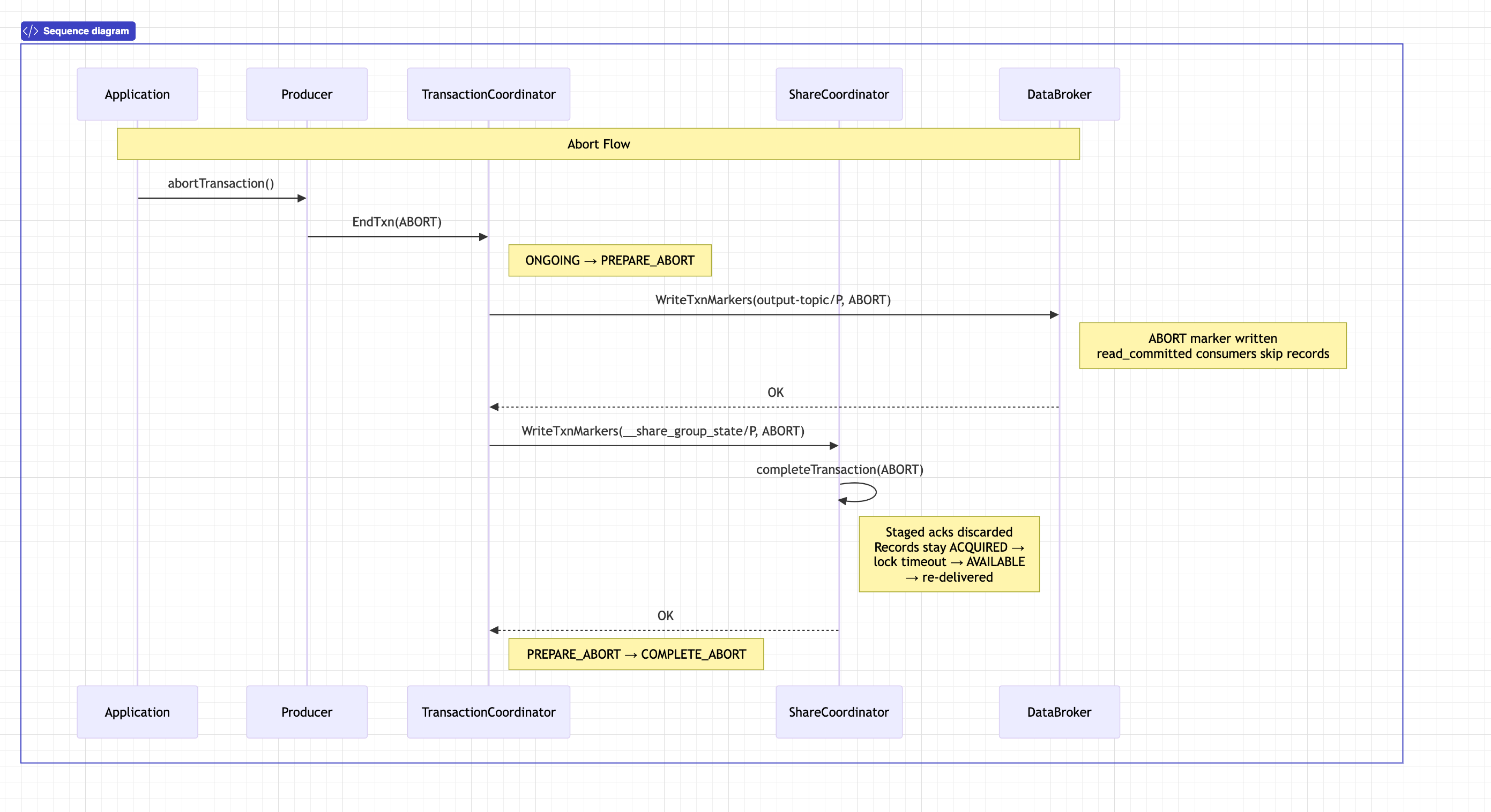
6. Corner Cases
Case 1: Crash BEFORE beginTransaction()
poll() -> records [0..9] ACQUIRED
<CRASH>
What happens:
- No transaction was started, no output produced, no acks sent
- ACQUIRED locks on records 0-9 expire (controlled by
share.record.lock.duration.ms) - Broker re-delivers records 0-9 to another member of the share group
- No data loss, no duplicates
Case 2: Crash AFTER send() but BEFORE commitTransaction()
poll() -> records [0..9] ACQUIRED
beginTransaction()
send(output for 0-9)       ← records written to broker, but transactional
<CRASH>
What happens:
- Output records are in the partition log but invisible (
read_committedconsumers skip uncommitted) - No
EndTxnRequestwas sent - TC detects transaction timeout (
transaction.timeout.ms), auto-aborts - TC sends
WriteTxnMarkers(ABORT)-> output records get ABORT marker, permanently invisible - Share group: no acks were sent, ACQUIRED locks expire, records 0-9 re-delivered
- No data loss, no duplicates
Case 3: Crash AFTER sendShareAcksToTransaction() but BEFORE commitTransaction()
poll() -> records [0..9] ACQUIRED
beginTransaction()
send(output)
sendShareAcksToTransaction()  ← acks written to SGC as PENDING
<CRASH>
What happens:
- Output records: in log, invisible (uncommitted)
- Share acks: stored in SGC as PENDING (not materialized)
- TC detects timeout, sends
WriteTxnMarkers(ABORT)to both data partitions AND__share_group_state - Output: ABORT marker written, records permanently invisible
- Share acks: SGC discards pending acks, locks expire, records 0-9 re-delivered
- No data loss, no duplicates -- this is the critical case that KIP-1289 solves
Case 4: Crash AFTER EndTxn(COMMIT) sent but BEFORE WriteTxnMarkers completes
poll() -> records [0..9] ACQUIRED
beginTransaction()
send(output)
sendShareAcksToTransaction()
commitTransaction()            ← EndTxn sent, PREPARE_COMMIT logged
<TC crashes or broker restart>
What happens:
PREPARE_COMMITis durable in__transaction_statelog- When TC recovers (or new leader elected for
__transaction_statepartition), it replays the log - TC sees PREPARE_COMMIT, resumes sending
WriteTxnMarkers(COMMIT)to all partitions - Output records become visible, share acks materialized
- No data loss, no duplicates -- the two-phase commit guarantees completion
Case 5: ProducerFencedException (zombie detection)
Instance A: beginTransaction(), send(), ...
Instance B: initTransactions() with same transactional.id
            ← TC bumps epoch, A is now a zombie
Instance A: commitTransaction()
            ← TC rejects: ProducerFencedException
What happens:
- Instance A's transaction is aborted by the TC (epoch fenced)
- Any pending output and share acks from A are discarded
- Instance B takes over, re-processes the records
- No data loss, no duplicates -- fencing prevents split-brain
Case 6: abortTransaction() called explicitly
poll() -> records [0..9] ACQUIRED
beginTransaction()
send(output for 0-4)
record 5 fails validation
abortTransaction()             ← explicit abort
What happens:
- TC writes PREPARE_ABORT, sends
WriteTxnMarkers(ABORT) - Output records 0-4: ABORT marker, permanently invisible
- Share acks (if any sent): discarded
- ACQUIRED locks expire, all records 0-9 re-delivered
- Application gets fresh batch, can retry
- No data loss
Case 7: Partial produce failure (network error to one partition)
beginTransaction()
send("enriched-orders-0", rec1)   ← success
send("enriched-orders-1", rec2)   ← network error, KafkaException
What happens:
- Application catches
KafkaException, callsabortTransaction() - Same as Case 6: everything rolled back, records re-delivered
- No data loss
The Guarantee Matrix
| Scenario | Output Records | Share Acks | Records Re-delivered? | Data Loss? | Duplicates? |
|---|---|---|---|---|---|
| Happy path (commit) | Visible | Materialized | No | No | No |
| Crash before txn | Never written | Never sent | Yes (lock expiry) | No | No |
| Crash mid-txn | Aborted (invisible) | Discarded | Yes (lock expiry) | No | No |
| Crash after PREPARE_COMMIT | Committed on recovery | Materialized on recovery | No | No | No |
| Zombie fenced | Aborted | Discarded | Yes (new instance) | No | No |
| Explicit abort | Aborted (invisible) | Discarded | Yes (lock expiry) | No | No |
| TC crash after PREPARE | Completed on failover | Completed on failover | No | No | No |
The fundamental property: at no point can output records be visible while share acks are uncommitted, or vice versa. They are in the same transaction and share the same COMMIT/ABORT fate.
7. Compatibility, Deprecation, and Migration Plan
Zero Breaking Changes: Current
implicitandexplicitmodes remain the default and continue to function as-is.Opt-in Requirement: Users must explicitly enable the new mode via
share.acknowledgement.mode = transactional.Version Safety: * Clients will "fail fast" if the connected broker does not support the new
TxnShareAcknowledgeRequest.Fallback logic is included to issue warnings if a downgrade to non-transactional acks is necessary.
8. Test Plan
The verification strategy focuses on state machine integrity and fault tolerance under high-concurrency and failure scenarios.
...
Unit Tests: Validates state transitions (e.g., ACQUIRED to ACKNOWLEDGED on commit vs. AVAILABLE on abort), idempotency of operations, and transaction timeout/auto-abort logic.
...
Integration Tests: Focuses on end-to-end commit/abort flows, coordinator recovery, and multi-consumer behavior within a single group during network partitions.
...
System & Performance Tests: Benchmarks transactional vs. non-transactional modes and verifies exactly-once delivery within Flink/Spark checkpointing cycles.
...
Corner cases
Here are your corner cases formatted using the same clean, un-phased, human-style layout. The wording, titles, technical specifications, and internal error codes remain exactly as provided.
1. Broker Crash During TX_PENDING (in-memory state)
- Scenario: broker stages TX_PENDING then crashes before marker arrives.
- Behavior: TX_PENDING is in-memory only (
__share_group_stateschema unchanged in v1); records replay as ACQUIRED/AVAILABLE after broker restart and are redelivered. - Guarantee: no data loss; at-least-once on broker-crash window (existing share-group baseline).
- Future: persistent TX_PENDING via extending
ShareSnapshotValue.DeliveryStatedeferred to a follow-up KIP.
2. TxnCoord Registration Fails (COORDINATOR_NOT_AVAILABLE, NOT_COORDINATOR)
- Scenario: broker-internal
AddPartitionsToTxnreturns retriable error. - Behavior: broker does NOT stage; returns error to producer; producer enters abortable state.
- Recovery: user catches
KafkaException→abortTransaction()→ retries.
3. Producer Fenced Mid-Stage (PRODUCER_FENCED, INVALID_PRODUCER_EPOCH)
- Scenario: zombie producer A (epoch 1) sends
TxnShareAcknowledgeafter producer B (epoch 2) has been initialized. - Behavior: TxnCoord registration rejects with fencing error → no staging happens → producer A becomes fatal.
- Late-arriving marker safety: per-
InFlightState(stagedProducerId,stagedProducerEpoch) filter rejects mismatched markers; idempotent.
5. Duplicate WriteTxnMarkers Delivery
- Scenario: TxnCoord retries marker after network failure; broker receives same marker twice.
- Behavior: second invocation finds state != TX_PENDING (already resolved) → no-op.
- Guarantee: idempotent by state filter — verified in
InFlightStateTxnTest.
6. Acquisition Lock Expiry While TX_PENDING
- Scenario: transaction stages records but stalls; lock duration expires before commit/abort.
- Behavior: lock timer detects TX_PENDING with expired lock → reverts to ACQUIRED → re-acquirable; subsequent marker for the stale staging is filtered out (epoch mismatch).
- Configuration:
group.share.record.lock.duration.ms(default 30s; per share group).
7. Transaction Timeout While TX_PENDING (transaction.timeout.ms)
- Scenario: producer crashes after staging; TxnCoord detects abandoned transaction via timeout.
- Behavior: TxnCoord auto-sends
WriteTxnMarkers(ABORT); broker reverts TX_PENDING → ACQUIRED → AVAILABLE on next lock cycle. No data loss; eventual redelivery.
8. Stale Member Epoch (STALE_MEMBER_EPOCH, UNKNOWN_MEMBER_ID)
- Scenario: rebalance changes
memberEpochbetweenshareGroupMetadata()snapshot andsendShareAcksToTransaction()call. - Behavior: broker compares request
memberEpochwith currentSharePartitionowner; mismatch → returnsSTALE_MEMBER_EPOCH; no staging. - Recovery: abortable; user retries the entire read-process-write loop with a fresh snapshot.
9. Mixed-Version Cluster During Rolling Upgrade
- Scenario: some brokers lack apiKey 93 (
TxnShareAcknowledge). - Behavior: producer probes
ApiVersions; if apiKey 93 absent on any broker →UnsupportedVersionExceptionthrown synchronously, no bytes on wire. - Recovery: user must abort the transaction (output-side
AddPartitionsToTxnstill needs cleanup). - Gating:
share.version=2finalized feature flag controls broker advertisement.
10. Invalid Acknowledge Type Inside Transaction
- Scenario: producer sends
AcknowledgeType.RELEASE(2),RENEW(4), orGAP(0) insidesendShareAcksToTransaction. - Behavior: broker rejects with
INVALID_RECORD_STATE; no staging. - Allowed values: only
ACCEPT(1) andREJECT(3) — release/renew/gap have no transactional semantics.
11. Partial Multi-Partition Stage Failure
- Scenario: producer stages on partitions A and B; A succeeds, B fails.
- Behavior: per-partition 2PC rollback — already-staged records on A are reverted to ACQUIRED before the response returns (commit 8 on the branch).
- Result: all-or-nothing per call; user sees error → aborts → retries.
- Guarantee: no partial commit; clean rollback semantics.
12. Leader Change for __share_group_state-N Between Stage and Commit
- Scenario: share-coordinator partition leadership moves from broker 5 to broker 7 between staging and
WriteTxnMarkersdispatch. - Behavior: TxnCoord re-resolves leader at commit time via
MetadataCache→ marker goes to broker 7; broker 7's in-memorypartitionCachedoes NOT contain the original TX_PENDING state. - Limitation in this intial version: TX_PENDING lost on share-coordinator leadership change (same root cause as Corner Case 1); lock-timeout reverts records; redelivery.
- Future: persistent TX_PENDING closes this case as well.
13. Transaction Aborted Without Markers Reaching Broker
- Scenario: transaction aborts but broker hosting TX_PENDING is partitioned from TxnCoord.
- Behavior: lock timeout (Corner Case 6) eventually reverts; subsequent late-arriving marker is no-op (state already AVAILABLE or epoch mismatched).
- Convergence guaranteed.
14. Concurrent Transactions From Same Producer (Different Epochs)
- Scenario: producer rapidly bumps epoch; old in-flight
TxnShareAcknowledgearrives with stale epoch. - Behavior: TxnCoord rejects with
PRODUCER_FENCED; broker never stages. Per-record fencing on the state machine prevents any stale marker from resolving newer staging.
...
Note: We can persist the record state and get rid of case 1 in follow up KIP.
Metrics
All new metrics follow the existing Kafka metric conventions (Yammer for broker JMX, KafkaMetric for client-side).
Metric names mirror the established kafka.server:type=group-coordinator-metrics,name=... and kafka.server:type=share-coordinator-metrics,name=... patterns.
Backward-compatible: no existing metrics renamed or removed.
| Module | Metric | Type | Purpose |
|---|---|---|---|
| Broker — SharePartitionManager | TxnPendingRecordsCount | Gauge | Current count of records in TX_PENDING (primary health signal) |
| Broker — SharePartitionManager | TxnShareAcknowledgeRequestLatencyMs | Histogram | p99 latency of staging requests |
| Broker — SharePartitionManager | TxnPendingLockExpiredCount | Counter | Any non-zero = abandoned txns or missing markers (critical alert) |
| Broker — TransactionCoordinator | TransactionPartitionsCount (existing) | Gauge | Reused; now includes __share_group_state-N entries |
| Producer | share-ack-txn-send-rate | Meter | EOS-call throughput |
| Producer | share-ack-txn-send-error-rate | Meter | Stage-failure rate (drives retry loops) |
| Consumer | share-group-metadata-fetch-rate | Meter | Confirms read-process-write loop is active |
| Total: 6 new + 1 reused = 7 metrics. Primary alert: TxnPendingRecordsCount > 0 sustained for > 60s. |
Compatibility, Deprecation, and Migration Plan
Enablement and Rollout Plan
Feature Gating
opt-in, online-upgradable, and zero-disruption for existing workloads - No new feature flag introduced. Uses existing kafka-features.sh machinery.
| Feature flag | Required level | Why |
|---|---|---|
| share.version | >= 2 | New level finalises KIP-1289; brokers below this advertise no apiKey <93> |
| transaction.version | >= 2 | KIP-1289 is TV2-only (inherits auto-registration and proper epoch fencing) |
Rolling Upgrade (Online; No Traffic Disruption)
Phase 1 — Software upgrade (rolling)
Upgrade brokers one at a time to the binary containing KIP-1289.
KIP-1289 code is dormant (share.version still 1).
Standard Kafka rolling-restart
Phase 2 — Soak timing
Verify cluster health
Phase 3 — Finalise feature
kafka-features.sh upgrade --feature share.version --version 2
- Online metadata propagation (update of __cluster_metadata)
- No restart, no rebalance, no leader change, no socket disruption
- Brokers begin advertising apiKey 93
Phase 4 — Client onboarding
Roll out applications calling sendShareAcknowledgementsToTransaction.
Add the alerts (esp. TxnPendingRecordsCount) and relevant metrics in dashboard & observability.
Cross-Version Client/Broker Matrix
| Client | Broker, share.version=2 | Broker, share.version=1 | Old broker (no binary) |
|---|---|---|---|
| New | Works | UnsupportedVersionException (synchronous, no wire bytes) | Same |
| Old | Unaffected | Unaffected | Unaffected |
Downgrade
1. Drain in-flight TX_PENDING:
- Halt producers calling sendShareAcknowledgementsToTransaction
- Wait for transaction.timeout.ms (default 60s) for any abandoned txns to clear
2. kafka-features.sh downgrade --feature share.version --version 1
Broker rejects the downgrade RPC if any in-memory TX_PENDING exists, preventing data inconsistency.
Software downgrade (binary): must follow feature downgrade; standard rolling restart.
Test Plan
Rough implementation [The actual implementation will be phasewise with multiple smaller PRs]:
https://github.com/apache/kafka/pull/22357
The verification strategy focuses on state machine integrity and fault tolerance under high-concurrency and failure scenarios.
Unit Tests: Validates state transitions (e.g.,
ACQUIREDtoACKNOWLEDGEDon commit vs.AVAILABLEon abort), idempotency of operations, and transaction timeout/auto-abort logic.Integration Tests: Focuses on end-to-end commit/abort flows, coordinator recovery, and multi-consumer behavior within a single group during network partitions.
System & Performance Tests: Benchmarks transactional vs. non-transactional modes and verifies exactly-once delivery.
Chaos Tests: Simulates broker and coordinator crashes specifically during critical phases like
PREPARE_COMMITto ensure protocol durability.
Follow-up KIP (deferred)
- Persistent TX_PENDING in __share_group_state for crash-resilient EOS on broker failover during staging (addresses Corner Cases).
- Per-share-partition metric for TX_PENDING residency time— would add a histogram of "time spent in TX_PENDING" useful for diagnosing slow producers; can be added in the persistence KIP without compatibility concerns.
- External processing engines or database as 2PC participants for write/sink records
...
- .
Rejected Alternatives
If there are alternative ways of accomplishing the same thing, what were they? The purpose of this section is to motivate why the design is the way it is and not some other way.