DUE TO SPAM, SIGN-UP IS DISABLED. Goto Selfserve wiki signup and request an account.

DUE TO SPAM, SIGN-UP IS DISABLED. Goto Selfserve wiki signup and request an account.
...
In SDN solutions, some networking services are provided by the SDN itself, for example
...
In this case, the CloudStack VR is used for to provide Dhcp/, Dns /and Userdata services to the vm instances. It is not in the path of the traffic, it acts VM instances, while remaining out of the data path, acting as a helper vmVM
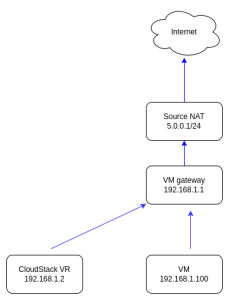
The goal of this feature is to support VPNs in Cloudstack VRto support VPN access from the Cloudstack VR when its out of the data path, thus supporting:
Please note, this supports VPC only. Isolated networks is not supported
As the first stepa pre-requisite, the CloudStack VR needs to be provided with a public IP (via static natStatic NAT).
For Remote access vpn, the diagram is as below
...
For Site-to-Site VPN, the diagram is as below
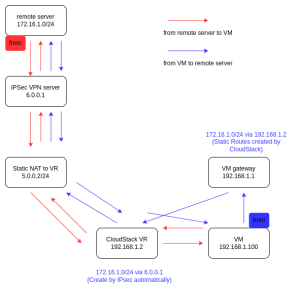
In both cases, as the last step, static routes need to be create injected by cloudstack and configured in SDNCloudStack in the SND fabric.
This described some details of the implementation
...
...
user_ip_address for public ip address, which ...
...
`for_router` tinyint(1) DEFAULT '0' COMMENT 'True if the ip address is used by Domain Router to expose services',tinyint(1) DEFAULT '0' COMMENT 'True if the ip address is used by Domain Router to expose services',
static_routes , which saves the next hop of static routes.`next_hop`varchar(50) COMMENT "next hop of the static route" AFTER `vpc_gateway_id`
...
To create a VPC, please refer to https://docs.cloudstack.apache.org/en/4.19.1.0/adminguide/networking_and_traffic.html#configuring-a-virtual-private-cloud
Remote In SDN networks, remote access VPN is not supported by on the Source NAT for SDN networksIP.
(1) acquire a Public IP
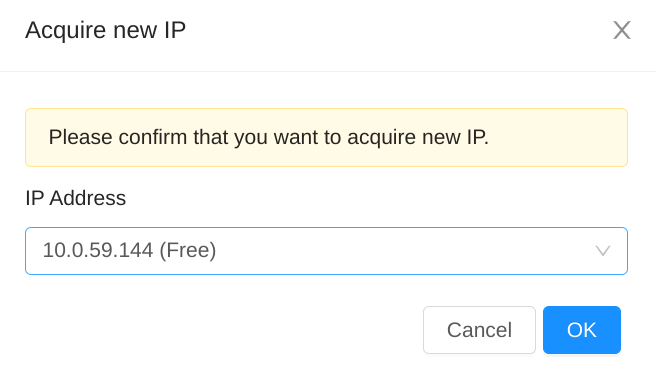
Please use an IP address which is not in the subnet of Source NAT of VPC VR (not Netris)VPN fabric.
(2) Enable Remote Access VPN
...
Please refer to https://docs.cloudstack.apache.org/en/4.19.1.0/adminguide/networking/using_remote_access.html#microsoft-windows-8
Remember Reminder, For for Windows clients,
Allow these protocols → Enable MSCHAP-v2
...
If remote access VPN is enabled, it gets the the same IP
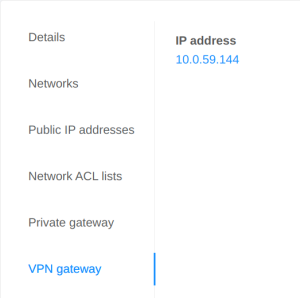
Otherwise, public IP is used, otherwise CloudStack automatically assign assigns a Public IP.
(2) Create customer gateway
...
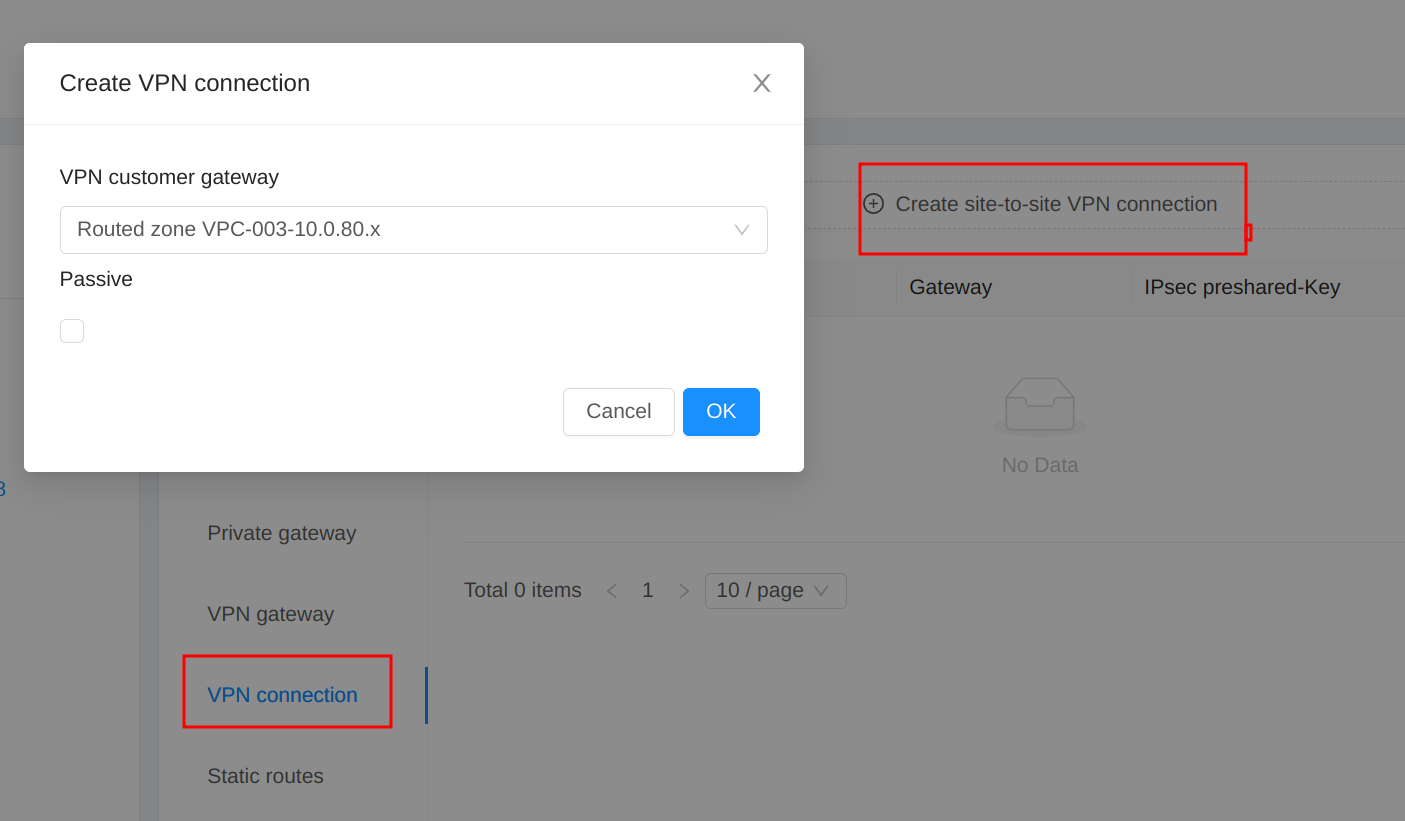
(3) Create VPN connection
Before testing
...
Test VPC tier deletion (first tier) | |
|
|
|
|
|
|
|
|
|
|
...
Test VPC tier deletion (from last tier) | |||||||||
|
| ||||||||
|
| ||||||||
|
| ||||||||
|
| ||||||||
|
|
|
| Should fail
|
| Remove VPC
|
|
| Should work |