DUE TO SPAM, SIGN-UP IS DISABLED. Goto Selfserve wiki signup and request an account.
...
Discussion thread: here
JIRA: TBD
| Jira | ||||||
|---|---|---|---|---|---|---|
|
Please keep the discussion on the mailing list rather than commenting on the wiki (wiki discussions get unwieldy fast).
...
Public Interfaces
New Broker Configuration
| Configuration name | Description | Values |
|---|---|---|
group.streams.topology.description.plugin.class | The fully qualified class name of a StreamsGroupTopologyDescriptionPlugin implementation. When not set, the feature is disabled. | Type: |
group.streams.topology.description.max.bytesTOPOLOGY_DESCRIPTION_TOO_LARGE.int, Default: 358400 (350 KB) |
New Client Configuration
| Configuration name | Description | Values |
|---|---|---|
topology.description.push.enabled | Controls whether the Kafka Streams client sends topology descriptions to the broker when requested. When set to |
TopologyDescriptionId set | Type: boolean, Default: true |
StreamsGroupHeartbeatResponse Change
...
| Code Block | ||
|---|---|---|
| ||
{ "name": "TopologyDescriptionIdTopologyDescriptionRequired", "type": "uuidbool", "versions": "N+",
  "nullableVersionsignorable": "N+"true, "default": "nullfalse",
"about": "When non-null,True if the client should pushsend its currentthe topology description tagged with this id via UpdateStreamsGroupTopologyDescription. Null when no push is requestedvia StreamsGroupTopologyDescriptionUpdate." } |
The broker mints a fresh TopologyDescriptionId on group creation and on every topology epoch bump and persists it on the streams group record. After each heartbeat from a non-STALE_TOPOLOGY member, the broker calls plugin.requiresTopologyPush(requestContext, groupId, topologyDescriptionId) with the current id; if the plugin returns true, the broker includes that id in the heartbeat response, otherwise the field is omitted.
New RPC: UpdateStreamsGroupTopologyDescription (API Key TBD)
sets this field to true when a topology description plugin is configured and the broker expects the client to send it's current version of the topology description.
New RPC: StreamsGroupTopologyDescriptionUpdate (API Key TBD)
A new RPC is introduced for setting the topology description for a streams group. Like A new RPC is introduced for setting the topology description for a streams group. Like StreamsGroupHeartbeat, the request is sent to the group coordinator for the group.
...
| Code Block | ||
|---|---|---|
| ||
{
  "apiKey": "TBD",
  "type": "request",
  "listeners": ["broker"],
  "name": "UpdateStreamsGroupTopologyDescriptionRequestStreamsGroupTopologyDescriptionUpdateRequest",
  "validVersions": "0",
  "flexibleVersions": "0+",
  "fields": [
    	{ "name": "GroupId", "type": "string", "versions": "0+", "entityType": "groupId",
	      "about": "The streams group identifier." },
    	{ "name": "TopologyDescriptionIdMemberId", "type": "uuidstring", "versions": "0+",
	      "about": "The topology description id received in the most recent heartbeat response, identifying which topology version this push corresponds toID of the streams group member sending the push." },
	{ "name": "TopologyEpoch", "type": "int32", "versions": "0+",
 	  "about": "The epoch of the topology being described." },
    { "name": "TopologyDescription", "type": "TopologyDescription", "versions": "0+",
      "about": "The topology description." }
   ],
  "commonStructs": [
    { "name": "TopologyDescription", "versions": "0+", "fields": [
      { "name": "Subtopologies", "type": "[]Subtopology", "versions": "0+",
        "about": "The subtopologies that make up this topology." },
      { "name": "GlobalStores", "type": "[]GlobalStore", "versions": "0+",
        "about": "Global state stores used by this topology." }
    ]},
    { "name": "Subtopology", "versions": "0+", "fields": [
      { "name": "SubtopologyId", "type": "string", "versions": "0+",
        "about": "The subtopology identifier, unique within the topology." },
      { "name": "Nodes", "type": "[]TopologyNode", "versions": "0+",
        "about": "The processing nodes in this subtopology." }
    ]},
    { "name": "TopologyNode", "versions": "0+", "fields": [
      { "name": "Name", "type": "string", "versions": "0+",
        "about": "The name of this node (e.g., KSTREAM-SOURCE-0000000000)." },
      { "name": "NodeType", "type": "int8", "versions": "0+",
        "about": "The type of this node: 1=SOURCE, 2=PROCESSOR, 3=SINK." },
      { "name": "SourceTopics", "type": "[]string", "versions": "0+", "entityType": "topicName",
        "about": "The source topics this node reads from. Defined Populatedonly for source nodes." },
 may be empty if source { topics are dynamically determined." },
      { "name": "SinkTopic", "type": "string", "versions": "0+", "entityType": "topicName",
        "nullableVersions": "0+", "default": "null",
        "about": "The topic this node writes to. PopulatedDefined only for sink nodes, may be null if sink topic is dynamically determined." },
         { "name": "Stores", "type": "[]string", "versions": "0+",
        "about": "The state store names accessed by this node. PopulatedDefined only for processor nodes." },
      { "name": "Successors", "type": "[]string", "versions": "0+",
        "about": "The names of successor nodes in the processing graph. Predecessor relationships are reconstructed from this field on the read side." }
    ]},
    { "name": "GlobalStore", "versions": "0+", "fields": [
      { "name": "Source", "type": "TopologyNode", "versions": "0+",
        "about": "The source node providing data to the global store." },
      { "name": "Processor", "type": "TopologyNode", "versions": "0+",
        "about": "The processor node that populates the global store." }
    ]}
  ]
} |
...
| Code Block | ||
|---|---|---|
| ||
{
  "apiKey": "TBD",
  "type": "response",
  "name": "UpdateStreamsGroupTopologyDescriptionResponseStreamsGroupTopologyDescriptionUpdateResponse",
  "validVersions": "0",
  "flexibleVersions": "0+",
  "fields": [
    { "name": "ThrottleTimeMs", "type": "int32", "versions": "0+",
      "about": "The duration in milliseconds for which the request was throttled due to a quota violation, or zero if the request did not violate any quota." },
    { "name": "ErrorCode", "type": "int16", "versions": "0+",
      "about": "The top-level error code, or 0 if there was no error." },
    { "name": "ErrorMessage", "type": "string", "versions": "0+",
      "nullableVersions": "0+", "default": "null",
      "about": "The top-level error message, or null if there was no error." }
  ]
} |
...
GROUP_AUTHORIZATION_FAILED— the client is not authorizedINVALID_REQUEST— the request is malformed , or the plugin semantically rejected the payload by completing its future withInvalidRequestException(including an emptyMemberId)UNSUPPORTED_VERSION— the coordinator cannot serve this RPC because no topology description plugin is configuredSTREAMS_TOPOLOGY_DESCRIPTION_TOOUPDATE_LARGEFAILED— the serialized topology description exceedsgroup.streams.topology.description.max.bytesplugin failed to process the request. The accompanyingErrorMessagecarries the plugin's exception message. The broker's response shape is identical for both permanent and transient plugin failures; the distinction is broker-internal state that determines whether subsequent heartbeats at the same topology epoch will re-solicit (see Broker Side).UNKNOWN_MEMBER_ID— the member named inMemberIdis no longer in the group; the client should treat itself as fenced and rejoinUNKNOWN_SERVER_ERROR— the plugin encountered an unexpected error processing the requestGROUP_ID_NOT_FOUND— the specified group does not existNOT_COORDINATOR— the broker is not the coordinator for this groupCOORDINATOR_NOT_AVAILABLE— the coordinator is not availableCOORDINATOR_LOAD_IN_PROGRESS— the coordinator is loading
...
Client-side retry behavior for each code is described in Error Handling and Retries Client Side below.
StreamsGroupDescribeRequest Change
...
| Code Block | ||||
|---|---|---|---|---|
| ||||
 {"name": "IncludeTopologyDescription", "type": "bool", "versions": "N+", "defaultignorable": true, "default": "false",
"about": "Whether to include the full topology description from the topology description plugin in the response." } |
A client that negotiates an older version is handled unchanged by any broker. The flag may only be set when version N or later is negotiatedClients on older versions never see the flag and behave unchanged.
StreamsGroupDescribeResponse Change
...
| Code Block | ||||
|---|---|---|---|---|
| ||||
 { "name": "TopologyDescription", "type": "TopologyDescription", "versions": "N+",
  "nullableVersions": "N+", "ignorable": true, "default": "null",
  "about": "The topology description for this group. Null if not available — see TopologyDescriptionStatus for the reason." },
{ "name": "TopologyDescriptionStatus", "type": "int8", "versions": "N+", "ignorable": true, "default": "0",
"about": "When TopologyDescription is null, the reasonThe status of the topology description for this group: 0=NOT_REQUESTED (client did not set IncludeTopologyDescription), 1=NOT_STORED (no topology description has been recorded for this group), 2=ERROR (the broker failed to fetch the topology description; check broker logs). Ignored when TopologyDescription is non-null." }, 3=AVAILABLE (a topology description is present in the TopologyDescription field). The broker MUST set this field to AVAILABLE whenever it attaches a TopologyDescription." } |
The The TopologyDescription common struct mirrors the struct used by UpdateStreamsGroupTopologyDescriptionRequest StreamsGroupTopologyDescriptionUpdateRequest (same field names and shape). Because . The nested struct names are prefixed TopologyDescription to avoid collision with the existing Subtopology struct already defined for the describe response. Because Kafka RPC schemas do not share common structs across message files, the struct is duplicated in StreamsGroupDescribeResponse.json.Setting Setting these fields does not change the ErrorCode on the DescribedGroup: a group with a successful describe but a missing or failed topology fetch still returns ErrorCode=NONE. The TopologyDescriptionStatus field tells the caller why TopologyDescription is null, so that "waiting for first push" (NOT_STORED) can be distinguished from "broker-side fetch failed" (ERROR) without an error-level change to the describe result.
Plugin Interface
DeleteGroupsResponse Change
DeleteGroupsRequest and DeleteGroupsResponse are both bumped to the next version (3). The request shape is unchanged at the new version; the response adds an ErrorMessage field to each per-group DeletableGroupResultA new interface is introduced in org.apache.kafka.coordinator.group.api.streams :
| Code Block | ||||
|---|---|---|---|---|
| ||||
{ "name": "ErrorMessage", "type": "string", "versions": "3+", "nullableVersions": "3+", "ignorable": true, "default": "null",
"about": "The error message, or null if there was no error." } |
A new generic error code is added to the per-group ErrorCode slot:
GROUP_DELETION_FAILED— the delete operation could not complete; the accompanyingErrorMessagedescribes the underlying cause. The group is not tombstoned, and the caller may retry once the underlying condition is resolved. For streams groups configured with a topology description plugin this is returned whenplugin.deleteTopologyfails; other group types may adopt the same code in the future.
This is the only deletion-blocking failure mode introduced by this KIP. Consumer and share groups are unaffected. See Broker Side for the full ordering rule and the recovery path.
Plugin Interface
A new interface is introduced in org.apache.kafka.coordinator.group.api.streams :
| Code Block | ||||
|---|---|---|---|---|
| ||||
/** * A broker-side plugin that stores, forwards, or exposes topology descriptions pushed * by Kafka Streams clientspackage org.apache.kafka.coordinator.group.api.streams; import org.apache.kafka.common.Configurable; import org.apache.kafka.common.Uuid; import org.apache.kafka.server.authorizer.AuthorizableRequestContext; import java.util.concurrent.CompletableFuture; /** * A broker-side plugin that manages topology descriptions for streams groups. * * <p>Implementations receive topology descriptions pushed by Kafka Streams clients * and can store, forward, or expose them however they see fit. * * <p>The broker calls {@link #requiresTopologyPush} on every heartbeat to determine * whether the client should send its topology description. Implementations that need * to consult an external service should kick off that work asynchronously on the * first call and return {@code false} until the result is available. * * <p>Every method takes an {@link AuthorizableRequestContext} as its first argument. * * <p>Implementations must be thread-safe. {@link #setTopology} may be called * concurrently by multiple group members observingof the same * {@code TopologyDescriptionId} in their heartbeat responses; concurrent * group; calls with the same * {@code (groupId, topologyDescriptionIdtopologyEpoch)} paircarry carry * identical data and must be treated as idempotent. */ public interface{@link StreamsGroupTopologyDescriptionPlugin#deleteTopology} extendsmust Configurable,also AutoCloseablebe { idempotent — it may /** be called more than once * Returnsfor whether the brokersame should request a topology push from the client. * * <p>Called on every successful heartbeat. Not called for members in * {@code STALE_TOPOLOGY} status. If this method returns {@code true}, the broker * includes the {@code topologyDescriptionId} in the heartbeat response. * * <p>This method should not throw. Failure modes should be handled internally * and converted to a return value of {@code false}. The broker defensively * catches any exception and treats it as {@code false}, logging at WARN; plugins * should not rely on this backstop. * * <p>This method is on the heartbeat path and must return quickly. Implementations * that need to consult an external service should return {@code false} until the * result is available. * * <p>See the KIP's <em>Plugin Implementation Guidelines</em> section for how * implementations should handle in-flight tracking, retries, and topology * expiration. * * @param requestContext the context of the heartbeat request * @param groupId the streams group ID * @param topologyDescriptionId the broker-minted id identifying the current topology * version for this group; opaque to the plugin * @return true if the broker should request a topology push from the client */ boolean requiresTopologyPush(AuthorizableRequestContext requestContext, String groupId, Uuid topologyDescriptionId); /** * Called when a client sends a topology description for a streams group. * This method may be called concurrently by multiple members of the same group; * all calls for the same (groupId, topologyDescriptionId) carry identical data. * * <p>The returned future completes when the topology has been persisted or * forwarded. Complete it exceptionally with * {@link org.apache.kafka.common.errors.InvalidRequestException} to signal that * the payload is semantically invalid; any other exception is treated as a * server-side plugin error. * * @param requestContext the context of the UpdateStreamsGroupTopologyDescription request * @param groupId the streams group ID * @param topologyDescriptionId the id this push is tagged with, as carried in the * heartbeat response that asked for it; opaque to the plugin * @param description the topology description * @return a future that completes when the operation is done */ CompletableFuture<Void> setTopology(AuthorizableRequestContext requestContext, String groupId, Uuid topologyDescriptionId, StreamsGroupTopologyDescription description); /** * Called when a group is explicitly deleted via DeleteGroups. Removes any topology * description stored for this group. * * <p>The returned future completes when the deletion has been processed. * If it completes exceptionally, the broker logs the error; the outcome does not * affect the DeleteGroups response returned to the caller. * * @param requestContext the context of the DeleteGroups request * @param groupId the streams group ID * @return a future that completes when the operation is done */ CompletableFuture<Void> deleteTopology(AuthorizableRequestContext requestContext, String groupId); /** * Called to retrieve the stored topology description for a group. This is invoked * by the broker when a client calls StreamsGroupDescribe with * {@code IncludeTopologyDescription=true}. * * <p>Returns a future that resolves to the stored topology description for the * given {@code (groupId, topologyDescriptionId)} pair, or to {@code null} if no * topology is stored (e.g. no push has succeeded yet, or the stored description * is tagged with a different id). If the future completes exceptionally, the * plugin signals a read error for this group. * * @param requestContext the context of the StreamsGroupDescribe request * @param groupId the streams group ID * @param topologyDescriptionId the id of the topology version the caller is * asking about; opaque to the plugin * @return a future resolving to the stored topology description, or null if none */ CompletableFuture<StreamsGroupTopologyDescription> getTopology(AuthorizableRequestContext requestContext, String groupId, Uuid topologyDescriptionId); } |
The plugin uses a StreamsGroupTopologyDescription POJO that mirrors org.apache.kafka.streams.TopologyDescription but lives in the org.apache.kafka.group.api.streams module; plugin implementations only need to depend on group-coordinator-api. The only difference is that there is no predecessor relation.
{@code groupId}, including when nothing is stored.
 */
@InterfaceStability.Evolving
public interface StreamsGroupTopologyDescriptionPlugin extends Configurable, AutoCloseable {

	/**
	 * Store the topology description for a streams group.
	 *
	 * <p>The returned future completes when the topology has been persisted or forwarded.
	 * Failures must be signalled by completing the future exceptionally — implementations
	 * must not throw synchronously. The completion exception drives broker-side behaviour:
	 *
	 * <ul>
	 *   <li>{@link StreamsTopologyDescriptionPermanentFailureException} — the description will never be accepted
	 *       at this topology epoch (e.g. too large, semantically rejected). The broker
	 *       ratchets {@code LastFailedTopologyEpoch} and stops re-soliciting until the
	 *       epoch advances.</li>
	 *   <li>{@link StreamsTopologyDescriptionTransientFailureException} or any other exception — treated as
	 *       transient. The broker arms or extends the per-group back-off (30 s → 1 h,
	 *       exponential) and re-solicits on a later heartbeat.</li>
	 * </ul>
	 *
	 * In both cases the caller receives error code
	 * {@code STREAMS_TOPOLOGY_DESCRIPTION_UPDATE_FAILED} with the exception's message in
	 * {@code ErrorMessage}; the permanent-vs-transient split is broker-internal state.
	 */
	CompletableFuture<Void> setTopology(String groupId, int topologyEpoch,
                                    	StreamsGroupTopologyDescription description);

	/**
	 * Remove any topology description stored for this group. Called when the group is
	 * deleted or expires. A failure (future completed exceptionally) is reported to the
	 * caller of {@code DeleteGroups} as {@code GROUP_DELETION_FAILED} with the exception message
	 * in the per-group {@code ErrorMessage}, and the broker does not tombstone the group;
 	 * a retry of {@code DeleteGroups} re-invokes this method idempotently. The
	 * periodic-cleanup path treats a failure identically — the group's tombstone is
	 * deferred to a future cycle.
	 */
	CompletableFuture<Void> deleteTopology(String groupId);

    /**
     * Return the stored topology description for {@code (groupId, topologyEpoch)}, or
     * {@code null} if the plugin no longer has the data (e.g. backend wipe). If the future
     * completes exceptionally, the broker reports a read error for the group.
     */
    CompletableFuture<StreamsGroupTopologyDescription> getTopology(String groupId, int topologyEpoch);
} |
The plugin uses a StreamsGroupTopologyDescription POJO that mirrors org.apache.kafka.streams.TopologyDescription but lives in the org.apache.kafka.coordinator.group.api.streams package; plugin implementations only need to depend on group-coordinator-api. The only difference is that there is no predecessor relation.
| Code Block | ||||
|---|---|---|---|---|
| ||||
package org.apache.kafka.coordinator.group.api.streams;

public class StreamsGroupTopologyDescription {
    public Collection<Subtopology> subtopologies();
    public Collection<GlobalStore> globalStores();

    public static final class Subtopology {
        public String id();
        public Collection<Node> nodes();
    }

	/**
     * A processing node in the topology. Predecessor nodes can be inferred from successor relation.
     */
    public sealed interface Node {
        String name();
        Set<String> successors();
    }

    public static final class Source implements Node {
        public Set<String> topics();
    }

    public static final class Processor implements Node {
        public Set<String> stores();
    }

    public static final class Sink implements Node {
        public Optional<String> topic();
    }

    public static final class GlobalStore {
        public Source source();
        public Processor processor();
    }
} |
Two new exception classes in the same package let the plugin signal the permanent-vs-transient distinction. Plugins that throw any other exception are treated as transient:
| Code Block | ||||
|---|---|---|---|---|
| ||||
package org.apache.kafka.coordinator.group.api.streams;

import org.apache.kafka.common.errors.ApiException;
import org.apache.kafka.common.annotation.InterfaceStability;

/** Signals that the topology description for the current epoch will never be accepted (e.g. too large, semantically rejected). */
@InterfaceStability.Evolving
public class StreamsTopologyDescriptionPermanentFailureException extends ApiException {
    public StreamsTopologyDescriptionPermanentFailureException(String message) { super(message); }
    public StreamsTopologyDescriptionPermanentFailureException(String message, Throwable cause) { super(message, cause); }
}

/** Signals a transient backend failure; the broker re-solicits on a later heartbeat. Plugins that throw any other exception are treated identically. */
@InterfaceStability.Evolving
public class StreamsTopologyDescriptionTransientFailureException extends ApiException {
    public StreamsTopologyDescriptionTransientFailureException(String message) { super(message); }
    public StreamsTopologyDescriptionTransientFailureException(String message, Throwable cause) { super(message, cause); }
} |
Broker-Side Persistence
Two new tagged fields are added to the persisted StreamsGroupMetadataValue record (a broker-internal record written to __consumer_offsets, not a wire-level change visible to clients):
| Code Block | ||||
|---|---|---|---|---|
| ||||
 { "name": "StoredTopologyEpoch", "versions": "0+", "taggedVersions": "0+", "tag": 3,
  "default": -1, "type": "int32",
  "about": "The topology epoch whose description is currently stored in the topology description plugin, or -1 if none is stored." },
{ "name": "LastFailedTopologyEpoch", "versions": "0+", "taggedVersions": "0+", "tag": 4,
  "default": -1, "type": "int32",
"about": "The topology epoch whose description push the plugin permanently rejected (signalled by StreamsTopologyDescriptionPermanentFailureException), or -1 if none. Heartbeat-path solicitation is suppressed while this equals the current topology epoch, to avoid hot-looping." } |
The two fields together drive the broker-side gating decision on the heartbeat and describe paths. Both are tagged fields, so older brokers that decode the record before deserializing the tags simply see the defaults. Streams groups that existed before this KIP land carry both fields as -1; on the first post-upgrade heartbeat the broker solicits a push, and the regular setTopology path persists the new value.
Admin Client Interface
DescribeStreamsGroupsOptions gains an includeTopologyDescription(boolean) setter. When set to true, the admin client sets IncludeTopologyDescription on the StreamsGroupDescribeRequest (at the new version) and the coordinator consults the plugin.
StreamsGroupDescription gains two accessors:
Optional<StreamsGroupTopologyDescription> topologyDescription()— empty unless the field was requested and the plugin returned a description.StreamsGroupTopologyDescriptionStatus topologyDescriptionStatus()— a new enum{ NOT_REQUESTED, NOT_STORED, ERROR, AVAILABLE }. Each enum value's ordinal matches the wire-levelTopologyDescriptionStatusint8 (0, 1, 2, 3).AVAILABLEis reported whenTopologyDescriptionis non-null.
The Admin client exposes a POJO hierarchy in org.apache.kafka.clients.admin that mirrors org.apache.kafka.streams.TopologyDescription but lives in the clients module. The admin client converts the wire-format struct into this hierarchy.
| Code Block | ||||
|---|---|---|---|---|
| ||||
package org.apache.kafka.clients.admin;

public class StreamsGroupTopologyDescription {
    public Collection<Subtopology> subtopologies();
    public Collection<GlobalStore> globalStores();

    public static final class Subtopology {
        public String id();
        public Collection<Node> nodes();
    }

    public interface Node {
        String name();

        /** Direct predecessor nodes. */
        Set<String> predecessors();

        /** Direct successor nodes. */
        Set<String> successors();
    }

    public static final class Source implements Node {
        public Set<String> topics();
    }

    public static final class Processor implements Node {
        public Set<String> stores();
    }

    public static final class Sink implements Node {
        public Optional<String> topic();
} | ||||
| Code Block | ||||
| ||||
package org.apache.kafka.group.api.streams; public class StreamsGroupTopologyDescription { public Collection<Subtopology> subtopologies(); public Collection<GlobalStore> globalStores(); public static final class SubtopologyGlobalStore { public StringSource idsource(); public Collection<Node>Processor nodesprocessor(); } public interface Node { String name(); Set<String> successors(); } public static class Source implements Node { public Set<String> topics(); } public static class Processor implements Node { public Set<String> stores(); } public static class Sink implements Node { public String topic(); } public static class GlobalStore { public Source source(); public Processor processor(); } } |
Admin Client Interface
DescribeStreamsGroupsOptions gains an includeTopologyDescription(boolean) setter. When set to true, the admin client sets IncludeTopologyDescription on the StreamsGroupDescribeRequest (at the new version) and the coordinator consults the plugin.
StreamsGroupDescription gains two accessors:
Optional<StreamsGroupTopologyDescription> topologyDescription()— empty unless the field was requested and the plugin returned a description.StreamsGroupTopologyDescriptionStatus topologyDescriptionStatus()— a new enum{ AVAILABLE, NOT_REQUESTED, NOT_STORED, ERROR }.AVAILABLEis reported whenTopologyDescriptionis non-null; the remaining values mirror the wire-levelTopologyDescriptionStatusint8.
The Admin client exposes a POJO hierarchy in org.apache.kafka.clients.admin that mirrors org.apache.kafka.streams.TopologyDescription but lives in the clients module. The admin client converts the wire-format struct into this hierarchy.
| Code Block | ||||
|---|---|---|---|---|
| ||||
package org.apache.kafka.clients.admin;

public class StreamsGroupTopologyDescription {
    public Collection<Subtopology> subtopologies();
    public Collection<GlobalStore> globalStores();

    public static class Subtopology {
        public String id();
        public Collection<Node> nodes();
    }

    public interface Node {
        String name();
        Set<String> predecessors();
        Set<String> successors();
    }

    public static class Source implements Node {
        public Set<String> topics();
    }

    public static class Processor implements Node {
        public Set<String> stores();
    }

    public static class Sink implements Node {
        public String topic();
    }

    public static class GlobalStore {
        public Source source();
        public Processor processor();
    }
} |
Command-Line Tool
kafka-streams-groups.sh gains a new --topology sub-action under --describe, parallel to --members, --offsets, and --state:
kafka-streams-groups.sh --bootstrap-server <broker> --describe --topology --group <group-id>
The output mirrors the format produced by Topology#describe() in the Kafka Streams API:
Topologies:
   Sub-topology: 0
     Source:  KSTREAM-SOURCE-0000000000 (topics: [input-topic])
       --> my-processor
     Processor: my-processor (stores: [my-store])
       <-- KSTREAM-SOURCE-0000000000
       --> KSTREAM-SINK-0000000002
     Sink: KSTREAM-SINK-0000000002 (topic: output-topic)
       <-- my-processor
Global stores, if present, are printed in a trailing Global Stores: block. The command calls the admin client with includeTopologyDescription(true).
When the coordinator returns no topology description, the command picks its output from the TopologyDescriptionStatus on the response:
NOT_STORED→"No topology description has been recorded for group '<group-id>'."ERROR→"The broker failed to retrieve the topology description for group '<group-id>' (check broker logs)."AVAILABLE→ normal pretty-printed topology.
Exit code. The command exits 0 for AVAILABLE. It exits 1 for NOT_STORED, for ERROR, and when the DescribedGroup.ErrorCode is non-zero (authorization failure, group not found, coordinator unavailable, etc.). NOT_REQUESTED does not occur for this command because it always sets IncludeTopologyDescription=true.
Proposed Changes
Broker Side
- The plugin is instantiated at broker startup if
group.streams.topology.description.classis configured. A broker without a plugin does not advertiseUpdateStreamsGroupTopologyDescriptionin itsApiVersionsresponse and returnsUNSUPPORTED_VERSIONfor any such request. Because a plugin-less broker never includes aTopologyDescriptionIdin heartbeat responses, in normal operation the RPC is only sent against a broker that has a plugin configured. - The broker mints a fresh
TopologyDescriptionId(a UUID) on group creation and on every topology epoch bump, and persists it on the streams group record as a tagged field. After a successfulStreamsGroupHeartbeat, the broker callsrequiresTopologyPushon the plugin with the current id.STALE_TOPOLOGYmembers are skipped. If the plugin returnstrue, the broker includes the id in the heartbeat response and the client pushes its topology under that id; otherwise the field is omitted. Per the plugin contractrequiresTopologyPushshould not throw; the broker defensively catches any exception, logs at WARN, and treats the call asfalse. Beyond theSTALE_TOPOLOGYskip the broker does no other gating — deduplication, timeouts, and back-off are the plugin's responsibility (see Plugin Implementation Guidelines). The plugin sees only the opaque id and the group identity; it does not see topology epochs or wall-clock timestamps. - On
UpdateStreamsGroupTopologyDescription, the broker checks theREADACL on the group and that a plugin is configured. If the serialized description exceedsgroup.streams.topology.description.max.bytes, the request is rejected withTOPOLOGY_DESCRIPTION_TOO_LARGE. Size is measured at the highestUpdateStreamsGroupTopologyDescriptionversion the broker supports — not the negotiated version — so a pre-validating client should use the same version (discoverable viaApiVersions). The broker then callssetTopologyon the plugin, passing theTopologyDescriptionIdfrom the request unchanged. On success, the response carriesNONE;InvalidRequestExceptionfrom the plugin maps toINVALID_REQUEST, any other exception maps toUNKNOWN_SERVER_ERROR, and both are logged at WARN. - On
DeleteGroups, the broker callsdeleteTopologyon the plugin only after the group delete has returned no error for that group.deleteTopologyfailures are logged but do not affect the deletion response. For groups that expire naturally (all members leave),deleteTopologyis not called — the plugin expires the topology via a wall-clock TTL (see Plugin Implementation Guidelines). - On
StreamsGroupDescribewithIncludeTopologyDescription=true, the broker reads the currentTopologyDescriptionIdfrom group metadata and callsgetTopologyon the plugin for each group, after assembling the rest of the response. Calls across groups run in parallel. Authorization is unchanged — the existingDESCRIBEACL on the GROUP resource covers the topology description.DescribedGroup.ErrorCodeis never modified by topology-related outcomes; theTopologyDescriptionStatusfield carries the reason whenTopologyDescriptionis null (NOT_REQUESTED,NOT_STORED, orERROR; the last is also logged at WARN). When no plugin is configured, the broker returnsNOT_STORED(the broker does not distinguish "no plugin" from "plugin has nothing stored" on the wire).
Client Side
- The Streams client records the
TopologyDescriptionIdfrom each heartbeat response. A non-null id means "push your topology under this id"; a null/missing id means no push is needed. - At startup, if
topology.description.push.enabled=true, the Streams client converts the topology returned byTopology#describe()to the wire format and stores it internally. Whentopology.description.push.enabled=false, no description is stored and the feature is disabled on this client. - On each consumer background-thread poll, the client sends
UpdateStreamsGroupTopologyDescriptionto the coordinator (carrying the most recently receivedTopologyDescriptionId) when a coordinator is known, the id is non-null, a stored topology description is available, and no prior request is in flight. Completion handling is described in Error Handling and Retries.
The push runs on the consumer background thread and never blocks user-facing Kafka Streams APIs. The push is best-effort: a failure to send the topology description does not prevent the Streams application from running.
Topology Translation
TopologyDescription from Kafka Streams maps one-to-one to the wire types in the RPC schema. Predecessor edges are not sent on the wire; the read side reconstructs them by inverting each node's successor list.
Error Handling and Retries
NOT_COORDINATOR and COORDINATOR_NOT_AVAILABLE trigger coordinator rediscovery; the pending id is preserved. COORDINATOR_LOAD_IN_PROGRESS and network exceptions leave the pending id in place for retry on the next poll.
All other errors (TOPOLOGY_DESCRIPTION_TOO_LARGE, INVALID_REQUEST, UNSUPPORTED_VERSION, UNKNOWN_SERVER_ERROR, GROUP_ID_NOT_FOUND, GROUP_AUTHORIZATION_FAILED) clear the pending id and log at WARN. The client does not retry on its own; re-attempts, if any, happen when the broker sends a non-null id on a subsequent heartbeat. See Plugin Implementation Guidelines for when the plugin should re-solicit.
A non-zero ThrottleTimeMs on the response delays the next push attempt by that amount, as with other request managers.
Plugin Implementation Guidelines
Broker-side gating around the plugin is minimal. The plugin can expect requiresTopologyPush to be called on a regular cadence following each group's heartbeat interval.
A correct plugin implementation should:
- Implement
requiresTopologyPushas a non-blocking, efficient call, since it is invoked frequently. - Expire and clean up stored topology descriptions for inactive groups and superseded ids internally. Incoming
requiresTopologyPushcalls can be used as an implicit keep-alive. - Avoid concurrent or repetitive pushes: track in-flight pushes per id, back off with an exponential schedule on transient failures, and disable pushes permanently for the id on permanent failures (
TOPOLOGY_DESCRIPTION_TOO_LARGE, plugin-semanticINVALID_REQUEST). - Not request repeated pushes from stable groups that have already pushed their topology under the current id.
Security Considerations
The topology description contains user-defined processor names, state-store names, and topic names. This KIP does not treat these as inherently sensitive and does not introduce any client-side redaction. Operators who consider node, store, or topic names sensitive should scope DESCRIBE ACLs on the GROUP resource accordingly: the same ACL that guards StreamsGroupDescribe guards the TopologyDescription field on the response. The UpdateStreamsGroupTopologyDescription path is guarded by READ on the GROUP, identical to the existing heartbeat ACL.
Metrics
This KIP does not introduce any new broker-side or client-side metrics.
Compatibility, Deprecation, and Migration Plan
This KIP bumps StreamsGroupHeartbeatResponse, StreamsGroupDescribeRequest, and StreamsGroupDescribeResponse to the next available version of each RPC and adds the new fields (TopologyDescriptionId, IncludeTopologyDescription, TopologyDescription, TopologyDescriptionStatus) at that version. Pre-upgrade clients negotiate an older version and never see the new fields, so all three changes are wire-compatible.
The new RPC uses a new API key and is only sent by clients that understand the feature.
} |
Command-Line Tool
kafka-streams-groups.sh gains a new --topology sub-action under --describe, parallel to --members, --offsets, and --state:
kafka-streams-groups.sh --bootstrap-server <broker> --describe --topology --group <group-id>
The output mirrors the format produced by Topology#describe() in the Kafka Streams API:
Topologies:
   Sub-topology: 0
     Source:  KSTREAM-SOURCE-0000000000 (topics: [input-topic])
       --> my-processor
     Processor: my-processor (stores: [my-store])
       <-- KSTREAM-SOURCE-0000000000
       --> KSTREAM-SINK-0000000002
     Sink: KSTREAM-SINK-0000000002 (topic: output-topic)
       <-- my-processor
Global stores, if present, are printed in a trailing Global Stores: block. The command calls the admin client with includeTopologyDescription(true).
When the coordinator returns no topology description, the command picks its output from the TopologyDescriptionStatus on the response:
NOT_STORED→"No topology description has been recorded for group '<group-id>'."ERROR→"The broker failed to retrieve the topology description for group '<group-id>' (check broker logs)."AVAILABLE→ normal pretty-printed topology.
Exit code. The command exits 0 for AVAILABLE. It exits 1 for NOT_STORED, for ERROR, and when the DescribedGroup.ErrorCode is non-zero (authorization failure, group not found, coordinator unavailable, etc.). NOT_REQUESTED does not occur for this command because it always sets IncludeTopologyDescription=true.
Proposed Changes
End-to-end Flow
The sequence below traces the four user-visible interactions — a successful push, a describe, an explicit DeleteGroups, and broker-driven cleanup of a naturally-expired group. Plugin calls return CompletableFutures; the broker awaits them asynchronously.
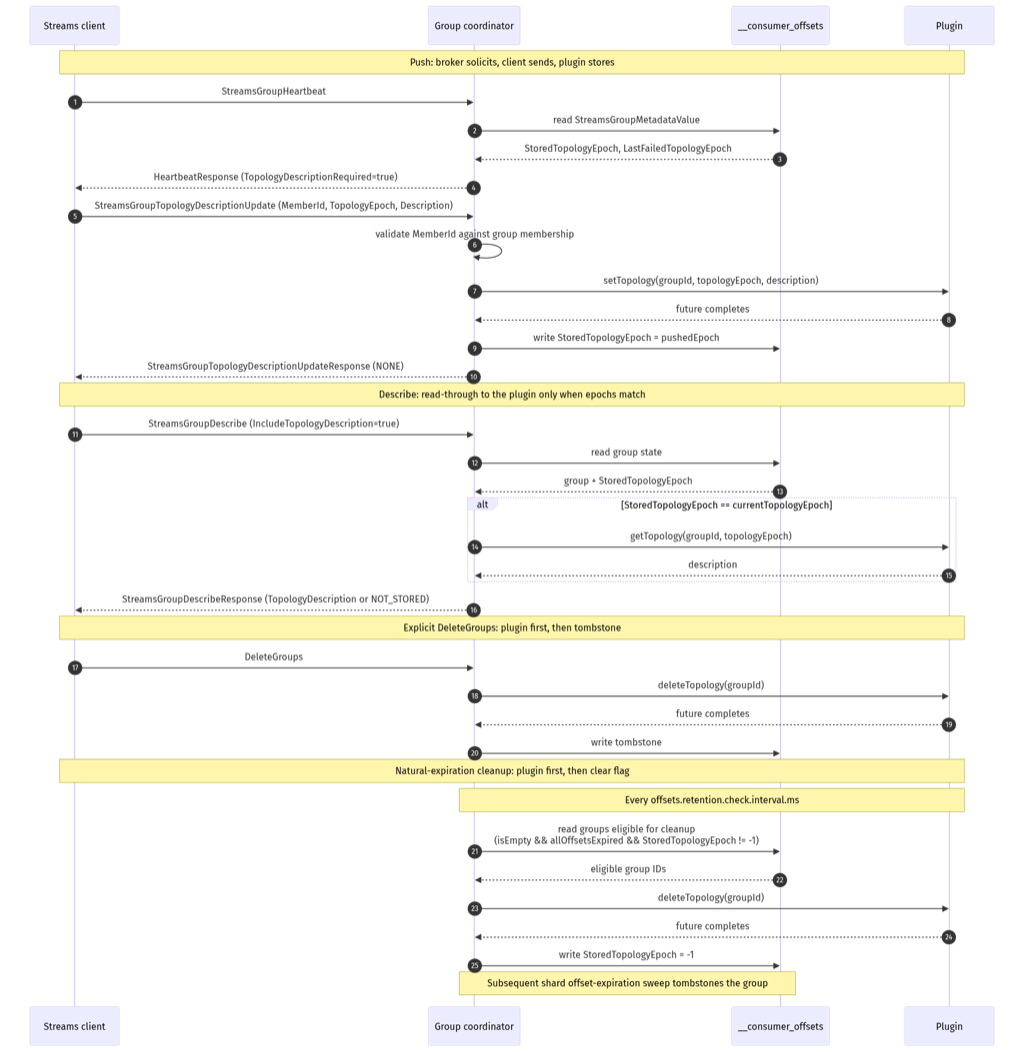
Broker Side
The plugin is instantiated at broker startup if
group.streams.topology.description.plugin.classis configured. A broker without a plugin returnsUNSUPPORTED_VERSIONforStreamsGroupTopologyDescriptionUpdateand never setsTopologyDescriptionRequired, so the RPC is only sent against a plugin-configured broker.After a successful
StreamsGroupHeartbeat, the broker decides whether to setTopologyDescriptionRequired=truepurely from the group's persisted state — no plugin RPC is involved. Members withSTALE_TOPOLOGYstatus are skipped. For all other members the broker sets the flag iffStoredTopologyEpoch != currentTopologyEpochANDLastFailedTopologyEpoch != currentTopologyEpochAND no per-group back-off is in its window. The back-off is in-memory state (keyed bygroupId, carryingtopologyEpoch+nextAttemptMs) that arms or extends every time the flag is set and additionally on a transientsetTopologyfailure; consecutive arms double the window from 30 s up to 1 h. It clears on a successful push, on a permanent failure (whereLastFailedTopologyEpochratchets), and implicitly on any topology-epoch advance. The same mechanism covers unresponsive plugins and clients that never push (for example, withtopology.description.push.enabled=false).On
StreamsGroupTopologyDescriptionUpdate, the broker checks theREADACL on the group and that a plugin is configured, then validates theMemberId: an emptyMemberIdis rejected withINVALID_REQUEST, a non-existing streams group withGROUP_ID_NOT_FOUND, and aMemberIdnot matching any current member withUNKNOWN_MEMBER_ID. The broker enforces no size limit; the plugin decides what it is willing to store. The broker then callssetTopologyon the plugin. On success it writes a metadata record settingStoredTopologyEpoch = pushedEpochand the response carriesNONE. OnStreamsTopologyDescriptionPermanentFailureExceptionit writesLastFailedTopologyEpoch = pushedEpochso subsequent heartbeats at the same epoch do not re-solicit. OnStreamsTopologyDescriptionTransientFailureExceptionor any other exception it writes no metadata record, arms the per-group back-off, and the next heartbeat re-solicits once the window elapses. In both failure cases the response carriesSTREAMS_TOPOLOGY_DESCRIPTION_UPDATE_FAILEDwith the plugin's exception message inErrorMessage; the permanent-vs-transient split is broker-internal state. If the plugin call succeeds but the metadata-record write fails, the next heartbeat sees the drift, re-solicits, and the idempotent re-push closes the gap.On
DeleteGroups, the broker callsdeleteTopologyon the plugin before writing the group tombstone, for each requested streams group withStoredTopologyEpoch != -1. On plugin success the group is tombstoned and the per-groupErrorCodeisNONE. On plugin failure the group is not tombstoned and the per-groupErrorCodeis set toGROUP_DELETION_FAILEDwith the plugin's exception message inErrorMessage(also logged at WARN); the operator retries the request once the plugin recovers, or unsets the plugin config to bypass it. Other groups in the same batch are unaffected — the failure is reported per group. This ordering matches the natural-expiration cleanup below, which also defers tombstoning untilplugin.deleteTopologysucceeds.- On
StreamsGroupDescribewithIncludeTopologyDescription=true, the broker callsgetTopologyon the plugin only whenStoredTopologyEpoch == currentTopologyEpochfor that group; otherwise it reportsNOT_STOREDwithout making a plugin call. Calls across groups run in parallel. Authorization is unchanged — the existingDESCRIBEACL on the GROUP resource covers the topology description.DescribedGroup.ErrorCodeis never modified by topology-related outcomes; theTopologyDescriptionStatusfield carries the reason whenTopologyDescriptionis null (NOT_REQUESTED,NOT_STORED, orERROR; the last is also logged at WARN). With no plugin configured the broker returnsNOT_STORED. AgetTopologycall returningnull(plugin-side data loss) surfaces asNOT_STOREDand is logged at WARN; subsequent describes keep returningNOT_STOREDuntil the topology epoch advances or an operator clears plugin state. - When a plugin is configured, the broker runs a periodic topology-description cleanup every
offsets.retention.check.interval.ms. Each fire fans out a read-only query across the broker's hosted__consumer_offsetspartitions to identify streams groups eligible for cleanup:isEmpty && allOffsetsExpired && StoredTopologyEpoch != -1. This is the same eligibility predicate the shard's offset-expiration sweep uses to delete consumer/share groups, with the additionalStoredTopologyEpoch != -1filter. For each eligible group, the broker callsplugin.deleteTopology(groupId)and, on success, writes a metadata record settingStoredTopologyEpoch = -1. Plugin failures leave the field set; the same group is retried on the next cycle. OnceStoredTopologyEpoch = -1, the shard's offset-expiration sweep tombstones the (now flag-cleared) group on a subsequent cycle. When no plugin is configured, the periodic cleanup does not run and the shard's offset-expiration sweep expires streams groups normally, ignoringStoredTopologyEpoch; operators that disable a previously-configured plugin are responsible for cleaning up plugin-side state out-of-band.
Client Side
- At startup, if
topology.description.push.enabled=true, the Streams client converts the topology returned byTopology#describe()to the wire format and stores it internally. The mapping is one-to-one with the RPC schema; predecessor edges are not sent on the wire and the read side reconstructs them by inverting each node's successor list. Whentopology.description.push.enabled=false, no description is stored and the feature is disabled on this client. - The Streams client records the
TopologyDescriptionRequiredflag from each heartbeat response. - On each consumer background-thread poll, the client sends
StreamsGroupTopologyDescriptionUpdateto the coordinator when a coordinator is known, the flag is set, a stored topology description is available, the client has a non-empty member ID assigned by the coordinator, and no prior request is in flight. The member ID populated on the request is the same one carried onStreamsGroupHeartbeat. The push runs on the consumer background thread and never blocks user-facing Kafka Streams APIs; the push is best-effort. Completion handling on the push response is keyed on the error code.
NOT_COORDINATORandCOORDINATOR_NOT_AVAILABLEtrigger coordinator rediscovery and leave the flag set.COORDINATOR_LOAD_IN_PROGRESSand network exceptions leave the flag set for retry on the next poll.UNKNOWN_MEMBER_IDmeans the member has been dropped from the group: the client clears the flag and relies on the existing membership-management path to trigger a clean rejoin on the next heartbeat. All other errors (STREAMS_TOPOLOGY_DESCRIPTION_UPDATE_FAILED,INVALID_REQUEST,UNSUPPORTED_VERSION,GROUP_ID_NOT_FOUND,GROUP_AUTHORIZATION_FAILED) clear the flag and log at WARN with the response'sErrorMessage; the client does not retry on its own, and a re-attempt happens only when the broker re-sets the flag via a subsequent heartbeat. A non-zeroThrottleTimeMson the response delays the next push attempt by that amount, as with other request managers.
Plugin Implementation Guidelines
A correct plugin implementation should:
- Treat
setTopology(on(groupId, topologyEpoch)) anddeleteTopology(on(groupId)) as idempotent; the broker may re-issue an identical call when an earlier call's bookkeeping write failed. - Be thread-safe under concurrent invocation:
setTopologymay be called by multiple members of the same group in the same heartbeat cycle, and the periodic-cleanup path may invokedeleteTopologywhile a member is mid-push. - Reject payloads the plugin will not accept by completing the
setTopologyfuture withStreamsTopologyDescriptionPermanentFailureException; the broker persists the rejection at the epoch level viaLastFailedTopologyEpochand stops re-soliciting at the same epoch. The exception message reaches the client inErrorMessage. - Signal transient storage-layer failures by completing the
setTopologyfuture withStreamsTopologyDescriptionTransientFailureException(or any other exception); the broker's per-group back-off (30 s → 1 h, exponential) throttles re-solicitation. - Return
nullfromgetTopologywhen the plugin has lost the description; the broker reportsNOT_STOREDon the describe response. Exceptions are reserved for transient backend failures and surface asERROR. - Avoid blocking coordinator threads (plugin methods may be invoked on them) and complete futures within seconds, not minutes; the broker applies no wall-clock deadline to plugin calls, so the coordinator's responsiveness is bounded by what the plugin does. Bound plugin-side state explicitly — the plugin shares the broker heap.
Security Considerations
The topology description contains user-defined processor names, state-store names, and topic names. This KIP does not treat these as inherently sensitive and does not introduce any client-side redaction. Operators who consider node, store, or topic names sensitive should scope DESCRIBE ACLs on the GROUP resource accordingly: the same ACL that guards StreamsGroupDescribe guards the TopologyDescription field on the response. The StreamsGroupTopologyDescriptionUpdate path is guarded by READ on the GROUP, identical to the existing heartbeat ACL.
Metrics
The following broker-side metrics are added under the existing group-coordinator-metrics group (JMX type kafka.server:type=group-coordinator-metrics). Each sensor produces both a rate and a cumulative count.
| MBean | Type | Description |
|---|---|---|
kafka.server:type=group-coordinator-metrics,name=streams-group-topology-description-set-success-{rate,count} | Meter | Successful plugin.setTopology calls. |
kafka.server:type=group-coordinator-metrics,name=streams-group-topology-description-set-error-{rate,count} | Meter | Failed |
kafka.server:type=group-coordinator-metrics,name=streams-group-topology-description-delete-success-{rate,count} | Meter | Successful plugin.deleteTopology calls (covers both the explicit DeleteGroups and periodic-cleanup paths). |
kafka.server:type=group-coordinator-metrics,name=streams-group-topology-description-delete-error-{rate,count} | Meter | Failed plugin.deleteTopology calls. |
kafka.server:type=group-coordinator-metrics,name=streams-group-topology-description-get-success-{rate,count} | Meter | Successful plugin.getTopology calls. |
kafka.server:type=group-coordinator-metrics,name=streams-group-topology-description-get-error-{rate,count} | Meter | Failed plugin.getTopology calls. |
kafka.server:type=group-coordinator-metrics,name=streams-group-topology-description-cleanup-cycle-{rate,count} | Meter | Periodic topology-description cleanup cycles that actually ran. |
kafka.server:type=group-coordinator-metrics,name=streams-group-topology-description-cleanup-eligible-{rate,count} | Meter | Streams group IDs identified as eligible for topology-description cleanup, summed across partitions. |
No client-side metrics are introduced.
Compatibility, Deprecation, and Migration Plan
This KIP bumps StreamsGroupHeartbeatResponse, StreamsGroupDescribeRequest, and StreamsGroupDescribeResponse to the next available version of each RPC and adds the new fields (TopologyDescriptionRequired, IncludeTopologyDescription, TopologyDescription, TopologyDescriptionStatus) at that version. Pre-upgrade clients negotiate an older version and never see the new fields, so all three changes are wire-compatible.
The new RPC uses a new API key and is only sent by clients that understand the feature.
Without a configured plugin, no flags are set and no topology descriptions are sent. There is no behavioral change for existing deployments.
DeleteGroupsRequest and DeleteGroupsResponse are bumped to version 3, which adds a per-group ErrorMessage field on the response and introduces the new GROUP_DELETION_FAILED error code. Older admin clients negotiate version 2 and never see the new field; they continue to receive only the per-group ErrorCode. DeleteGroups can newly fail on streams groups when a topology description plugin is configured and its deleteTopology call fails. Brokers without a configured plugin keep today's behaviour. Older clients that do receive GROUP_DELETION_FAILED (because they understand version 3 but predate this KIP's error-code addition) decode the code as UNKNOWN_SERVER_ERROR via the standard forward-compatibility fallback in Errors.forCode; the group is still not tombstoned, so an idempotent retry of DeleteGroups converges once the plugin recovers. No client-side change is requiredWithout a configured plugin, no flags are set and no topology descriptions are sent. There is no behavioral change for existing deployments.
Rolling Upgrades
During a rolling upgrade of brokers, some brokers may have the plugin configured and some may not. The TopologyDescriptionId The TopologyDescriptionRequired flag is only set by plugin-equipped coordinators; a client whose current coordinator lacks the plugin never sees the idflag. If the coordinator migrates mid-push to a plugin-less broker, the client receives UNSUPPORTED_VERSION, clears the pending id topologyDescriptionRequired flag, and does not retry. A new id is sent The flag is set again only when if a future heartbeat response from a plugin-equipped coordinator includes one TopologyDescriptionRequired=true.
During a rolling upgrade of the Streams application (topology epoch change), the broker mints a new TopologyDescriptionId and skips the plugin entirely heartbeat-path gating for STALE_TOPOLOGY members — the response flag is not set, regardless of the persisted StoredTopologyEpoch. Only members running the new topology reach the gating comparison. If every active member is stale during the rollout, the current-epoch topology remains uncaptured until at least one member heartbeats with the new epoch.
During this transition the assignment topology (advanced synchronously when a new-epoch member heartbeats) and the plugin and receive the new id. If every active member is stale during the rollout, the current topology remains uncaptured until at least one member heartbeats at the new epochdescription topology (advanced asynchronously via the plugin) can briefly disagree: StreamsGroupDescribe may report the new topologyEpoch while TopologyDescription is still null with status NOT_STORED until the first push for the new epoch succeeds. The two reconverge once any member at the new epoch pushes its description.
Future Work
Hash-based mismatch detection. A future enhancement could introduce a topology hash to detect clients running on different topology code at descriptions reporting the same topology epoch (e.g., a partial deployment), which the broker-minted id alone cannot catch.
Multi-version describe. The describe response surfaces only the topology under the group's current topologyEpoch. During a rolling topology upgrade, the previous epoch's description is still stored by the plugin but is no longer reachable via describe. A natural extension is a descriptions[] array on the response, tagged by epoch, allowing operators to view both the previous and the in-flight new topology while the rollout completes.
Node grouping. A nodeGroup field on TopologyNode for UI grouping, requiring an extension to the public TopologyDescription.Node interface in Kafka Streams — best addressed in a follow-up KIP.
Test Plan
Integration Tests
...
Broker
StreamsGroupTopologyDescriptionUpdateRequestTest(new) — push happy path;StreamsTopologyDescriptionPermanentFailureException(ratchetsLastFailedTopologyEpoch) andStreamsTopologyDescriptionTransientFailureException(arms back-off) both surface asSTREAMS_TOPOLOGY_DESCRIPTION_UPDATE_FAILEDwith the cause inErrorMessage; heartbeat-flag gating; member/group/MemberIdfencing; explicitDeleteGroupsplugin-success path (tombstone written) and plugin-failure path (GROUP_DELETION_FAILEDreturned withErrorMessage, group not tombstoned, retry converges after plugin recovery).StreamsGroupTopologyDescriptionUpdateNoPluginRequestTest(new) — broker without plugin: pushes rejected, flag never set, describe returnsNOT_STORED.AuthorizerIntegrationTest—READACL on the GROUP resource for the new RPC.
Streams client
TopologyDescriptionPluginIntegrationTest(new) — end-to-end push against an in-memory plugin; describe status mapping;topology.description.push.enabled=falseopt-out.
CLI
TopologyDescriptionFormatterTest(new) — eachTopologyDescriptionStatus, the pretty-print format, and the exit-code mapping.StreamsGroupCommandTest— the--topologysub-action against a populated group.
System Tests
New ducktape suite streams_topology_description_plugin_test.py driving the Java harness TopologyDescriptionPluginSystemTest:
StreamsTopologyDescriptionPluginTest— CLI describe of a running Kafka Streams app; client opt-out; periodic-cleanup-after-retention. The last scenario lives here because realisticoffsets.retention.minutesis minutes-to-hours; overriding it low enough at the integration layer would affect unrelated tests on the shared embedded cluster.StreamsTopologyDescriptionPluginNoPluginTest— broker without plugin reportsNOT_STOREDand never asks the client to push
- A Streams client pushes its topology description after the broker requests it, and the configured plugin receives the description.
- A broker without a topology description plugin never asks the client to push and rejects pushes outright.
- Authorization is enforced on the new RPC.
- Topology descriptions exceeding the configured size limit are rejected; descriptions at the limit are accepted.
- Permanent plugin-side validation failures stop the client from retrying; transient failures and throttling delay subsequent attempts.
- Requesting a topology description via describe returns it for groups that have pushed, and surfaces the appropriate non-available status (no description stored, or read error) otherwise — without turning the describe itself into an error.
- The CLI prints the topology when it is available and reports a clear, distinct message for each non-available outcome, with exit code 0 only when the topology is actually returned.
System Tests
- A running Kafka Streams application pushes its topology and an operator can retrieve and pretty-print it via the CLI end-to-end.
- Disabling the feature on the client stops it from sending topology descriptions altogether.
- During a rolling upgrade the feature degrades gracefully on either side: pre-upgrade clients are not asked to push, and pre-upgrade brokers cleanly reject pushes from upgraded clients.
Rejected Alternatives
Embedding the topology description in the heartbeat
...
KIP-714 supports compression (ZStd, LZ4, GZip, Snappy) for telemetry payloads because metrics are pushed repeatedly at high frequency. Topology descriptions are pushed infrequently (only on topology epoch changes) and are the wire payload is expected to fit comfortably under the 350 KB default limit even for complex for typical applications. The Kafka protocol's flexible versions already provide efficient serialization. Adding compression would add complexity without meaningful benefit for this use case.
Appendix: Example RPC payload
For illustration, consider a Kafka Streams application that reads from orders, filters out null values, and writes the remaining records to valid-orders:
...
Topologies:
   Sub-topology: 0
    Source: KSTREAM-SOURCE-0000000000 (topics: [orders])
      --> KSTREAM-FILTER-0000000001
    Processor: KSTREAM-FILTER-0000000001 (stores: [])
      --> KSTREAM-SINK-0000000002
      <-- KSTREAM-SOURCE-0000000000
    Sink: KSTREAM-SINK-0000000002 (topic: valid-orders)
      <-- KSTREAM-FILTER-0000000001
The corresponding UpdateStreamsGroupTopologyDescription StreamsGroupTopologyDescriptionUpdate request body, with the topology converted to the wire format, looks like this:
{
  "GroupId": "orders-app",
   "TopologyDescriptionIdTopologyEpoch": "8d7e3c2a-4f6b-4d9a-9c1b-7e5f3a8d2c4e"0,
   "TopologyDescription": {
    "Subtopologies": [
      {
        "SubtopologyId": "0",
        "Nodes": [
          {
            "Name": "KSTREAM-SOURCE-0000000000",
            "NodeType": 1,
            "SourceTopics": ["orders"],
            "SinkTopic": null,
            "Stores": [],
            "Successors": ["KSTREAM-FILTER-0000000001"]
          },
          {
            "Name": "KSTREAM-FILTER-0000000001",
            "NodeType": 2,
            "SourceTopics": [],
            "SinkTopic": null,
            "Stores": [],
            "Successors": ["KSTREAM-SINK-0000000002"]
          },
          {
            "Name": "KSTREAM-SINK-0000000002",
            "NodeType": 3,
            "SourceTopics": [],
            "SinkTopic": "valid-orders",
            "Stores": [],
            "Successors": []
          }
        ]
      }
    ],
    "GlobalStores": []
  }
}
...