DUE TO SPAM, SIGN-UP IS DISABLED. Goto Selfserve wiki signup and request an account.

DUE TO SPAM, SIGN-UP IS DISABLED. Goto Selfserve wiki signup and request an account.
Bug Reference: CLOUDSTACK-763
Currently only ACL allow rules are supported as part of Network ACLs. Default is to block all incoming and all outgoing traffic between tiers and between tiers and various gateways (including Public). ACL deny rules will be supported through this feature. New fields "number" and "action"will be added to rules to resolve conflicting rules.
NetworkACLContainer will be introduced to manage NetworkACLs.
NetworkACLContainer is a numbered list of NetworkACLs that are evaluated in order, starting with the lowest numbered rule, to determine whether traffic is allowed in or out of any tier associated with the network ACL container.
Instead of adding NetworkACLs directly to the tier, NetworkACLs will be added to the NetworkACLContainer. Tier will be associated with a NetworkACLContainer at all times (default NetworkACLContainer will be used when no ACL container is associated. Default behavior will be deny all).
NetworkACLContainer can be assigned to multiple vpc tiers. Each tier can be associated with only one NetworkACLContainer.
Add/Remove networkACL to container
NetworkACLs can be added or removed from the container using APIs createNetworkACL and removeNetworkACL APIs.
Creating Tier with default acl container and assigning a custom acl container later
Create Tier with custom acl container in 1 step
createNetworkAcl
Adds a networkACL to the specified container.
New parameters
container_id is required while creating network ACLs. network_id parameter is not required when container_id is specified.
createNetwork
In VPC case, createNetwork is used to create a tier within VPC. Tier can be associated with a container during creation. If container_id is not specified default container will be used.
New parameters
updateNetworkACL
Updates an existing NetworkACL
Parameters:
createNetworkAclContainer
Created network ACL container
Parameters:
Response:
deleteNetworkAclContainer
Deletes network ACL conatiner. If the container is assigned to any network, deletion will fail.
Parameters:
Response:
listNetworkAclContainers
Containers can be listed by id or tier
Parameters:
Response:
replaceNetworkACLContainer
Assigns specified container to a tier (network)
Parameters:
Response:
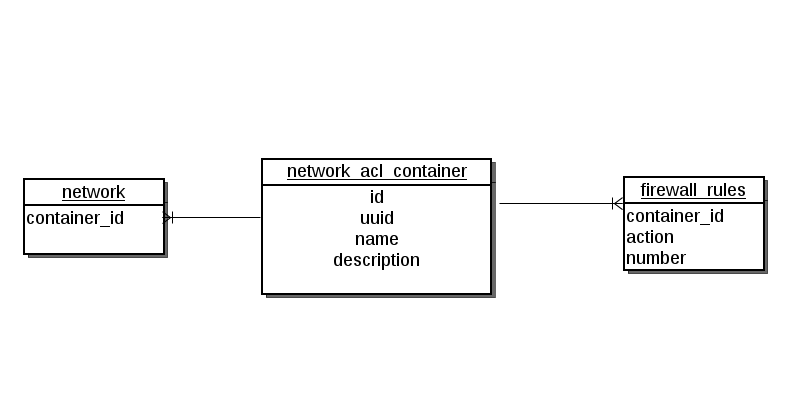
1. network_acl_container
1. firewall_rules
action, number, container_id are mandatory for rule with purpose NetworkACL.
2. networks
vpc_acl.sh will be modified to support ACL deny rules. iptables rules will ACCEPT or DROP based on the ACL action. iptables rules will added in the order of the number starting from the lowest.
UI changes are required to:
For each tier, a new network acl container is created during the upgrade, All ACLs that were assigned to this tier, will be part of the newly created network acl container. If there are no ACLs for any tier, it'll be associated with the default container.
All existing rules in firewall_rules table of type NetworkACL will have action "allow". Rule number will be sequentially assigned for all rules in each tier.