<div class="content"> |
This page describes the architecture of the junit4osgi framework. This does not include the maven-junit4osgi-plugin.
|
|
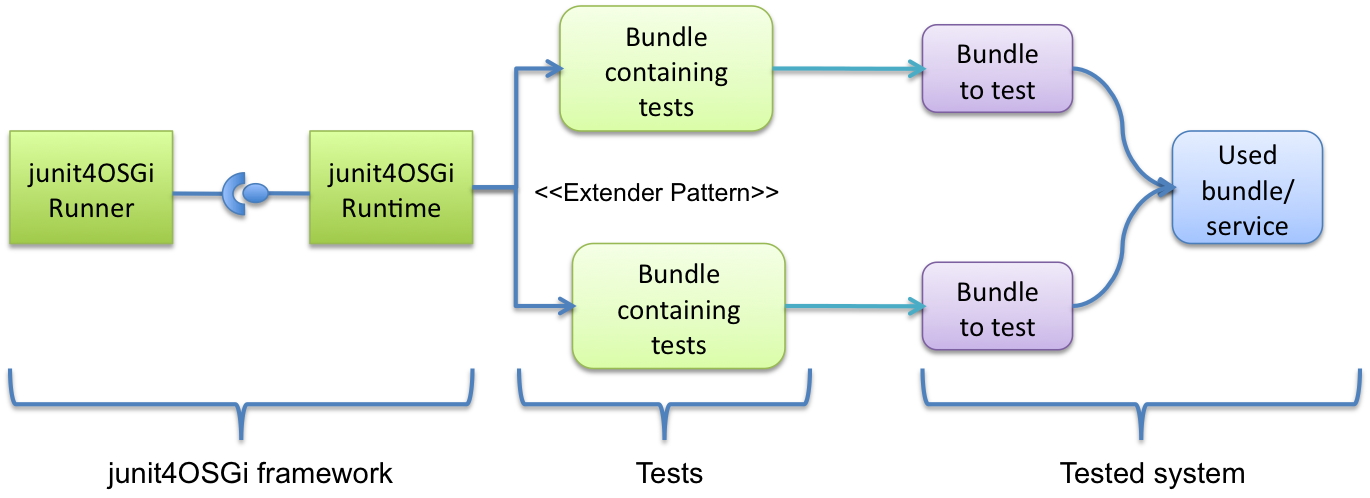
A system tested with junit4OSGi is divide in three parts:
true application.junit4OSGi does not impacts anything on the system under test. Test bundles interact with the system under test via services/events ... Bundle containing tests declared contained test suites in there manifest such as:
Test-Suite: org.apache.felix.ipojo.test.scenarios.ps.ProvidedServiceTestSuite, org.apache.felix.ipojo.scenarios.ps.StrategyTestSuite |
Thanks to this manifest header, the junit4OSGi runtime bundle collects tests. This bundle is the core of the test framework, and manage both collection and execution of tests. The runner bundle just launch tests. According to the runner implementation, test selection can also be done. Several runner have been developped:
junit Felix command: executing test from the Felix shell (only for Felix)The junit4OSGi framework use junit 3 because it was design and developed to test embedded systems. So, the junit4OSGi framework runs on a J2ME Foundation Profile 1.1 virtual machine (such as Mika). However, soon, junit4OSGi will evolve to support Junit4 and TestNG.