Cambricon® is a company developing machine learning processors which are used in cloud servers, smart devices, etc. Products that we have released include IP cores (e.g., Cambricon-1A, Cambricon-1H and Cambricon-1M) for smart devices and AI accelerating card for servers (e.g., MLU100).
The Cambricon software stack is shown in Figure 1. As shown, CNRTTM (Cambricon NeuwareTM Runtime Library) is a runtime library; CNMLTM (Cambricon Neuware Machine Learning Library) is a high-performance computing library for machine learning which depends on CNRT.
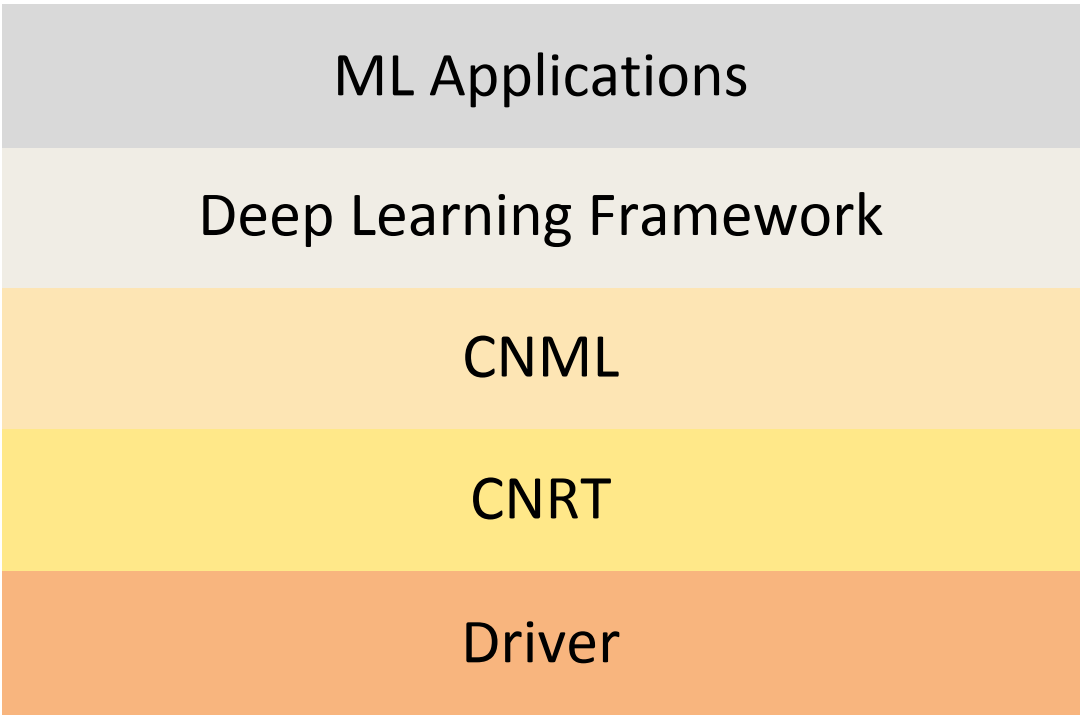 Fig 1. The Cambricon Software Stack
After integrating with CNML/CNRT, developers can work with MXNet on Cambricon MLUs.
This proposal firstly introduces CNML and CNRT, and then the design of integrating CNML/CNRT into MXNet. We discuss future works at the end.
Notes:
The Cambricon software stack is suitable for both IP core and AI accelerating card. This proposal uses “MLU (machine learning unit)” to represent both IP core and AI accelerating card.
Unless otherwise specified, an “operator” denotes a CNML operator, an "MLU operator" denotes an MXNet operator whose device type is ”mlu”. Moreover, “imperative mode” and “symbolic mode” denote the two programming styles in CNML, and “imperative programming” and ”symbolic programming” denote the two programming styles in MXNet.
MLUs have an instruction set designed specifically for deep learning algorithms. Computational tasks are compiled by the CPU into Cambricon instructions which are stored in the host memory. The process of executing a computational task has three phases: a) the MLU reads the instructions and the data associated with this computational task from the host memory; b) the MLU executes instructions to process data; c) the MLU writes results back to the host memory. To improve the performance and reduce the memory usage, CNML uses JIT (Just In Time) compilation to compile operators before they are executed. The paradigm of programming with CNML is as below:
The attributes (including data types) of tensors on MLU may be different from that on CPU. CNML provides cnmlCpuTensor and cnmlTensor as the descriptors of tensors on CPU and MLU respectively. Some tensors are read-only, and some tensors can be updated during the computation. CNML uses enumerated values CNML_TENSOR, CNML_FILTER and CNML_CONST - of type cnmlTensorType_t - to label read/write characteristics of tensors. There are a lot of CNML_FILTER and CNML_CONST tensors in neural network inference. CNML provides an interface to bind cnmlCpuTensors and data addresses to their cnmlTensors when an operator is created. The data of the CNML_FILTER and CNML_CONST tensors will be preprocessed during the compilation of the operator instance.
The basic operator of CNML is represented by the structure BaseOp. Developers can use cnmlCompileBaseOp() to compile a BaseOp. In general, a neural network is composed of many BaseOps. Compared with compiling these BaseOps one by one, compiling these BaseOps as a computation subgraph - which we call fusion compilation - may achieve better performance. As a whole, CNML uses a FusionOp structure to represent those BaseOps included in the computation subgraph. Meanwhile, CNML provides cnmlFuseOp() to add multiple BaseOps to a FusionOp one by one. Finally, the FusionOp is compiled by cnmlCompileFusionOp().
One important method of BaseOp and FusionOp is Forward(). When Forward() is executed, instructions and data are copied from host memory to MLU memory, then the MLU reads them and executes the instructions.
Forward() is executed asynchronously for better performance. Specifically, after the host process invokes the Forward() method, it can proceed with other tasks without waiting for the computation task on the MLU to finish. The asynchronous execution mechanism of the Forward() method is implemented through the cnrtQueue. The task types in the cnrtQueue include computation, synchronization and so on. Before the cnrtQueue is used, a cnrtQueue instance must be created. Every time the Forward() method of a BaseOp or FusionOp is invoked, a computation task is generated and then pushed into the cnrtQueue instance. Every time the cnrtSyncQueue() interface is invoked, a synchronization task is generated and then pushed into the cnrtQueue instance. When a host process invokes the cnrtSyncQueue() interface, the corresponding host process will be blocked until the synchronization task in the cnrtQueue instance is finished. The cnrtQueue has the following characteristics:
This section briefly introduces inference APIs from CNML and CNRT. More details are described in the attached document: Introduction to CNML&CNRT APIs(Introduction to CNML&CNRT APIs.pdf).
Tensor Descriptor | Create a tensor descriptor |
|
Destroy a tensor descriptor |
| |
Data bind for CNML_FILTER and CNML_CONST tensor |
| |
Handle MLU memory for CNML_TENSOR tensor after operator compilation |
| |
Operator | Normal operation about BaseOp |
|
Normal operation about FusionOp |
| |
cnrtQueue | Create and Destroy a cnrtQueue |
|
Send a sync task into a cnrtQueue instance |
|
With CNML, MXNet runs a neural network model in one of two modes - the imperative mode or symbolic mode. This section illustrates how to work with CNML in a neural network which consists of a series of CNML operators.
In the imperative mode, BaseOps in the neural network are compiled by cnmlCompileBaseOp(). The Forward() method of each BaseOp is invoked in a topological order. The imperative mode can satisfy the need of imperative execution and facilitate development and debugging.
In the symbolic mode, BaseOps are put into one FusionOp by cnmlFuseOp(). The FusionOp is then compiled by cnmlCompileFusionOp(). Forward() of the FushionOp is executed for inference. When MXNet performs neural network inference for the same network, the symbolic mode can improve the utilization of the MLU hardware resources and achieve better performance than the imperative mode.
In the second step above, each CNML operator is executed once it has been compiled. Actually, we can also adopt other ways that satisfy the principle: compile an operator before execute it. For example, compile all the operators in a neural network first, then execute them in a topological order.
In this section, we construct a simple neural network which consists of "convolution + activation". Base on this demo network, we give pseudocodes for performing network inference in two modes respectively.
/* Create all operator instances in the neural network. * The conv_in_data, conv_filter_data, conv_bias_data and act_out_data are host memory pointers. */ cnmlCreateCpuTensor(&conv_in_cpu_tensor, CNML_TENSOR, ...) /* The conv_filter_cpu_tensor(CNML_FILTER), conv_bias_cpu_tensor(CNML_CONST) * and act_out_cpu_tensor(CNML_TENSOR) are also created. */ cnmlCreateTensor(&conv_in_tensor, CNML_TENSOR, ...) /* The conv_filter_tensor(CNML_FILTER), conv_bias_tensor(CNML_CONST), * conv_out_tensor(CNML_TENSOR) and act_out_tensor(CNML_TENSOR) are also created. */ cnmlBindConstData (conv_filter_tensor, conv_filter_cpu_tensor, conv_filter_data) cnmlBindConstData (conv_bias_tensor, conv_bias_cpu_tensor, conv_bias_data) cnmlCreateConvParam(&convParam, stride, dilation, ...) cnmlCreateConvOp(&conv_op, convParam, ...) cnmlActiveFunction_t actFuncParam = CNML_ACTIVE_SIGMOID cnmlCreateActiveOp(&act_op, actFuncParam, ...) cnrtCreateQueue(&queue) /* Compile and execute all the operators in the neural network. */ cnmlCompileBaseOp(conv_op, ...) /* The conv_in, conv_out are MLU memory pointers. */ cnmlMemcpyTensorToDevice(conv_in_cpu_tensor, conv_in_data, conv_in_tensor, conv_in) cnrtInvokeFuncParam_t invoke1(affinity, ...) cnmlComputeConvOpForward(conv_op, conv_in, conv_out, &invoke1, queue, ...) cnrtSyncQueue(queue) cnmlCompileBaseOp(act_op, ...) cnrtInvokeFuncParam_t invoke2(affinity, ...) /* The act_out is MLU memory pointer. */ cnmlComputeActiveOpForward(act_op, conv_out, act_out, &invoke2, queue, ...) cnrtSyncQueue(queue) /* Finish the computation and release computing resources. */ cnmlMemcpyTensorToHost(act_out_tensor, act_out, act_out_cpu_tensor, act_out_data) free data and resource ... |
/* Create operator instances of the neural network, and add them into the same FusionOp. * The conv_in_data, conv_filter_data, conv_conv_data and act_out_data are host memory pointers. */ cnmlCreateCpuTensor(&conv_in_cpu_tensor, CNML_TENSOR, ...) /* The conv_filter_cpu_tensor(CNML_FILTER), conv_bias_cpu_tensor(CNML_CONST) * and act_out_cpu_tensor(CNML_TENSOR) are also created. */ cnmlCreateTensor(&conv_in_tensor, CNML_TENSOR, ...) /* The conv_filter_tensor(CNML_FILTER), conv_bias_tensor(CNML_CONST), * conv_out_tensor(CNML_TENSOR) and act_out_tensor(CNML_TENSOR) are also created. */ cnmlBindConstData (conv_filter_tensor, conv_filter_cpu_tensor, conv_filter_data) cnmlBindConstData (conv_bias_tensor, conv_bias_cpu_tensor, conv_bias_data) cnmlCreateConvParam(&convParam, stride, dilation, ...) cnmlCreateConvOp(&conv_op, convParam, ...) cnmlActiveFunction_t actFuncParam = CNML_ACTIVE_SIGMOID cnmlCreateActiveOp(&act_op, actFuncParam, ...) cnmlCreateFusionOp(&fusion_op) cnmlFuseOp(conv_op, fusion_op) cnmlFuseOp(act_op, fusion_op) cnmlSetFusionIO(fusion_op, ...) cnrtCreateQueue(&queue) /* Compile and execute the fusion_op in the neural network. */ cnmlCompileFusionOp(fusion_op) /* The conv_in and act_out are MLU memory pointers. */ cnmlMemcpyTensorToDevice(conv_in_cpu_tensor, conv_in_data, conv_in_tensor, conv_in) cnrtInvokeFuncParam_t invoke(affinity, ...) cnmlComputeFusionOpForward(fusion_op, &conv_in, 1, &act_out, 1, &invoke, queue, ...) cnrtSyncQueue(queue) /* Finish the inferences and release computing resources. */ cnmlMemcpyTensorToHost(act_out_tensor, act_out, act_out_cpu_tensor, act_out_data) free data and resource ... |
One design principle of integrating CNML/CNRT to MXNet is to make the latter use MLU operators to run neural networks efficiently with symbolic programming.
For an existing MXNet operator, we use one or more CNML operators to compose an MLU operator whose function is same as that of the MXNet operator. A user can set the device type of the MXNet operators to “mlu” so that they run on the MLU.
We need to integrate creation, compilation and execution of the MLU operator into MXNet existing symbolic programming inference process.
The steps that users use MXNet Python symbolic programming APIs to run inference are as follows:
We don’t want to change the above work flow while integrating CNML/CNRT to MXNet so we propose to integrate creation, compile and execution of the MLU operator as follows:
We have some slight modification in the Operator and Executor Modules. We also updated some data structures - like NDArray, TBlob and mShadow Tensor - so that they can handle memory in MLU. Lastly, we also need to add a new attribute value “mlu” to the attribute of device type in the python::context module in MXNet. Overview of the MXNet modules which need to be modified in the integration design is shown below.
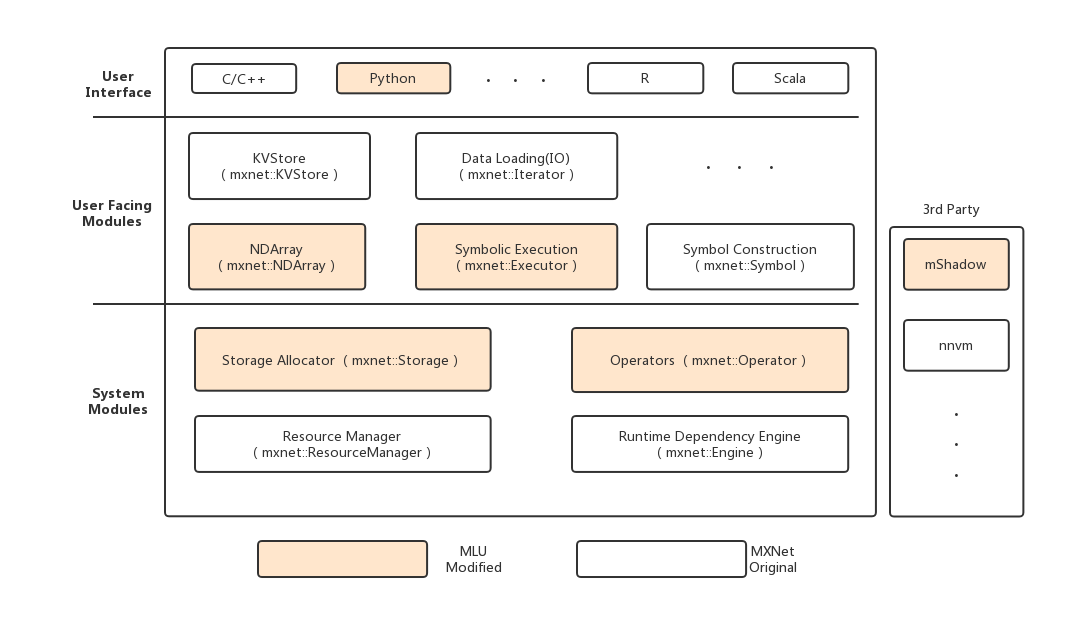 Fig 2. Overview of MLU modified modules
Next, we will introduce the details in the integration design. For the convenience of your understanding, we will introduce the CNML/CNRT integration for the imperative mode first, and then the symbolic mode.
A new value “mlu” will be introduced to the attribute of the device type in the context module in MXNet, so that users can set the device type of nodes in the network to “mlu”.
An operator executor contains data, status flags and methods which are necessary in MXNet operator execution. MLU operator compilation and execution need some data results which are created during MLU operator creation. So we add a new abstract class MluOpExecutor which inherits the class OpExecutor for the purpose of adapting the OpExecutor for creation, compilation and execution of the MLU operator and avoiding influence on the original execution flow of the OpExecutor. There are two new fields called internal_ops and inter_data in the class MluOpExecutor. The internal_ops is used for saving the BaseOps which constitute an MLU operator, and the inter_data is used for saving the intermediate results which are produced by the BaseOps in the internal_ops. In addition, the class MluOpExecutor adds a new virtual method Init() to adapt the creation of the MLU operator. Furthermore, we also add two new classes, namely, class MluFComputeExecutor and class MluStatefulComputeExecutor, which inherit the abstract class MluOpExecutor. Before introducing the two new MLU operator executors, we will introduce the implementation of the MLU operator firstly.
An MXNet operator is now registered in two ways: a stateless MXNet operator is registered with NNVM and a stateful MXNet operator is defined in the legacy way.
For an existing stateless MXNet operator, our implementation of the corresponding MLU operator is as follows:
For an existing stateful MXNet operator, our implementation of the corresponding MLU operator is similar to that of a stateless MLU operator. The main difference between these two implementations is as follows. Since the stateful MXNet operator is a class object, we can add two new fields called internal_ops and inter_data to the class of the stateful MXNet operator. In this case, the Init() method of the stateful MLU operator can save the BaseOps into the internal_ops of the MLU operator and the data structures of intermediate results into inter_data of the MLU operator. The Forward() method of the MLU operator can use the two fields directly instead of getting them from its operator executor. However, since the MluStatefulComputeExecutor needs the results in internal_ops in the MLU operator compilation, the internal_ops acting as a returned value of the Init() method of the MLU operator is assigned to the internal_ops of the MluStatefulComputeExecutor.
After introducing the implementation of the stateless and stateful MLU operators, we will introduce the extension of the OpExecutor for the MLU operator. At present, the two kinds of MLU operators both implement the Forward() methods which can only handle the data structure of type TBlob, so we add two new operator executors, namely, the MluFComputeExecutor and the MluStatefulComputeExecutor, for the two kinds of MLU operators, respectively.
The MluFComputeExecutor is the operator executor for the present type of Forward() method of the stateless MLU operator. For the creation, compilation and execution of the stateless MLU operator, the implementation of the MluFComputeExecutor is as follows:
The MluStatefulComputeExecutor is the operator executor for the present type of Forward() method of the stateful MLU operator, its implementation is similar to that of the MluFComputeExecutor. The main difference between these two implementations is caused by the fact that the stateless and stateful MLU operators save the internal_ops and inter_data in different positions. After the Init() method of the MluStatefulComputeExecutor invokes the Init() method of the MLU operator, it only updates the internal_ops of the MluStatefulComputeExecutor for the MLU operator compilation. What’s more, when the Forward() method of the MLU operator is invoked, it is not necessary to receive the internal_ops and inter_data from the Run() method of the MluStatefulComputeExecutor.
In the introduction to the implementation of the MLU operator, we mention that the cnrtQueue will be integrated into the mShadow Stream. Next, we will introduce the design of the cnrtQueue integration.
We specialize the template of the mShadow Stream for MLU and implement the class mShadow Stream<mlu>. The mShadow Stream<mlu> has a new field queue_ which is a pointer to a cnrtQueue instance, and provides a Wait() method which can push a synchronous task into the cnrtQueue instance pointed by the queue_. In addition, we implement interfaces, such as SetDevice(), NewStream(), DeleteStream and so on, for the mShadow Stream<mlu>.
In the aspect of use of the mShadow Stream<mlu>, the NaiveEngine creates and destroys the Stream<mlu> by the NewStream() interface and the DeleteStream() interface, and puts it into the RunContext for the MLU operator.
The SimpleBind()/Bind() method of the MXNet front-end Symbol creates and initializes a GraphExecutor instance. The Forward() method of the front-end Executor invokes the Forward() method of the GraphExecutor to perform network inference. In the backend, the OpExecutor instances are created and initialized in the Init() method of the GraphExecutor. In addition, in the Forward() method of the GraphExecutor, the Run() method of the OpExecutor acting as an execution task is pushed into the MXNet Engine. Thus, the GraphExecutor plays an important role in the compatibility between the front-end and the backend. We adapt the Init() and Forward() methods of the GraphExecutor for the MluOpExecutor.
The main process of the Init() method of the GraphExecutor is as follows:
Analyze the process above, creating the operator executor for the MLU operator should be better to be performed in the interface AttachOpExecs(). When the interface AttachOpExecs() is creating an operator executor instance, if the dispatch mode of the operator node is not “kFComputeEx” and the device type of the operator node is “mlu”, the AttachOpExecs() interface will create the suitable operator executor instance for the MLU operator. Moreover, the MLU operator creation doesn’t need the actual data of the inputs, but needs the shape and data type of the inputs/outputs. So after the InitCachedOps() method of the GraphExecutor updates the in_array and out_array of the OpExecutors in the op_execs, it invokes the Init() method of each OpExecutor in the op_execs to complete the MLU operator creation in the computation graph.
The flow of the Forward() method of the GraphExecutor doesn’t need to be changed. The Forward() method of the GraphExecutor pushes the cached_opr of each OpNode in the computation graph into the MXNet Engine in topological turn to complete the MLU operator compilation and execution.
We need to adapt the MXNet data structures including NDArray, TBlob and mShadow Tensor, so that the MXNet can handle the memory in the MLU via these MXNet data structures.
For the purpose of showing the data information in the MLU, we add some new fields to the NDArray, TBlob and mShadow Tensor as follows:
Class NDArray {
  public:
    ......
  private:
    Struct Chunk {
      cnmlTensor_t cnml_tensor; // new field, a pointer to the cnmlTensor.
      void* mptr; // new field, a pointer to the MLU memory address of the NDArray data.
      ......
    };
    ......
}; |
Class TBlob {
  public:
    // new field, a pointer to the pointer to cnmlTensor.
    cnmlTensor_t* cnml_tensor_;
    // new field, a pointer to the cnmlTensorType_t.
    std::shared_ptr<cnmlTensorType_t> cnml_tensor_type_;
    // new field, a pointer to the pointer to the MLU memory address of the TBlob data.
    void** mptr;
    ......
  private:
    ......
}; |
template<typename Device, int dimension, typename DType ......>
Struct Tensor : public TRValue < Tensor<Device,dimension,DType>, ......> {
  public:
    // new field, a pointer to the pointer to cnmlTensor.
    cnmlTensor_t* cnml_tensor_;
    // new field, a pointer to the cnmlTensorType_t.
    std::shared_ptr<cnmlTensorType_t> cnml_tensor_type_;
    // new field, a pointer to the pointer to the MLU memory address of the Tensor data.
    void** mptr;
    ......
}; |
Besides the new fields above, we also add some new interfaces based on the mShadow Tensor with device type “mlu” to the mShadow module, such as InitCnmlTensor(), GetMptr(), AllocSpace(), FreeSpace(), Copy() and so on. The mShadow Tensor uses these interfaces for handling its MLU memory and cross-device copying its data between the host and the MLU. Meanwhile, NDArray implements its cross-device copy between the host and the MLU via these new interfaces in mShadow module.
In the present design of CNML, we cannot allocate the MLU memory for the tensors related to the MLU operator until the MLU operator is compiled. However, the MLU operator compilation is performed during the execution of the Forward() method of the GraphExecutor. So the input data related to the MLU operator need to be saved temporarily in the host buffer before the MLU operator is compiled. We use the storage::NaiveStorageManager<storage::CPUDeviceStorage> for managing the host buffer of the NDArray whose device type is “mlu”.
In order to initialize/exit CNML during the period of the MXNet initialization/exit, some work needed is as follows:
When we use the MXNet to perform neural network inference, it is possible that device type of most of the nodes in the network is “mlu” and device type of the rest is host device type. In this case, if we want to perform network inference in symbolic mode, we cannot put all the MXNet operators into a FusionOp. Hence we need to divide the MLU operators of an initialized computation graph into several fusion segments before the fusion compilation. Each fusion segment is a computation subgraph consisting of the MLU operators which can be put into the same FusionOp.
In order to solve the problem above, we add a new class MluFuseGraphExecutor which inherits the class GraphExecutor. The MluFuseGraphExecutor acts as the computation graph executor of the network in the symbolic mode. Without compiling and executing each MLU operator in a fusion segment, the MluFuseGraphExecutor compiles and executes the FusionOp for each fusion segment instead. Thus all the integration work in the imperative mode is necessary for the symbolic mode except the work about MLU operator compilation and execution in the imperative mode .
In symbolic mode, the SimpleBind()/Bind() method of the front-end Symbol invokes the MluFuseSimpleBind()/MluFuseBind() method of the MluFuseGraphExecutor instead of the SimpleBind()/Bind() method of the GraphExecutor. The MluFuseSimpleBind()/MluFuseBind() initializes the MluFuseGraphExecutor via its own Init() method. During the MluFuseGraphExecutor initialization, the following work needs to be done. Firstly, the Init() method of the parent class GraphExecutor is invoked to complete the computation graph initialization, MLU operator and operator executor creation and so on. Then, check the initialized computation graph and generate the possible fusion segments. Lastly, if necessary, the Init() method of the MluFuseGraphExecutor will create the FusionOp for each fusion segment and set I/O for the FusionOp. In the process of MluFuseGraphExecutor initialization, generating fusion segments from a computation graph is an important work. Before we introduce the algorithm for this work, we introduce two important concepts about the fusion segment, namely, the input operator and output operator of a fusion segment.
After introducing the two concepts, we will introduce the present algorithm for generating fusion segments from a graph as follows:
A front-end Executor object of the graph is got by invoking the SimpleBind()/Bind() method of the front-end Symbol. The Forward() method of the front-end Executor performs the network inference by invoking the MluRunOps() method of the MluFuseGraphExecutor. During the execution of the MluRunOps() method, the method compiles every possible fusion segment in the graph, and then completes the network inference by processing every node of the initialized graph in topological turn as follows:
After implementing the design of CNML/CNRT integration, the MXNet can perform neural network inference on the MLU in the imperative mode and the symbolic mode. In this pull request, the MXNet integrating with CNML/CNRT only supports the symbolic programming and the MXNet Naive Engine in the network inference on the MLU.