To be Reviewed By:Dec 20,2019
Authors: Xiaojian Zhou
Status: Draft | Discussion | Development | Active | Dropped | Superseded
Superseded by: N/A
Related: N/A
To support clear() operation on Partitioned Region (PR - partitioned region will be referred as PR in parts of this doc).
Clear() operation: Removes all entries from this region. Clear will be distributed to other caches if the scope is not Scope.LOCAL (from Region.clear java doc)
Currently non-partitioned regions support clear() operation, supporting this capability on PR enables consistent API support and user experience across the cache regions.
The clear() operation will be supported from client-server and peer-to-peer topology.
Considerations/Challenges in supporting partitioned region clear():
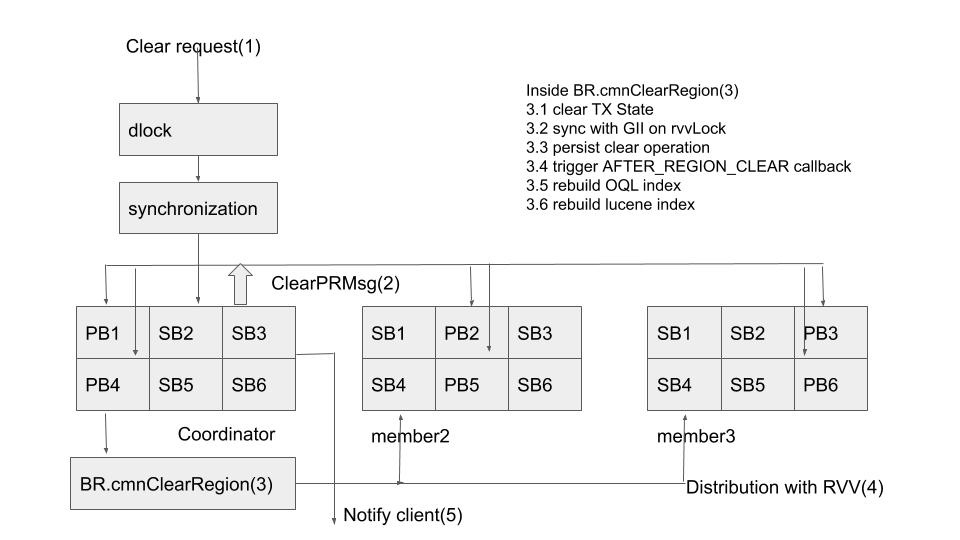
When clear() is executed from client or peer member, one of the members is selected as clear message co-ordinator (likely where the command is originated/received). The co-ordinator member propagates the clear message to all the members hosting that region. And the co-ordinator member will become responsible for handling success or failure condition while processing local or distributed clear message.
At a high level the steps involved in initiating and completing clear operation:
After Successful clear() operation on the PR:
Scenarios/options considered in supporting clear operation:
At communication level:
1) Co-ordinator member sends a single PR clear message to each member hosting the region (data store)
2) Co-ordinator member sending PR clear message for each primary bucket (similar to region.removeAll() operation)
At data store level:
3) Renaming of the PR - rename the PR to a temp PR and perform data removal in the background thread (if needed).
4) Recreate the PRs low level map - clear/remove data from the old map in back ground thread (if needed).
Considering the pros and cons (explained below) of each options, the option-1 and option-2 was picked as probable choices and finally option-2 was chosen as a viable option.
In this case the co-ordinator member will send a single clear region message to all other members hosting the region; the receiving member will process this message serially or in-parallel using thread/executor pool. The co-ordinator member gets the primary bucket info, sends the clear messages to remote member with primary bucket list. The co-ordinator member has to obtain and manage the primary bucket list, in order to address any bucket region movement during the clear (due to destroy or rebalance) and retry the clear operation. This is similar to how the query engine executes queries on remote bucket region;
Pros:
Less number of messages communicated between the members (compared to option-2).
Cons/issues:
Processing clear on the receiver with single thread may be slower; potential for dead lock with Transaction.
Processing clear with multiple threads introduces thread management, error handling complexities; potential for dead lock with transaction.
Potential dead lock with TX:
The member contains primary bucket1 and bucket2. Both clear and TX uses RvvLock at bucket level, if clear thread is processing bucket1, then bucket2, and TX thread is doing operation on bucket2 first and then on bucket1 they will end up with dead lock.
In this case the co-ordinator member will send a separate clear region message to every primary bucket. And handles success and failure (retry) based on the response to those messages. This is similar to how the region.removeAll() works.
Pros:
Message is handled per bucket level, which allows to handle failure conditions easily.
Don't have to wait for response for all buckets from a single member (failure/retry can be performed sooner).
Most of the removeAll logic related to messaging, failure handling, event routing and client messaging can be leveraged. Which is well tested.
No dead lock scenarios between concurrent clear and transaction operation.
Cons:
Message communication could be large based on number of buckets. But the pay-load (message size) will be small with clear (as there is no data sent as part of this).
Based on the pros and cons between option-1 and option-2; option 2 is the recommended solution to implement.
(addressing the consideration/challenges listed above)
Acquires the distributed lock; and elects himself as the co-ordinator member. This prevents multiple clear() ops concurrently getting executed.
Gets the primary bucket list. Sends clear message to the primary buckets (members).
The primary buckets upon receiving the message (processing), take a distributed lock to prevent losing primary bucket. Then takes RVV.lockForClear (a local write lock to prevent on-going operations, GII. transactions).
Upon completion of clear on primary bucket, sends the clear message to secondary buckets (members).
When secondary bucket receives RVV, it will wait/check for local RVV to dominate the received RVV, which makes sure the concurrent cache operations are applied/rejected accordingly.
NOTE:
The cache operations are synchronized under the RVV lock; for non off-heap region the clear will call the map.clear() which should have minimal or no impact on performance. For off-heap region map.clear() will iterate over the entries to clear the off-heap entries; this could have impact on cache operation performance. This will be documented. And In future option of iterating over region entires could be done in background thread.
As the clear and transactions are handled at bucket region level. They will operate by taking rvvLock.
If TX gets lock first, clear thread will wait until TX finishes and releases the rvvLock.
If clear gets the rvvLock first, TX will fail and rollback.
The index are managed both synchronously and asynchronously. The clear will update both synchronous and asynchronous indexes under lock, by clearing both index data structures and the queues used for asynchronous maintenance.
The subscription clients will be notified with clear region event (with version info?) at PR level.
The clear will throw RegionDestroyedException at bucket region level. The coordinator should collect the exception and throw this exception to caller.
As part of clear(), the Lucene indexes need to be recreated via a RegionEvent passing through AEQ. Before GEODE-9133 supported RegionEvent on AEQ, we will throw UnsupportedException for the time being.
Currently PartitionRegion.Clear() throws UnsupportedOperationException. It will be updated to perform clear operation.
Cache operation on off-heap region during clear could be impacted.
Clear will throw exception, if there is any older version member running in the cluster.
The data consistency is not satisfied If region does not enable concurrency check (there will be no rvv and rvvLock). This is also current behavior with non partitioned region clear().
Besides option-1 and option-2 following options are considered. These are considered keeping the performance impact with data iteration during clear.
Option-3: Rename the PartitionedRegion
This is considered keeping the performance impact with data iteration during clear. The idea is to rename the PR under clear with temp name and create a new PR with old PRs name.
Option-4: Recreate the low level region map
The idea is to destroy/rename the low level bucket region maps and attach a new map.
FAQ
Answers to questions you’ve commonly been asked after requesting comments for this proposal.
What are minor adjustments that had to be made to the proposal since it was approved?
During implementation we came across design limitations/challenges in preserving cache (entry level) operation ordering when there are concurrent entry operations in progress during clear, with client notification and cache listener invocation. Initially the thought process was to adopt approaches similar to existing non-replicated clear and partitioned region destroy operation. As we started understanding these code paths in depth, we realized the same approach can not be adopted for partitioned clear operation. In case of region destroy, concurrent operations are handled by raising region destroy exceptions.
Based on our new understanding, to satisfy the goal of “Notifying clients subscribed to the PR on clear events, and keeping it consistent with server side data”, we are planning to take/adopt “Solution 1” detailed in the following section.
With the clear operation following callback/event notification needs to be handled:
As discussed in the RFC, the plan was to follow/adopt the approach used with bulk operation (putAll, removeAll) where clear is applied on all the primary PR buckets.
Messaging for Cache Writer:
A local CacheWriter is invoked first, if the writer is not found locally, a message is sent to one of the peer node hosting the PR, if it is not successful, the other nodes are tried (one at a time) till its successfully invoked or all the peer nodes hosting the PR is tried (may be optimized to see which node has Cache writer).
Messaging for clear operation:
It is applied on local primary buckets and a clear message for each remote primary bucket is sent from the coordinator node. The primary buckets will take care of sending distribution clear messages to redundant copies.
Messaging for Cache Listener and Notifying Clients
Once the clear is done on primary buckets, the primary bucket holder will send a distribution clear message to the peer nodes.
After the clear is done on all buckets, the coordinator will send a new message to all servers(including accessor) to trigger listeners and notify clients. Upon receiving this new message (PRClearNotificationMessage), the servers will invoke the cache listener (if present) and notify the client queue if the server hosts a client queue.
Challenges:
In this approach, it could so happen that after a clear is finished on a primary bucket (say B1), while clear is still in progress on other primary buckets, A cache op on B1 could trigger Cache Listener invocation and client notification event, before the clear callback is performed, thus changing the ordering of the notification and client out of sync with server.
Solution 1:
The following steps are the new changes from initial RFC
Check if the PR has clients interested in it (interests and CQs) and has listeners:
If has:
The co-ordinator will become the write lock manager on all primary buckets
This blocks any cache operation on that PR.
If not:
In this case the coordinator node doesn’t manage locks on local and remote primary buckets.
Cache operations are not blocked on PR level, only at bucket region level.
Assumption:
This approach blocks any cache operation during PR clear, when the PR has cache listeners or interested clients. The assumption here is the clear will be called mostly when there is no major activity in that region. As the clear is done by calling map.clear (non off-heap), the clear op won’t be clocking the ops for a long time (we will do benchmark/measurement with this).
Pros:
Adding/supporting messages at each task.
Blocks all the cache ops, ordering of the listener and client events are maintained.
Risk:
All the cache ops are blocked on that PR till clear is completed.
Increased complexity. Need to address scenarios like:
Solution 2:
In this approach the primary bucket locks are held by peer nodes, which hosts the buckets.
With this approach the ordering of events within the node is preserved, but the ordering will not be guaranteed when the events are distributed to the redundant buckets and client queues.
Solution 3:
Similar to RegionDestroy, for any concurrent cache operation during clear, an exception is thrown to the caller.