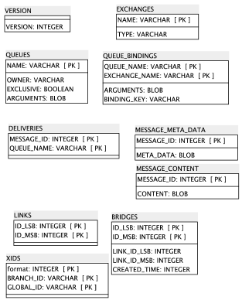
There are several ways to implement database structure for storing configuration objects.
In this page we would like to analyze all the alternatives and identify what would be the best option for the database structure to store configurable objects
Existing database schema contains 10 tables to store the following:
In order to store the entire broker configuration with such schema more tables are actually needs to be created for storing configuration entities like broker, virtual hosts etc.
That's seems impractical and require extra development efforts to implement functionality for each configurable object.
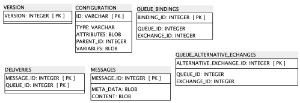
With this design configurable objects (broker, virtual hosts, queues, queue bindings, exchanges, exchange bindings etc) can be stored in CONFIGURATION table.
Each configurable object should have a unique ID and all its attributes are stored in attributes column as BLOB.
One-to-many relationship are stored using PARENT_ID column.
For storing many-to-many relationships (like queue bindings, exchange bindings etc) special tables are created for each of the relationship.
On the design above QUEUE_BINDINGS table is added to store queue bindings and QUEUE_ALTERNATE_EXCHANGES is added to store queue alternate exchanges
Advantages
Disadvantages
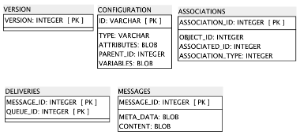
With this design configurable objects (broker, virtual hosts, queues, queue bindings, exchanges, exchange bindings etc) can be stored in CONFIGURATION table.
Each configurable object have a unique ID and all its attributes are stored in attributes column as BLOB.
One-to-many relationship are stored using PARENT_ID column.
All many-to-many relationships (like queue bindings, exchange bindings etc) are stored in the special ASSOCIATIONS table.
ASSOCIATION_TYPE column is used to distinguish the association type.
Advantages
Disadvantages
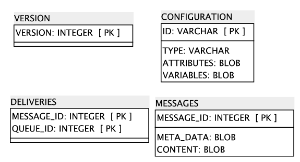
With this design configurable objects are stored in CONFIGURATION table.
All relationship (one-to-many, many-to-many) are stored in attributes field in JSON format as IDs.
Advantages
Disadvantages
The last approach to store relationships as part of attributes JSON seems the most preferable and does not requires a lot of efforts to implement.