
This is a review of where we are with the domain support. We have two node style APIs so we need to understand the overall picture and how we can rationalize what we have to clarify and simplify. Here's an updated overview.
The following are manually drawm UML style diagrams of the two approaches that are currently working in the code base.
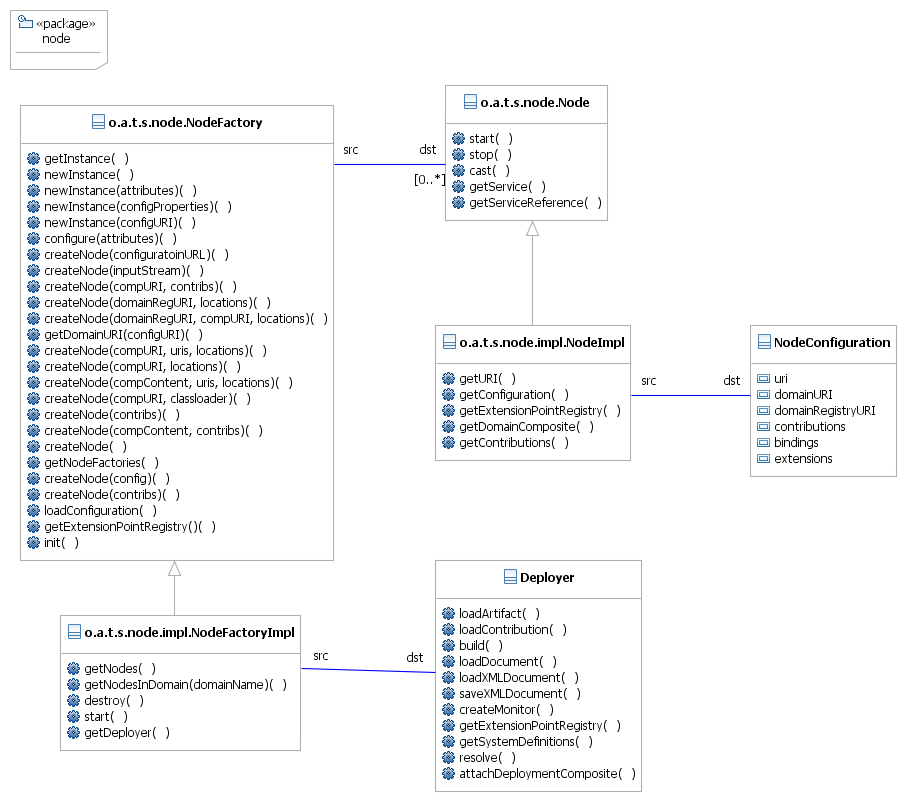
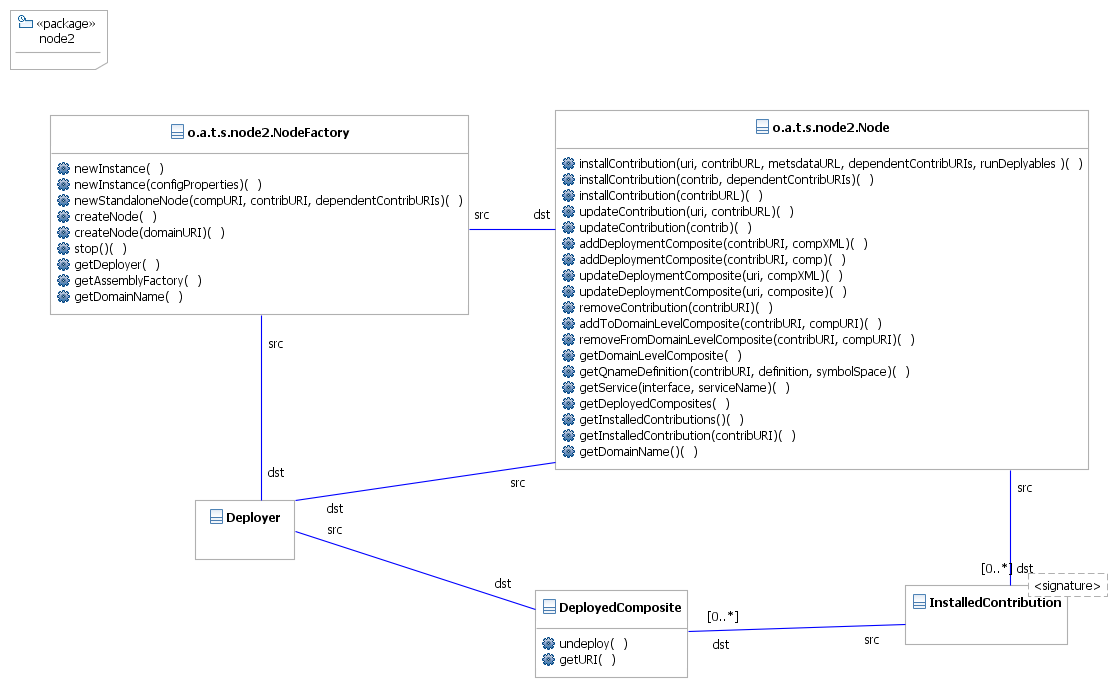
From the two node implementations I've tried to draw out the pertinent points and position some SPIs / APIs accordingly for discussion.
domain - as the spec says "a complete runtime configuration, potentially distributed over a series of interconnected runtime nodes."
In Tuscany there may (not yet in 2.x) or may not be a centralized representation of the domain. We have a domain registry (currently just
embodied in the endpoint registry) that provides an interface for accessing information about the domain.
domain uri - the unique identifier of the domain. May or may not contain parameters to configure the domain.
domain name - Not sure but I would say domain uri minus any attached configuration parameters, i.e. the bit after the ? (see http://en.wikipedia.org/wiki/URI_scheme#Generic_syntax)
node - the domain's representative in a class loading space
node factory - creates nodes, associates them with domains and configures them
installed contribution - contribution who's resources are available for use in the domain (in a node)
deployed composite - composite that's deployed into the domain level composite (in a node)
domain registry - an interface that nodes use to share domain level information
The assembly spec defines a running start but it is difficult to distinguish between deployed and running.
Embodied on the deployer
load contribution
determine contribution dependencies
build composite
start composite
stop composite
following APIs are built on these
Sometimes orthoganol to the definitions above
manage domain configuration (currently done through createNode/SCAClient)
manage node configuration (TBD)
create node (nodeFactory)
managing contributions - (node)
manage composite
manage domain
domain registry
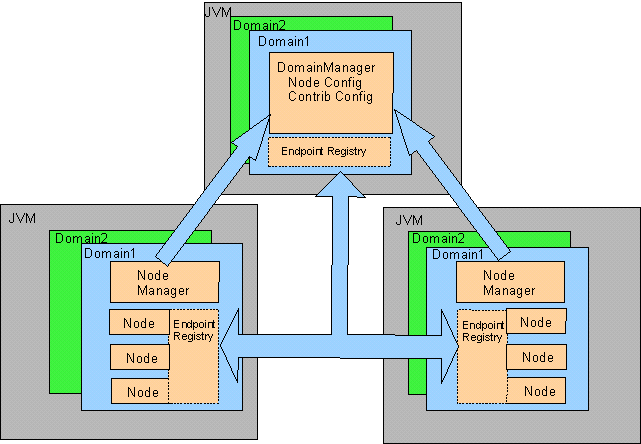
Need to define what the different parts do and if they are all required
SCA Domain/Node Diagrams (PDF) (OpenOffice odg File)
Composite Application Deployment with SCA Domain
Players:
Domain:
1) Deployment: Manage SCA contributions, composites and node configurations.
This is the deployment manager that helps SCA assemblers/deployers to
partition the domain composite into smaller composite applications that can
be deployed a specific runtime unit. For example, the administrator can
starts with a deployable composite. The domain manager can then find the
required contributions based on the import/export. The composite application
can then be allocated a node. It ends up with a configuration for a node.
A node can have a fixed configuration to a given composite application. Or
the domain can assign a composite application to the node dynamically based
on the capability of the node (such as implementation/binding/policy types).
In a node-centric view, node configurations can be manually crafted
(programmatically or via node.xml) or locally discovered (from the
classpath).
In a domain-centric view, node configurations are received from the domain
(by connecting to the domain deployment manager or taking a pre-built xml
document).
2) Runtime: Share service descriptions so that we can perform SCA
domain-level wiring. This can be done in "online" mode or "offline" mode.
Online mode: There is a live service registry (centralized or distributed)
that keeps up-to-date information of the domain-level service descriptions.
Offline mode: The domain-level service descriptions are pre-built (or even
pre-resolved) and a SNAPSHOT of that is used. For example, some XML
documents (such as a deployment composite with all the SCA endpoints)
resolved are used to store the domain metadata.
Case |
Options |
|---|---|
a1 |
A single contribution |
a2 |
Multiple dependent contributions |
where each contribution can be directories, jar, zip, bundle, war, ear...
|
|
|
|---|---|---|
b1 |
one or more composite files but which are not listed in |
|
b2 |
one or more composite files but which are listed in |
|
b3 |
one or more composite files but which are present in |
|
|
|
|
|---|---|---|
c1 |
node(s) with contributions passed in on command line, |
|
c2 |
node(s) with contributions pulled from domain manager |
|
c3 |
node(s) in a webapp |
|
c4 |
node(s) as eclipse project(s) |
|
c5 |
node(s) integrated into Tomcat and Geronimo plugin |
|
c6 |
node(s) as OSGi service listeners? (is that the right term?) |
|
c7 |
node(s) in cloud (what does this mean) |
|
One or more nodes may run in a single VM
|
|
|
|---|---|---|
|
1 node configured from command line, programmatically, in node.xml (c1) |
|
|
1 node configured from command line, programmatically, in node.xml (c1) |
|
|
1 node packaged with webapp (c3) |
|
|
tomcat instance as a domain (c5) |
|
|
eclipse workspace as domain (c4) |
|
|
|
|
As a review exercise can we correct/complete this list by getting all
of the scenarios people have in their heads out on the table. I
believe we have all imagined different scenarios.
This is a TODO for this review. This is a mildly enhanced version of
what we already have or have discussed at various times.
Entities |
Operations |
Descriptions |
|---|---|---|
Node |
Create with configuration |
|
Endpoint Registry (should this be domain registry now) |
Add/remove/query endpoints |
|
Domain Manager |
Add/Remove contribution |
|