Current state: Under Discussion
Discussion thread: here
JIRA: here
Please keep the discussion on the mailing list rather than commenting on the wiki (wiki discussions get unwieldy fast).
As per the Tiered Storage feature introduced in KIP-405, the follower fetch protocol was modified for topics enabled with tiered storage. For such topics, the empty follower finds the offset and leader epoch, up to which the auxiliary state (i.e. leader epoch sequence, producer snapshot state) needs to be built from the leader. The follower then starts fetching the data from the leader starting from that offset. In the KIP, it was decided to use the local-log-start-offset as the offset for this purpose. Instead of using the local-log-start-offset as the starting offset from where the follower starts replicating the data from the leader, we could also use the last-tiered-offset as the starting offset (technically we will use the next offset for last-tiered-offset).
This offset is the last offset that has been uploaded to the remote storage. With this option, the follower will only need to replicate a small number of segments from the leader. This is because in most cases where there is no lag, most of the inactive log segments are already available on the remote storage. If this follower does become a leader in the future, it can still serve older segments because they are already on remote storage. Because the follower needs to copy only a small number of segments from the leader, it can quickly catch up with the leader and join the ISR list for the topic partition. In practice, the amount of data the follower needs to replicate from the leader can be as low as 10-15%. Therefore the time for the new follower to join the ISR list is also 10-15% compared to before. What this implies is that with this strategy an empty broker can quickly join the ISR list for the topic partitions that are assigned to it.
A drawback of using the last-tiered-offset is that this new follower would possess only a limited number of locally stored segments. Should it ascend to the role of leader, there is a risk of needing to fetch these segments from the remote storage, potentially impacting broker performance. There can be several ways to prevent such followers from transitioning to a leader role, such as having strict leader election criteria, wherein followers with limited locally stored segments are not allowed to become a leader, or having slightly relaxed criteria wherein other followers are preferred for leadership over this follower. Incorporating these preventing measures alongside the proposed utilization of last-tiered-offset can effectively balance the advantage of rapid follower synchronization and mitigate potential performance impacts on the broker, thereby optimizing the overall efficiency and reliability.
In this KIP, we will focus only on the follower fetch protocol using the last-tiered-offset, which will be helpful in quickly converting empty followers to in-sync followers. This can drastically reduce the time taken to run cluster rebalances. Similarly, it can drastically shorten the time to replace a faulty broker.
A new broker property will be added to enable/disable the feature of using last-tiered-offset in the follower fetch.
follower.fetch.last.tiered.offset.enable
The following diagram provides a visual representation of the leader topic partition's log offsets and will help understand the new follower fetch protocol.
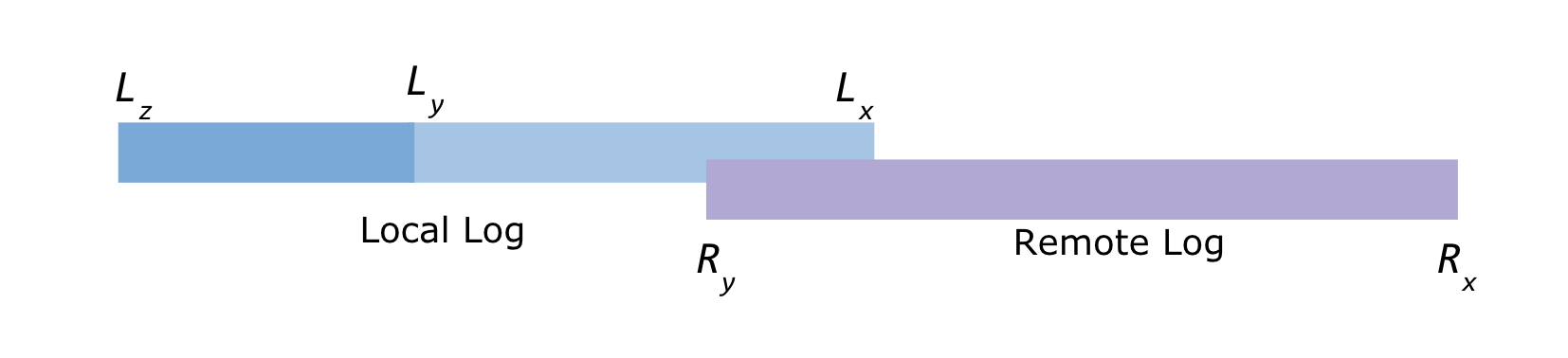
Lx = Local log start offset Lz = Local log end offset Ly = Last stable offset(LSO)
Ry = Remote log end offset / Last Tiered Offset Rx = Remote log start offset
Lz >= Ly >= Lx and Ly >= Ry >= Rx
Let us quickly recap the current follower fetch protocol. The follower does the following:
This case is also true when the leader has uploaded the segments, but hasn't cleared the segments from the local disk yet. In such a case, the requested offset (offset 0) may still be available on the leader and the leader will respond with the data to the follower.
We make the following changes to the follower-fetch protocol when the requested offset is not present on the leader (Case 2). These changes apply only when the follower is empty.
We will add a new API for the follower to be able to fetch the pending-upload-offset from the leader. The leader already keeps track of the highest offset that has been uploaded to the remote storage.
On receiving an OFFSET_OUT_OF_RANGE or OFFSET_MOVED_TO_TIERED_STORAGE error, ReplicaFetcher does the following:
Whenever this happens (Earliest-Pending-Upload-Offset < Log-Start-Offset), it simply means that there are no valid log segments on the remote yet (otherwise, the leader would return an offset >= log-start-offset). Hence the ReplicaFetcher simply truncates its log and starts replicating all data the leader has locally.
Step 1:
Fetch remote segment info, and rebuild leader epoch sequence.
Broker A (Leader) | Broker B (Follower) | Remote Storage | RL Metadata Storage |
|---|---|---|---|
3: msg 3 LE-1 4: msg 4 LE-1 5: msg 5 LE-2 6: msg 6 LE-2 7: msg 7 LE-3 (HW) leader_epochs: LE-0, 0 LE-1, 3 LE-2, 5 LE-3, 7 |
leader_epochs: LE-0,0 LE-1,3 LE-2,5 | seg-0-2, uuid-1 log: 0: msg 0 LE-0 1: msg 1 LE-0 2: msg 2 LE-0 epochs: LE-0, 0 seg 3-5, uuid-2 log: 3: msg 3 LE-1 4: msg 4 LE-1 5: msg 5 LE-2 epochs: LE-0, 0 LE-1, 3 LE-2, 5 | seg-0-2, uuid-1 segment epochs: LE-0, 0 seg-3-5, uuid-2 segment epochs: LE-1, 3 LE-2, 5 |
Step 2:
Continue fetching from the leader
Broker A (Leader) | Broker B (Follower) | Remote Storage | RL Metadata Storage |
|---|---|---|---|
3: msg 3 LE-1 4: msg 4 LE-1 5: msg 5 LE-2 6: msg 6 LE-2 7: msg 7 LE-3 (HW) leader_epochs: LE-0, 0 LE-1, 3 LE-2, 5 LE-3, 7 | Fetch from EPUO to HW 6: msg 6 LE-2 7: msg 7 LE-3 (HW) leader_epochs: LE-0,0 LE-1,3 LE-2,5 LE-3,7 | seg-0-2, uuid-1 log: 0: msg 0 LE-0 1: msg 1 LE-0 2: msg 2 LE-0 epochs: LE-0, 0 seg 3-5, uuid-2 log: 3: msg 3 LE-1 4: msg 4 LE-1 5: msg 5 LE-2 epochs: LE-0, 0 LE-1, 3 LE-2, 5 | seg-0-2, uuid-1 segment epochs: LE-0, 0 seg-3-5, uuid-2 segment epochs: LE-1, 3 LE-2, 5 |
Unit Tests and Integration Tests for the various follower fetch scenarios.