
Introduction
Purpose
Currently in CloudStack, the admin can limit the resources managed by CloudStack by setting limits for accounts and domains. But these existing limits are based on resource count, that limits the user on the basis of no. of VMs, no. of Volumes, no. of snapshots etc. and not of the basis of storage space, CPU, memory etc.
This feature will add new (CPU, RAM, Primary storage, Secondary storage, network rate etc.) resource types to the existing pool of resources. CS admin would be able to set the limits i.e. CPU, memory, storage etc. for accounts/domains through API or through CloudStack UI. This is functional specifications of feature CLOUDSTACK-713.
Current Scenario
- updateResourceLimit API has the following resource types:** Instance - Number of instances a user can create.
- Public IPs - Number of public IP addresses a user can own.
- Volume - Number of disk volumes a user can create.
- Snapshot - Number of snapshots a user can create.
- Template - Number of templates that a user can register/create.
- Network - Number of guest networks that a user can create.
- VPC - Number of VPCs that a user can create.
References
Feature Specifications
Requirements
- Update Resource Limit: Root/Domain Admin should be able to limit the following resources
- CPUs
- RAM
- Primary (shared) storage (Volumes)
- Secondary storage (Snapshots, Templates & ISOs)
- Network bandwidth rate (in mbps)
- Usage: Limits can be imposed on Accounts, Domains and Projects.
- List Resource Limit: Any User/RootAdmin/Domain Admin can list Resources
- Resource Limit Logs: Ensure proper logs are maintained into vmops.log and api.log
Use Cases
Use-Case 1: ‘Custom VM’ model for an employee in an Enterprise (Limit Only)
IT Admin would like to allow users to create custom VMs based on need. For example, one large VM or many small VMs etc. However the admin would like to restrict the maximum resources a employee can consume by setting limits
Use-Case 2: ‘Custom VM’ model for a researcher in a University (Reservation & Limit)
Cloud Admin wants to reserve certain resources to the researcher and allow him to create VMs of choice. Based on the research needs the VM configuration could be different. The researcher is guaranteed the assigned resources, but at the same time he is not allowed to exceed the resources he is assigned.Test guidelines
Configuration
- global configuration parameters:
- max.account.cpus - Maximum number of CPU cores that can be used for an account. Default value for this is 40.
- max.account.ram (in MB) - Maximum RAM that can be used for an account. Default value for this is 40960.
- max.account.primary.storage (in GB) - Maximum primary storage space that can be used for an account. Default value for this is 20*10.
- max.account.secondary.storage (in GB) - Maximum secondary storage space that can be used for an account. Default value for this is 20*20.
- max.account.network.rate(in mbps) - Maximum network rate that can be used for an account. Default value for this is 200.
- max.project.cpus - Maximum number of CPU cores that can be used for an account. Default value for this is 40.
- max.project.ram (in MB) - Maximum RAM that can be used for an account. Default value for this is 40960.
- max.project.primary.storage (in GB) - Maximum primary storage space that can be used for an account. Default value for this is 20*10.
- max.project.secondary.storage(in GB) - Maximum secondary storage space that can be used for an account. Default value for this is 20*20.
- max.project.network.rate(in mbps) - Maximum network rate that can be used for an account. Default value for this is 200.
User permission
- Normal users would have privilege to list resource limits (listResourceLimits).
- Root-Admin would have privilege to list and update resource limits.
- Domain-Admin would have privilege to list resources and update resource limits that are assigned to the domain.
Use cases
Domain D1 , Account A1 and Project P1
1. Number of CPUs:
-
- Root/Domain-Admin update CPU to 10 for domain D1. Users belonging to Domain D1 should not be able to use more than that.
- Root/Domain-Admin update CPU to 10 for Account A1 in Domain D1. Users belonging to Account A1 should not be able to use more than that. Also, they should not cross CPU limit defined for D1 domain.
- Limits imposed on Domain D1 should be imposed on sub-domain SD1 as well.
- Root/Domain-Admin update CPU to 10 for Project P1 having account A1 . Users belonging to Project P1 should not be able to use more CPUs than the defined limit.
2. Amount of RAM:
-
- Root/Domain-Admin update RAM to 1GB for domain D1. Users belonging to Domain D1 should not be able to use more than that.
- Root/Domain-Admin update RAM to 1GB for Account A1 in Domain D1. Users belonging to Account A1 should not be able to use more than that. Also, they should not cross RAM limit defined for D1 domain.
- Limits imposed on Domain D1 should be imposed on sub-domain SD1 as well.
- Root/Domain-Admin update RAM to 1GB for Project P1 having account A1. Users belonging to Project P1 should not be able to use more RAM than the defined limit.
3. Amount of Primary Storage:
-
- Root/Domain-Admin update primary storage to 5GB for domain D1. Users belonging to Domain D1 should not be able to use more than that.
- Root/Domain-Admin update primary storage to 5GB for Account A1 in Domain D1. Users belonging to Account A1 should not be able to use more than that. Also, they should not cross primary storage limit defined for D1 domain.
- Limits imposed on Domain D1 should be imposed on sub-domain SD1 as well.
- Root/Domain-Admin update primary storage to 5GB for Project P1 having account A1. Users belonging to Project P1 should not be able to use more primary storage than the defined limit.
4. Amount of Secondary Storage:
-
- Root/Domain-Admin update secondary storage to 5GB for domain D1. Users belonging to Domain D1 should not be able to use more than that.
- Root/Domain-Admin update secondary storage to 5GB for Account A1 in Domain D1. Users belonging to Account A1 should not be able to use more than that. Also, they should not cross secondary storage limit defined for D1 domain.
- Limits imposed on Domain D1 should be imposed on sub-domain SD1 as well.
- Root/Domain-Admin update secondary storage to 5GB for Project P1 having account A1. Users belonging to Project P1 should not be able to use more secondary storage than the defined limit.
5. Network bandwidth rate:
-
- Root/Domain-Admin update network bandwidth rate to 200mbps for domain D1. Users belonging to Domain D1 should not be able to use more than that.
- Root/Domain-Admin update network bandwidth rate to 200mbps for Account A1 in Domain D1. Users belonging to Account A1 should not be able to use more than that. Also, they should not cross network bandwidth rate limit defined for D1 domain.
- Limits imposed on Domain D1 should be imposed on sub-domain SD1 as well.
- Root/Domain-Admin update network bandwidth rate to 200mbps for Project P1 having account A1. Users belonging to Project P1 should not be able to use more network bandwidth rate than the defined limit.
6. If admin reduces the total no. of VM limit for an account and set it to less then the total no. of currently running VMs under that account, the existing behaviour of CS for the following commands are:
-
- migrateVirtualMachine: User under that account will be able to migrate the running VM into any other host without facing any limit issue.
- recoverVirtualMachine: If user destroy one of the running VMs and later if he tries to recover it, CS will not allow this operation.
Architecture and Design description
Existing API Changes:
1. updateResourceLimit
ApiName |
Request Parameters |
Response Parameters |
Available to regular user |
updateResourceLimit |
- resourcetype (admin can pass new resource type to update CPU, RAM, primary storage, secondary storage and network rate)
- account
- domainid
- max
- projectid
|
- account
- domain
- domainid
- max
- project
- projectid
- resourcetype
|
No |
In the above mentioned API, admin can pass the newly added resource types to set the limits.
2. updateResourceCount
ApiName |
Request Parameters |
Response Parameters |
Available to regular user |
updateResourceCount |
- domainid
- account
- projectid
- resourcetype (admin can pass new resource type to update CPU, RAM, primary storage, secondary storage *and network rate*)
|
- account
- domain
- domainid
- project
- projectid
- resourcecount
- resourcetype
|
No |
In the above mentioned API, admin can pass the newly added resource types to get the resource count.
3. listResourceLimits
This API is available to regular users and this will list the resource limits including the new resource types.
Example:
http://localhost:8080/client/api?command=updateResourceLimit&resourcetype=9&max=1024&domainid=2&apikey=pFZ6ZdlN-TmlBQWJRhncYUAUFCOGk3aCbbLGRAqtSG3KnbYnTEHXvh1MP-Y5801JAn-aFPODB-7vl1P8DiPQ1A&signature=6he37Flw1zRwNDe0yejyHk6oXcE%3d
DB Changes:
No DB Changes.
Changes to Existing Files:
- Add new resource types in Resource.java .
- Add new resource type in description field of resource_types in UpdateResourceCountCmd.java and in UpdateResourceLimitCmd.java .
- Add new resource type in description field of resource_types in* ResourceCountResponse.java and in ResourceLimitResponse.java .*
- Add new methods in* ResourceLimitManagerImpl.java* to get resourceCount for newly added resource types*.*
- Add new method in UserVmDaoImpl.java to get a list of serviceOfferingIds by passing a vmId.
- Add new calls in UserVmManagerImpl.java and BareMetalVmManagerImpl.java to check the limits for an account and to increment or decrement resource count for an account.
- (i will keep updating the changes as implementation progresses).
Design Decisions: TBD
- The Limit imposed (per account, per Domain, per Project) should not conflict
- What should be the maximum limit for CPU, RAM, Primary Storage, Secondary Storage, Network rate
UI flow
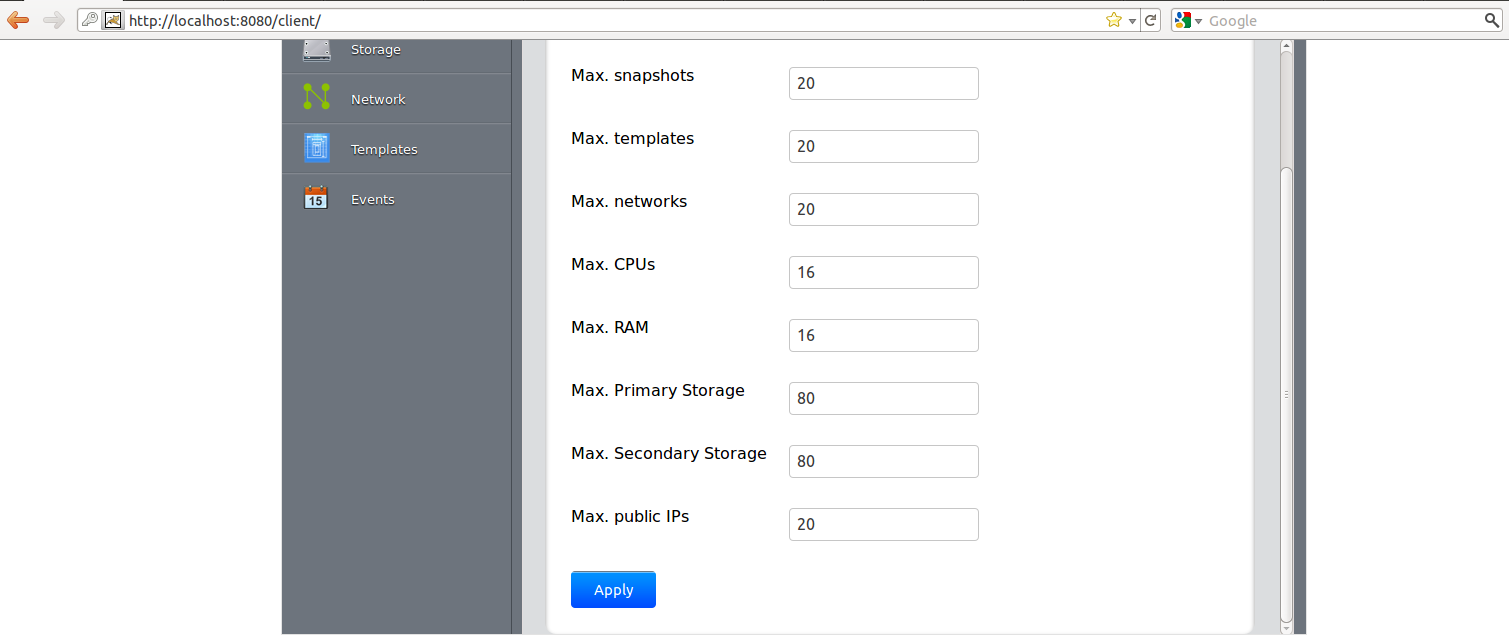
- _On Project Dashboard: Resource page - add resource options as following:
_ 
- On Domain and Account Info page add the option of additional resource proposed in this spec