Authors: Luke Chen, Federico Valeri, Omnia Ibrahim, PoAn Yang, Kuan-Po Tseng, Jiunn-Yang Huang
This page is meant as a template for writing a KIP. To create a KIP choose Tools->Copy on this page and modify with your content and replace the heading with the next KIP number and a description of your issue. Replace anything in italics with your own description.
Current state:"Under Discussion"
Discussion thread: here [Change the link from the KIP proposal email archive to your own email thread]
JIRA: here [Change the link from KAFKA-1 to your own ticket]
Please keep the discussion on the mailing list rather than commenting on the wiki (wiki discussions get unwieldy fast).
Kafka deployments often require replicating data across geographically distributed clusters for disaster recovery (DR), regulatory compliance, data locality, cluster migrations or active-active architectures. While MirrorMaker 2.0 (MM2) provides cross-cluster replication capabilities, it presents significant operational challenges.
Cluster Mirroring addresses these operational challenges by integrating cross-cluster replication directly into Kafka brokers, providing a simpler and more robust solution for cross-cluster replication.
Figure 1: Cluster Mirroring Setup.
While Cluster Mirroring is optimized for geo-replication, disaster recovery and migration use cases where a single source cluster replicates to one or more destination clusters, its coordinator-based architecture provides a foundation for more complex topologies.
This proposal describes asynchronous replication between clusters. Support for synchronous replication is deferred to future work.
Producers write to the source cluster and receive acknowledgments based on the source cluster's replication requirements (e.g. acks=all ensures replication to all in-sync replicas within the source cluster). Data is then asynchronously replicated to destination clusters with no impact on producer latency or throughput.
This decision reflects the reality that cross-datacenter network latency makes synchronous replication impractical for some deployments. Requiring synchronous acknowledgment from a geographically distant cluster would introduce significant latency (typically 50-200ms for inter-region replication), making it unsuitable for latency-sensitive applications.
Implications for DR use cases:
Asynchronous replication should provide the right balance for disaster recovery use cases where availability and performance of the primary cluster must not be compromised by cross-datacenter latency. Applications requiring zero data loss across cluster failures can wait for the follow-up KIP that will extend this design to support synchronous mirroring, or handle the lag using application-level caching.
Stretched clusters are not suitable for disaster recovery scenarios because they provide no protection against software failures or configuration incidents. Vendors that recommend stretched cluster deployments typically position them for high availability (HA) rather than DR, and notably, most do not offer stretched clusters as a managed service option, further underscoring the operational challenges and limited DR effectiveness of this architecture.
This proposal does not support unclean leader elections because there is no way to reconcile log divergence between source and destination clusters without a shared leader epoch. When the unclean.leader.election.enable is set to true, the broker will log a warning at every configuration synchronization period.
In normal Kafka operation, once a record is committed (part of the high watermark), it is immutable and will never be changed or removed. When a new leader is elected, followers use the epoch information to determine which records are safe to keep and which must be truncated to align with the new leader's log. Replicas eventually converge to the same data through epoch-based reconciliation. Unclean leader elections break this guarantee by allowing non-ISR brokers to become leaders, potentially with fewer records than were previously committed.
Source and destination clusters have completely independent controller architectures. Leadership changes in the source cluster happen independently of destination leadership changes. This means that epoch values diverge between clusters even though they represent the same logical topic partition. Source cluster epoch N and destination cluster epoch N have no inherent relationship, they represent different leadership events that happened at different times. This means that standard epoch comparison is insufficient because epochs are meaningful only within their originating cluster.
Solving this issue would require creating a shared leader epoch between source and destination clusters. Every time there is a source leader election we would need to notify the destination cluster and append data only after receiving a reply. This means that the overall latency would be cross-cluster replication latency plus intra-cluster replication latency. Read more in the Rejected Alternatives section.
Cluster Mirroring introduces a coordinator-based architecture integrated into Kafka brokers for managing cross-cluster replication. The design consists of three primary components that work together to provide automatic metadata synchronization and data replication. The following diagram illustrates how these components are wired together.
Figure 2: High Level Architecture.
The mirror name is stored as a topic-level configuration (mirror.name) that propagates through Kafka's metadata log as configuration change records. When topics are added to a mirror via the addTopicsToMirror API, the controller generates configuration records that are replicated to all brokers through the standard metadata update mechanism.
Brokers monitor these configuration changes to detect when partitions they lead belong to a mirror, triggering the creation of mirror fetchers and enforcement of read-only semantics. This design ensures that mirror associations are visible, auditable, and manageable through standard Kafka configuration introspection tools while maintaining strict control over how mirroring relationships are established and modified.
The MirrorCoordinator (MC) manages Cluster Mirroring state using a partitioned coordinator pattern similar to the group and transaction coordinators.
We use a composite key of mirror name, topic id, and partition number to distribute coordination work across the __mirror_state topic's partitions, which is the internal compacted topic used to store mirror metadata. Each mirror partition independently hashes to a coordinator, spreading the load across all brokers in the cluster. This means a mirror with hundreds of partitions will have its state management distributed evenly rather than concentrated on a single broker.
Responsibilities:
Figure 3: Mirror Partition Lifecycle.
States descriptions:
Scenarios:
Starting a mirror (UNKNOWN -> PREPARING -> MIRRORING): The addTopicsToMirror command sets mirror.name config via the controller. The metadata update propagates to brokers. The broker leading the partition sees it's the coordinator, finds no cached state (UNKNOWN), and transitions to PREPARING. After truncation completes, it moves to MIRRORING.
Failover (MIRRORING -> STOPPING -> STOPPED): The removeTopicsFromMirror command clears mirror.name. The coordinator detects the stop request, transitions to STOPPING, persists the last offset, then moves to STOPPED. The topic is now writable.
Restarting a stopped mirror (STOPPED -> PREPARING -> MIRRORING): The mirror.name config is set again. onMetadataUpdate sees the partition in STOPPED state and transitions to PREPARING, re-truncating and resuming replication.
The MirrorMetadataManager (MMM) implements periodic metadata synchronization between source and destination clusters. It maintains persistent network connections to all source clusters.
Responsibilities:
Cluster Mirroring allows users to modify configurations in the destination cluster, though these changes are periodically overridden by the topic configuration synchronization cycle. This design choice was made because while dynamic configuration changes could be blocked, static configuration changes via properties files cannot be prevented, making override inevitable.
However, this approach presents challenges in environments with external governing systems like the Strimzi operator, where the continuous reconciliation process conflicts with the refresh cycle, potentially causing performance impacts. More critically, temporary configuration mismatches such as reduced retention periods or altered partition counts could lead to data loss or missing partitions until the next synchronization cycle detects and corrects the discrepancy, highlighting the need for careful operational awareness when mixing mirroring with external cluster management solutions.
Metadata synchronization operates at the mirror level rather than the partition level, so it uses a separate coordinator assignment based on the mirror name alone. Only the broker assigned as the metadata coordinator for a given mirror performs synchronization, and it applies changes only to the mirror partitions it manages. This avoids both redundant synchronization across brokers and unnecessary updates to partitions managed by other coordinators.
Each mirror can define its own filtering rules independently, loaded from the manager at each refresh cycle:
The MirrorFetcherManager (MFM) extends AbstractFetcherManager to handle fetcher thread lifecycle for mirror partitions. It uses a three-dimensional key (fetcher ID, source broker, mirror name) to organize threads, ensuring that:
The MirrorFetcherThread (MFT) is a specialized implementation of AbstractFetcherThread that handles cross-cluster data replication with consumer Fetch requests and different epoch semantics than standard intra-cluster replication, but keeping the same log consistency validations.
In Cluster Mirroring, destination partition leaders operate in a dual-role. They act as followers when fetching committed data (up to the LSO) from the source cluster leader, while simultaneously serving as leaders for their local replicas in the destination cluster. To maintain data consistency, destination partitions are read-only and reject produce requests from clients with ReadOnlyTopicException.
A mirror leader partition begins with an unknown source leader epoch. When it sends Fetch requests to the source cluster, the source leader may respond with a FencedLeaderEpochException. When such an error occurs, the mirror fetcher extracts the current source leader epoch from the error response and updates its internal fetch state to track the source cluster's actual leader epoch. The last fetched epoch is always set to empty to disable log divergence checks due to unclean leader election (see non-goals section).
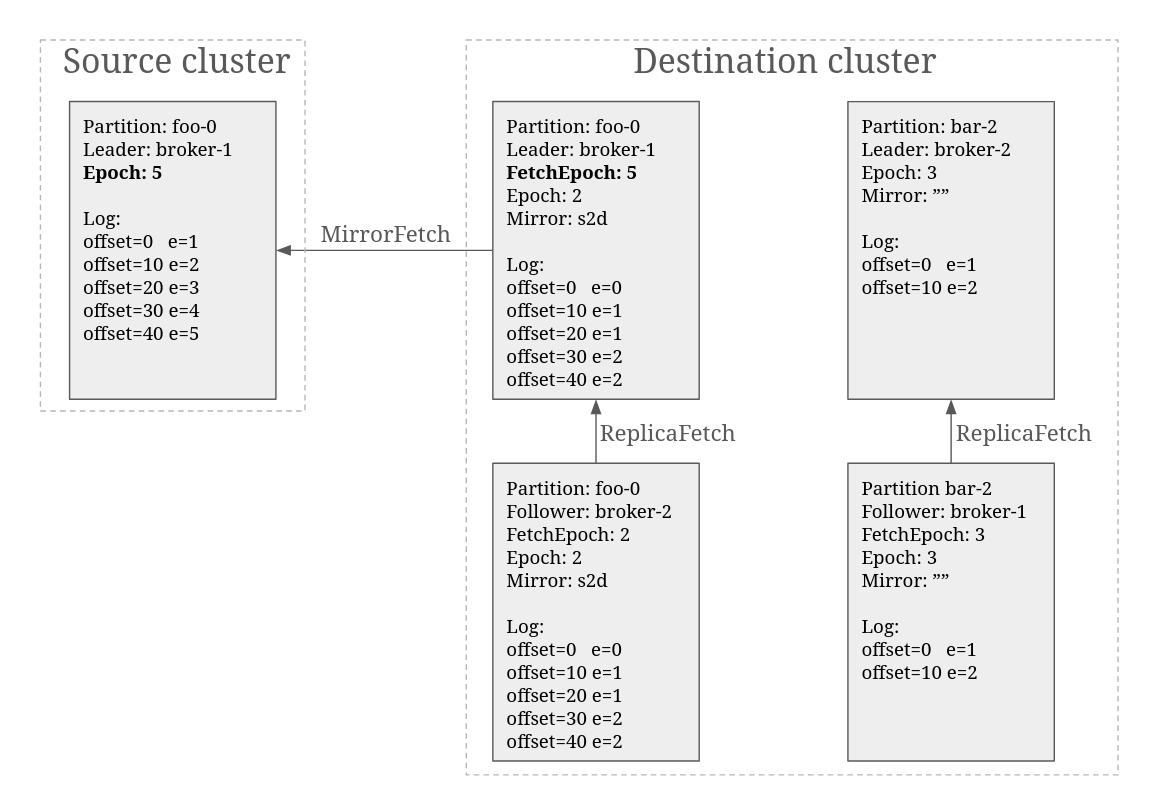
Figure 4: Mirror Leader Fetch State.
On subsequent Fetch requests:
The source epoch tracking is purely for fetch validation, while the destination uses its own independent epoch sequence for replication and durability. This design keeps the two clusters' epoch spaces completely separate, allowing the destination to operate as a normal Kafka cluster with standard intra-cluster replication.
When the source partition's leader changes, a NotLeaderOrFollowerException is returned. At this point, the mirror fetcher thread queries the MirrorMetadataManager to get the updated endpoint and either creates a new fetcher thread or reuses one that is already connected to the new endpoint. This allows mirroring to continue seamlessly despite leadership changes in the source cluster.
When users remove a topic from the mirror, the partition will be removed from the fetch thread, and any late fetch responses will be skipped because the partition is not registered anymore in the fetcher thread.
Failover is initiated by calling the RemoveTopicsFromMirror API, which appends a .removed suffix into the mirror.name internal config. This transitions the mirror topics from read-only to writable state after the stopping process completes gracefully.
When producers reconnect to the destination cluster after failover, they obtain new producer IDs which are separate from previously mirrored IDs, so they begin writing with fresh sequence numbers starting from 0.
Consumers can reconnect to the destination cluster using the same group ID, resuming from the last synchronized offsets, minimizing data re-processing or gaps. The transition is transparent from the consumer's perspective and offset management continues normally through the destination's group coordinator.
Failback enables mirroring to be reversed after a failover, allowing the original source cluster to become the destination and vice versa. This is critical for scenarios where you want to fail back to the original cluster after recovering from an outage or planned maintenance.
For each partition, we track the high watermark (HW) by storing it in the cluster metadata as Last Mirrored Offset (LMO) when removing a topic from a mirror (failover phase). The LMO represents the last record successfully mirrored from the original source cluster to the destination cluster before failover.
When reverse mirroring is initiated on the old source cluster, it needs to determine where to truncate its log before starting to fetch from the new source cluster. If the new API is supported, the broker sends a LastMirrorredOffsets request to the new source cluster asking for the latest mirrored offset, and then truncates its local log to the returned offset. If the new API is not supported, the broker truncates to zero and starts mirroring from scratch.
Before transitioning a mirror partition from PREPARING to MIRRORING, the MirrorCoordinator must ensure that all in-sync replicas in the destination cluster have truncated their logs to the correct offset. If less than min ISR are available, we will skip and retry in the following fetch. This coordination step validates that every ISR member has completed truncation before the partition is allowed to begin actively fetching from the source cluster. Without it, the mirror leader could start appending new data from the source while local followers still hold divergent log segments, causing inconsistencies within the destination cluster. After truncation, reverse mirroring begins normally.
Note that the log truncation on the reverse mirroring may cause the data loss for the records that didn’t get mirrored to the old destination cluster earlier.
Cluster Mirroring preserves the compression format of record batches from the source cluster without recompression. When mirroring data, compressed record batches are copied directly from the source to the destination cluster, maintaining the original compression type (gzip, snappy, lz4, zstd, or none) and the exact byte-level representation of the data. This approach avoids unnecessary CPU overhead from decompression and recompression during replication, ensures bit-for-bit data integrity, and prevents potential issues with different compression implementations producing different outputs for the same data.
Cluster Mirroring fully supports log compacted topics, preserving both compacted records and offset gaps from the source cluster. When a topic uses cleanup.policy=compact, Kafka removes obsolete records with duplicate keys, creating gaps in the offset sequence. For example, if a source partition contains offsets 0-100 and compaction removes records at offsets 30-40 and 60-70, the remaining records will have gaps: offsets 0-29, 41-59, and 71-100 are missing.
The mirror leader replicates these compacted log segments exactly as they exist in the source cluster, maintaining the same offset assignments and gaps. After failover, when the mirrored topic becomes writable, log compaction continues normally in the destination cluster according to the topic's compaction policy, and any new records produced locally will fill in after the highest mirrored offset.
Cluster Mirroring handles topic retention policies by periodically synchronizing the topic configurations from the source cluster, ensuring that the topic retention policies are consistent. When the source cluster applies retention policies, older log segments are deleted and the log start offset advances. For example, if a topic originally contained offsets 0-100 and retention deletes offsets 0-99, the source cluster's log start offset becomes 100. When the mirror leader fetches from the source, it discovers the new log start offset and updates its local log start offset to match, creating the same offset gap.
If a mirror follower attempts to fetch from an offset below the source cluster's log start offset (e.g., fetching offset 50 when log start offset is 100), the source broker returns an OffsetOutOfRangeException. The mirror leader handles this by truncating its local log to the source's current log start offset and resuming fetching from that point. This ensures the destination cluster mirrors the current retention state of the source cluster without attempting to replicate already-deleted data.
Cluster Mirroring synchronizes consumer group offsets from the source cluster to the destination cluster, enabling consumers to resume consumption from their last committed offset after failover. The MirrorMetadataManager periodically fetches consumer group committed offsets from the source cluster and replicates it to the destination cluster's. This ensures that consumer groups maintain their consumption progress across both clusters.
During offset synchronization, the committed offset in the destination cluster may temporarily exceed the current log end offset (LEO) of the mirror topic. For example, if a consumer commits offset 100 in the source cluster but the destination cluster has only mirrored up to offset 80 (LEO = 80), the MirrorMetadataManager still commits offset 100 to the destination cluster. This is acceptable because the mirror leader continues fetching data and the LEO will eventually advance to include offset 100. However, if a failover occurs before the mirrored data catches up, consumers attempting to resume from offset 100 will receive an OffsetOutOfRangeException.
To handle this scenario gracefully, consumers should configure auto.offset.reset=latest when consuming from mirrored topics. This ensures that if a committed offset is beyond the current LEO after failover, the consumer automatically resets to the latest available offset rather than failing or resetting to the earliest offset.
Cluster Mirroring supports comprehensive security controls through both authorization and authentication mechanisms. On the destination cluster, mirror-related operations (creating mirrors, adding/removing topics from mirrors, managing mirror configurations) require the CLUSTER_ACTION permission on the cluster resource. This ensures that only authorized principals can establish and manage cluster mirrors. When configuring a mirror, administrators specify ACLs that should be synchronized from the source cluster, and these ACLs are periodically replicated to the destination cluster to maintain consistent access control policies across both environments.
For connecting to the source cluster, Cluster Mirroring requires only the bootstrap server address and appropriate credentials, no other sensitive cluster information is exposed or required. The destination cluster's mirror configuration supports all standard Kafka authentication mechanisms including TLS/SSL for encrypted transport and SASL for client authentication.
Each mirror can be configured with its own security settings, allowing different mirrors to connect to source clusters with varying security requirements. This enables secure cross-cluster replication even when source and destination clusters use different authentication protocols or when connecting across security boundaries such as on-premises to cloud environments. All credentials are stored in the destination cluster's mirror configuration and used exclusively for establishing authenticated connections to the source cluster.
The idempotent producers rely on producer IDs to detect duplicate writes and ensure idempotent production. To avoid conflicts with the destination cluster's producer ID space, we rewrite source producer IDs to occupy the unused negative space by applying the formula:
destinationProducerId = -(sourceProducerId + 2)
The rationale of this formula is to keep the existing semantic of NO_PRODUCER_ID (-1) but still have a way to avoid the conflict. The CRC checksum is automatically recalculated after the producer ID changes to maintain batch integrity. Producer epochs from the source cluster are preserved exactly as they appear in the source batches. This ensures the last stable offset is correctly reflected because the producer state is updated after each append.
When a mirror topic becomes writable during failover, records with transformed producer IDs (<= -2) remain in the log with their original sequence numbers and epochs. Applications that reconnect to the destination cluster receive new producer IDs (>=0) from the destination's transaction coordinator, allowing them to continue producing.
Cluster Mirroring ensures transactional consistency when stopping by truncating to the Last Stable Offset (LSO). Note that this doesn’t mean it supports exactly-once semantics (EOS) across clusters, which would require synchronous communication.
During the mirror stopping transition, the MirrorCoordinator performs a log truncation operation that resets each mirror partition to its LSO. This offset represents the point in the log where all transactions have been decided (committed or aborted), essentially the highest offset where data is known to be consistent from a transactional perspective. Any records beyond this point may belong to incomplete transactions and should not persist after mirroring stops.
This approach prevents a critical consistency issue: the destination cluster could retain partial transaction data that would never be completed since mirroring has stopped. This would leave the topic in an inconsistent state where read_committed consumers may be blocked due to incomplete transaction data. Additionally, the transaction coordinator would not be able to rollback these hanging transactions because there is no __transaction_state metadata in the destination cluster.
Consider this source cluster log:
Offset | Type | isTxn | PID | Content |
0 | DATA_RECORD | true | 4001 | key=A, value=1 |
1 | DATA_RECORD | true | 4001 | key=B, value=2 |
2 | DATA_RECORD | true | 4002 | key=X, value=9 |
3 | CONTROL_MARKER | true | 4001 | COMMIT marker for PID 4001 |
4 | CONTROL_MARKER | true | 4002 | ABORT marker for PID 4002 |
5 | DATA_RECORD | false | none | key=Z, value=10 |
If replication reaches offset 4 and the source cluster fails, the destination cluster contains data records for transaction 4002 (offset 2) without the abort marker (offset 4). This creates a hanging transaction that can never be committed or aborted on the destination cluster.
Note that this approach causes data loss for any in-flight transactions during the failover and may result in already-processed records being lost if consumers on the destination cluster read uncommitted data.
Cluster Mirroring adopts a dual-sided throttling mechanism that extends Kafka's existing bandwidth control capabilities to work across cluster boundaries.
Tiered Storage is not initially supported, but a detailed design of the metadata synchronization protocol, API schema, and state management will be provided in a follow-up KIP.
A mirror follower that receives an OffsetMovedToTieredStorageException from the source leader handles it by marking the partition as failed, and also the mirror partition state will move to FAILED state.
Cluster Mirroring supports both traditional consumer groups and share consumer groups (Kafka Queue functionality) to ensure seamless failover for all consumer types. While the data mirroring mechanism remains identical, the offset synchronization strategy differs based on the group type.
Share consumer groups use a different offset management model based on Share-Partition Start Offset (SPSO) and Share-Partition End Offset (SPEO) rather than traditional committed offsets. First we retrieve the current SPSO for each share group using the DescribeShareGroupOffsets API from the source cluster, and then we update the SPSO in the destination cluster using the AlterShareGroupOffsets API, which also initializes the group state in both the group coordinator and share coordinator. This means the API can initialize a share group in the destination cluster even if it doesn't exist yet, eliminating the need for pre-creation or complex state management.
Kafka enforces that consumer group and share group names must be unique within a single cluster. This creates a potential conflict scenario during mirroring. When such conflicts occur, the offset commit operation will fail with GroupIdNotFoundException. Users must resolve these conflicts manually by either deleting the conflicting group in the destination cluster before mirroring begins, or excluding the conflicting groups from offset synchronization. These conflicts affect only offset synchronization and do not impact data mirroring itself. The topic data continues to replicate normally, and only the automatic offset synchronization for the conflicting groups is blocked.
At the time of writing, the Diskless Topics KIP (KIP-1500 and other sub-KIPs) are still under discussion, so there will be future KIPs to support this feature
Active-active topology is not initially supported in Cluster Mirroring, though it could potentially be achieved through topic prefixing and removing the reliance on topic ID for mirroring. This is a candidate for a future improvement KIP.
Instead, bidirectional mirroring is supported, but only when mirroring different topics between clusters, allowing records produced to either cluster to be consumed from both. Unlike MirrorMaker 2, Cluster Mirroring does not need special cycle detection or prevention logic because the read-only enforcement inherently blocks the conditions that would create infinite replication loops.
A new command-line tool kafka-mirrors.sh provides administrative operations for managing cluster mirrors.
Create a new cluster mirror configuration in the destination cluster:
$ echo "bootstrap.servers=localhost:9092" >/tmp/mirror.properties $ bin/kafka-mirror.sh --bootstrap-server :9094 --create --mirror my-mirror --mirror-config /tmp/mirror.properties |
Created mirror my-mirror
Add a topic or set of topics to an existing cluster mirror (start mirroring):
$ bin/kafka-mirror.sh --bootstrap-server :9094 --add --topic my-topic --mirror my-mirror --replication-factor 2 --remote-bootstrap-server :9092 --topic-id gWrR6uDrSNSSfu_ubGndCg Added 1 topic(s) to mirror my-mirror: [my-topic] |
List configured mirrors with additional information:
$ bin/kafka-mirrors.sh --bootstrap-server :9094 --list MIRROR TOPICS SOURCE-BOOTSTRAP my-mirror 2 localhost:9091 new-mirror 1 localhost:9091 |
Describe configured mirrors to check their lag compared to their source topics:
$ bin/kafka-mirrors.sh --bootstrap-server :9094 --describe MIRROR TOPIC PARTITION SOURCE-OFFSET DESTINATION-OFFSET LAG STATE my-mirror bar 0 2324 2324 0 MIRRORING my-mirror foo 0 69 66 3 MIRRORING my-mirror foo 1 94 84 10 MIRRORING my-mirror foo 2 94 90 4 MIRRORING new-mirror baz 0 189 189 0 MIRRORING new-mirror baz 1 859 859 0 MIRRORING |
Remove a specific topic or set of topics from a mirror (stop mirroring / failover):
$ bin/kafka-mirror.sh --bootstrap-server :9094 --remove --topic my-topic --mirror my-mirror Removed 1 topic(s) from mirror my-mirror: [my-topic] |
Delete a mirror including its topics and configuration (stop mirroring / promotion):
TODO
Alter mirror configuration (e.g. authentication):
TODO
Throttling on the destination cluster:
$ bin/kafka-configs.sh --bootstrap-server :9094 --entity-type brokers --entity-name 4 --alter --add-config mirror.replication.throttled.rate=100000000 Completed updating config for broker 4. $ bin/kafka-configs.sh --bootstrap-server :9094 --entity-type topics --entity-name my-topic --alter --add-config mirror.replication.throttled.replicas=[0:4] Completed updating config for topic my-topic. |
Throttling on the source cluster:
$ bin/kafka-configs.sh --bootstrap-server :9091 --alter --add-config 'consumer_byte_rate=1024' --entity-type clients --entity-name broker-4-fetcher-0-mirror-my-mirror Completed updating config for client broker-4-fetcher-0-mirror-my-mirror. |
New methods are added to the Admin interface for programmatic cluster mirror management, along with their supporting classes:
CreateMirrorResult createMirror(String mirrorName, Map<String, String> configs, CreateMirrorOptions options); AddTopicsToMirrorResult addTopicsToMirror(Map<String, String> topicToMirrorName, AddTopicsToMirrorOptions options); RemoveTopicsFromMirrorResult removeTopicsFromMirror(String mirrorName, Set<String> topics, RemoveTopicsFromMirrorOptions options); ListMirrorsResult listMirrors(ListMirrorsOptions options); DescribeMirrorsResult describeMirrors(Collection<String> mirrorNames, DescribeMirrorsOptions options); |
This KIP extends CreateTopic API, but also introduces some new APIs and metadata records.
The CreateTopic API is updated to add information required for mirror topic creation.
// new added
{ "name": "MirrorInfo", "type": "MirrorInfo", "versions": "8+", "nullableVersions": "8+", "ignorable": true,
  "about": "Mirror information for creating a mirror topic from a source cluster.", "fields": [
    { "name": "TopicId", "type": "uuid", "versions": "8+",
    "about": "The topic ID from the source cluster." }
]} |
In normal topic creation, the MirrorInfo field will be null. When receiving the CreateTopic request, the controller will check the new field. If it is not set, the topic ID will be generated with random UUID as usual. Otherwise, the controller will do the following validation:
{
  "apiKey": TBD,
  "type": "request",
  "listeners": ["broker", "controller"],
  "name": "CreateMirrorRequest",
  "validVersions": "0",
  "flexibleVersions": "0+",
  "fields": [
    { "name": "MirrorName", "type": "string", "versions": "0+", "nullableVersions": "0+",
      "about": "The cluster mirror name."},
    { "name": "Config", "type": "[]MirrorConfig", "versions": "0+",
      "about": "The cluster mirror configurations.",  "fields": [
      { "name": "Name", "type": "string", "versions": "0+", "mapKey": true,
        "about": "The configuration key name." },
      { "name": "Value", "type": "string", "versions": "0+", "nullableVersions": "0+",
        "about": "The value to set for the configuration key."}
    ]}
  ]
} |
{

  "apiKey": TBD,

  "type": "response",

  "name": "CreateMirrorResponse",

  "validVersions": "0",

  "flexibleVersions": "0+",

  "fields": [

    { "name": "ThrottleTimeMs", "type": "int32", "versions": "0+",

      "about": "The duration in milliseconds for which the request was throttled due to a quota violation, or zero if the request did not violate any quota." },

    { "name": "ErrorCode", "type": "int16", "versions": "0+",

      "about": "The error code, or 0 if there was no error." },

    { "name": "ErrorMessage", "type": "string", "versions": "0+", "nullableVersions": "0+", "ignorable": true,

      "about": "The error message, or null if there was no error." }

  ]

} |
{

  "apiKey":TBD,

  "type": "request",

  "listeners": ["broker", "controller"],

  "name": "AddTopicsToMirrorRequest",

  "validVersions": "0",

  "flexibleVersions": "0+",

  "fields": [

    { "name": "Topics", "type": "[]TopicState", "versions": "0+", "about": "The topic state.",

      "fields": [

        { "name": "TopicId", "type": "uuid", "versions": "0+", "about": "The unique topic ID."},

        { "name": "TopicName", "type": "string", "versions": "0+", "mapKey": true, "entityType": "topicName",

          "about": "The topic name." },

        { "name": "MirrorName", "type": "string", "versions": "0+", "nullableVersions": "0+",

          "about": "The mirror name."}

      ]}

  ]

} |
{

  "apiKey":TBD,

  "type": "response",

  "name": "AddTopicsToMirrorResponse",

  "validVersions": "0",

  "flexibleVersions": "0+",

  "fields": [

    { "name": "ThrottleTimeMs", "type": "int32", "versions": "0+",

      "about": "The duration in milliseconds for which the request was throttled due to a quota violation, or zero if the request did not violate any quota." },

    { "name": "TopicId", "type": "uuid", "versions": "0+", "about": "The unique topic ID."},

    { "name": "ErrorCode", "type": "int16", "versions": "0+",

      "about": "The error code, or 0 if there was no error." },

    { "name": "ErrorMessage", "type": "string", "versions": "0+", "nullableVersions": "0+", "ignorable": true,

      "about": "The error message, or null if there was no error." }

  ]

} |
{

  "apiKey": TBD,

  "type": "request",

  "listeners": ["broker", "controller"],

  "name": "RemoveTopicsFromMirrorRequest",

  "validVersions": "0",

  "flexibleVersions": "0+",

  "fields": [

    { "name": "MirrorName", "type": "string", "versions": "0+", "ignorable": true,

      "about": "The cluster mirror name." },

    { "name": "Topics", "type": "[]TopicState", "versions": "0+", "about": "The topic state.",

      "fields": [

        { "name": "TopicId", "type": "uuid", "versions": "0+", "about": "The unique topic ID."},

        { "name": "TopicName", "type": "string", "versions": "0+", "mapKey": true, "entityType": "topicName",

          "about": "The topic name." }

      ]}

  ]

} |
{

  "apiKey":96,

  "type": "response",

  "name": "RemoveTopicsFromMirrorResponse",

  "validVersions": "0",

  "flexibleVersions": "0+",

  "fields": [

    { "name": "ThrottleTimeMs", "type": "int32", "versions": "0+",

      "about": "The duration in milliseconds for which the request was throttled due to a quota violation, or zero if the request did not violate any quota." },

    { "name": "TopicId", "type": "uuid", "versions": "0+", "about": "The unique topic ID."},

    { "name": "ErrorCode", "type": "int16", "versions": "0+",

      "about": "The error code, or 0 if there was no error." },

    { "name": "ErrorMessage", "type": "string", "versions": "0+", "nullableVersions": "0+", "ignorable": true,

      "about": "The error message, or null if there was no error." }

  ]

} |
{

  "apiKey":97,

  "type": "request",

  "listeners": ["broker", "controller"],

  "name": "LastMirroredOffsetsRequest",

  "validVersions": "0",

  "flexibleVersions": "0+",

  "fields": [

    { "name": "MirrorName", "type": "string", "versions": "0+", "about": "The mirror name." },

    { "name": "Topics", "type": "[]TopicState", "versions": "0",

      "about": "The responses per topic.", "fields": [

      { "name": "Name", "type": "string", "versions": "0", "entityType": "topicName",

        "about": "The topic name." },

      { "name": "Partitions", "type": "[]PartitionState", "versions": "0",

        "about": "The responses per partition.", "fields": [

        { "name": "PartitionIndex", "type": "int32", "versions": "0",

          "about": "The partition index." }

      ]}

    ]}

  ]

} |
{

  "apiKey":97,

  "type": "response",

  "name": "LastMirroredOffsetsResponse",

  "validVersions": "0",

  "flexibleVersions": "0+",

  "fields": [

    { "name": "ThrottleTimeMs", "type": "int32", "versions": "0+",

      "about": "The duration in milliseconds for which the request was throttled due to a quota violation, or zero if the request did not violate any quota." },

    { "name": "ErrorCode", "type": "int16", "versions": "0+",

      "about": "The error code, or 0 if there was no error." },

    { "name": "Topics", "type": "[]OffsetResponseTopic", "versions": "0",

      "about": "The responses per topic.", "fields": [

      { "name": "Name", "type": "string", "versions": "0", "entityType": "topicName",

        "about": "The topic name." },

      { "name": "Partitions", "type": "[]OffsetResponsePartition", "versions": "0",

        "about": "The responses per partition.", "fields": [

        { "name": "PartitionIndex", "type": "int32", "versions": "0",

          "about": "The partition index." },

        { "name": "LastMirroredOffset", "type": "int64", "versions": "0",

          "about": "The last mirrored record offset." },

        { "name": "ErrorCode", "type": "int16", "versions": "0",

          "about": "The error code, or 0 if there was no error." }

      ]}

    ]}

  ]

} |
{

  "apiKey": 98,

  "type": "request",

  "listeners": ["broker"],

  "name": "ListMirrorsRequest",

  // Version 0 is the initial version.

  "validVersions": "0",

  "flexibleVersions": "0+",

  "fields": []

} |
{

  "apiKey": 98,

  "type": "response",

  "name": "ListMirrorsResponse",

  // Version 0 is the initial version.

  "validVersions": "0",

  "flexibleVersions": "0+",

  "fields": [

    { "name": "ThrottleTimeMs", "type": "int32", "versions": "0+", "ignorable": true,

      "about": "The duration in milliseconds for which the request was throttled due to a quota violation, or zero if the request did not violate any quota." },

    { "name": "ErrorCode", "type": "int16", "versions": "0+",

      "about": "The error code, or 0 if there was no error." },

    { "name": "Mirrors", "type": "[]ListedMirror", "versions": "0+",

      "about": "Each mirror in the response.", "fields": [

      { "name": "MirrorName", "type": "string", "versions": "0+",

        "about": "The mirror name." },

      { "name": "SourceBootstrap", "type": "string", "versions": "0+",

        "about": "The source cluster bootstrap servers." },

      { "name": "TopicCount", "type": "int32", "versions": "0+", "default": "0",

        "about": "The number of topics configured for this mirror. 0 indicates an empty mirror with no topics." }

    ]}

  ]

} |
{

  "apiKey": 99,

  "type": "request",

  "listeners": ["broker"],

  "name": "DescribeMirrorsRequest",

  // Version 0 is the initial version.

  "validVersions": "0",

  "flexibleVersions": "0+",

  "fields": [

    { "name": "MirrorNames", "type": "[]string", "versions": "0+",

      "about": "The names of the mirrors to describe. Null or empty array means all mirrors." },

    { "name": "IncludeAuthorizedOperations", "type": "bool", "versions": "0+", "default": "false",

      "about": "Whether to include authorized operations." }

  ]

} |
{

  "apiKey": 99,

  "type": "response",

  "name": "DescribeMirrorsResponse",

  // Version 0 is the initial version.

  "validVersions": "0",

  "flexibleVersions": "0+",

  "fields": [

    { "name": "ThrottleTimeMs", "type": "int32", "versions": "0+",

      "about": "The duration in milliseconds for which the request was throttled due to a quota violation, or zero if the request did not violate any quota." },

    { "name": "Mirrors", "type": "[]DescribedMirror", "versions": "0+",

      "about": "Each described mirror.", "fields": [

      { "name": "ErrorCode", "type": "int16", "versions": "0+",

        "about": "The error code, or 0 if there was no error." },

      { "name": "MirrorName", "type": "string", "versions": "0+",

        "about": "The mirror name." },

      { "name": "Topics", "type": "[]TopicPartitions", "versions": "0+",

        "about": "Each topic in the mirror.", "fields": [

        { "name": "TopicName", "type": "string", "versions": "0+",

          "about": "The topic name." },

        { "name": "Partitions", "type": "[]PartitionDetail", "versions": "0+",

          "about": "Each partition detail.", "fields": [

          { "name": "PartitionIndex", "type": "int32", "versions": "0+",

            "about": "The partition index." },

          { "name": "SourceOffset", "type": "int64", "versions": "0+",

            "about": "The high watermark offset from the source cluster leader." },

          { "name": "DestinationOffset", "type": "int64", "versions": "0+",

            "about": "The log end offset on the destination cluster." },

          { "name": "Lag", "type": "int64", "versions": "0+",

            "about": "The lag (source offset - destination offset)." },

          { "name": "State", "type": "string", "versions": "0+",

            "about": "The partition state (INITIALIZING, PREPARING, MIRRORING, STOPPING, STOPPED, FAILED)." }

        ]}

      ]},

      { "name": "AuthorizedOperations", "type": "int32", "versions": "0+", "default": "-2147483648",

        "about": "32-bit bitfield to represent authorized operations for this mirror." }

    ]}

  ]

} |
{

  "apiKey":100,

  "type": "request",

  "listeners": ["broker", "controller"],

  "name": "ReadMirrorStatesRequest",

  "validVersions": "0",

  "flexibleVersions": "0+",

  "fields": [

    { "name": "MirrorName", "type": "string", "versions": "0+", "about": "The mirror name." },

    { "name": "Topics", "type": "[]TopicState", "versions": "0",

      "about": "The responses per topic.", "fields": [

      { "name": "Name", "type": "string", "versions": "0", "entityType": "topicName",

        "about": "The topic name." },

      { "name": "Partitions", "type": "[]PartitionState", "versions": "0",

        "about": "The responses per partition.", "fields": [

        { "name": "PartitionIndex", "type": "int32", "versions": "0",

          "about": "The partition index." }

        ]}

      ]},

    { "name": "NeedPartitionStates", "type": "bool", "versions": "0+", "default": "true",

      "about": "Need the partition states or only topics states needed." }

  ]

} |
{

  "apiKey":100,

  "type": "response",

  "name": "ReadMirrorStatesResponse",

  "validVersions": "0",

  "flexibleVersions": "0+",

  "fields": [

    { "name": "ThrottleTimeMs", "type": "int32", "versions": "0+",

      "about": "The duration in milliseconds for which the request was throttled due to a quota violation, or zero if the request did not violate any quota." },

    { "name": "ErrorCode", "type": "int16", "versions": "0+",

      "about": "The error code, or 0 if there was no error." },

    { "name": "Topics", "type": "[]TopicState", "versions": "0",

      "about": "The responses per topic.", "fields": [

      { "name": "Name", "type": "string", "versions": "0", "entityType": "topicName",

        "about": "The topic name." },

      { "name": "Partitions", "type": "[]PartitionState", "versions": "0",

        "about": "The responses per partition.", "fields": [

        { "name": "PartitionIndex", "type": "int32", "versions": "0",

          "about": "The partition index." },

        { "name": "LastMirroredOffset", "type": "int64", "versions": "0",

          "about": "The last mirrored record offset." },

        { "name": "state", "type": "int8", "versions": "0+",

          "about": "The mirror partition state." },

        { "name": "ErrorCode", "type": "int16", "versions": "0",

          "about": "The error code, or 0 if there was no error." }

      ]}

    ]}

  ]

} |
{

  "apiKey":101,

  "type": "request",

  "listeners": ["broker", "controller"],

  "name": "WriteMirrorStatesRequest",

  "validVersions": "0",

  "flexibleVersions": "0+",

  "fields": [

    { "name": "MirrorName", "type": "string", "versions": "0+", "about": "The mirror name." },

    { "name": "TopicsUpdated", "type": "[]TopicState", "versions": "0",

      "about": "The topics to be updated.", "fields": [

      { "name": "Name", "type": "string", "versions": "0", "entityType": "topicName",

        "about": "The topic name." },

      { "name": "Partitions", "type": "[]PartitionState", "versions": "0",

        "about": "The responses per partition.", "fields": [

        { "name": "PartitionIndex", "type": "int32", "versions": "0",

          "about": "The partition index." },

        { "name": "LastMirroredOffset", "type": "int64", "versions": "0",

          "about": "The last mirrored record offset." },

        { "name": "state", "type": "int8", "versions": "0+",

          "about": "The mirror partition state." }

      ]}

    ]},

    { "name": "RemovedTopics", "type": "[]string", "versions": "0+", "about": "The topic names to be removed." }

  ]

} |
{

  "apiKey":101,

  "type": "response",

  "name": "WriteMirrorStatesResponse",

  "validVersions": "0",

  "flexibleVersions": "0+",

  "fields": [

    { "name": "ThrottleTimeMs", "type": "int32", "versions": "0+",

      "about": "The duration in milliseconds for which the request was throttled due to a quota violation, or zero if the request did not violate any quota." },

    { "name": "ErrorCode", "type": "int16", "versions": "0+",

      "about": "The error code, or 0 if there was no error." },

    { "name": "Topics", "type": "[]TopicState", "versions": "0",

      "about": "The responses per topic.", "fields": [

      { "name": "Name", "type": "string", "versions": "0", "entityType": "topicName",

        "about": "The topic name." },

      { "name": "Partitions", "type": "[]PartitionState", "versions": "0",

        "about": "The responses per partition.", "fields": [

        { "name": "PartitionIndex", "type": "int32", "versions": "0",

          "about": "The partition index." },

        { "name": "ErrorCode", "type": "int16", "versions": "0",

          "about": "The error code, or 0 if there was no error." }

      ]}

    ]}

  ]

} |
The FindCoordinatorRequest object is extended to support a new coordinator type:
public enum CoordinatorType {
GROUP((byte) 0),
TRANSACTION((byte) 1),
MIRROR((byte) 2); // New type
}
LastMirroredOffsets record tracks the latest successfully mirrored offset for each partition.
{
"apiKey": 1,
"type": "coordinator-key",
"name": "LastMirroredOffsetsKey",
"validVersions": "0",
"flexibleVersions": "none",
"fields": [
{ "name": "MirrorName", "type": "string", "versions": "0",
"about": "The cluster mirror name."}
]
}
{
"apiKey": 1,
"type": "coordinator-value",
"name": "LastMirroredOffsetsValue",
"validVersions": "0",
"flexibleVersions": "0+",
"fields": [
{ "name": "Topics", "type": "[]Topic", "versions": "0+",
"about": "The mirror topics for which we want to store the last mirrored offsets.", "fields": [
{ "name": "Name", "type": "string", "versions": "0",
"about": "The topic name." },
{ "name": "Partitions", "type": "[]Partition", "versions": "0+",
"about": "Each partition to record the last mirrored offsets.", "fields": [
{ "name": "PartitionIndex", "type": "int32", "versions": "0+",
"about": "The partition index." },
{ "name": "LastMirroredOffset", "type": "int64", "versions": "0+",
"about": "The last mirrored offset for this partition." }
]}
]}
]
}
MirrorPartitionState record represents the lifecycle states of a mirrored partition.
{
"apiKey": 2,
"type": "coordinator-key",
"name": "MirrorPartitionStateKey",
"validVersions": "0",
"flexibleVersions": "none",
"fields": [
{ "name": "MirrorName", "type": "string", "versions": "0",
"about": "The cluster mirror name."}
]
}
{
"apiKey": 2,
"type": "coordinator-value",
"name": "MirrorPartitionStateValue",
"validVersions": "0",
"flexibleVersions": "0+",
"fields": [
{ "name": "TopicName", "type": "string", "versions": "0",
"about": "The topic name."},
{ "name": "Partition", "type": "int32", "versions": "0",
"about": "The partition index."},
{ "name": "State", "type": "int8", "versions": "0+",
"about": "The mirror partition state." }
]
}
A new configuration resource type is added for cluster mirrors, which is stored in the cluster metadata internal log:
public enum Type {
// ... existing types ...
MIRROR((byte) 64, "mirror"); // New type
}
Cluster mirrors can be configured using the following properties:
Key | Description | Default | Dynamic |
Identifies the mirror that manages this topic. Topics with this configuration set are read-only and can only be modified through mirror management APIs. | “” | yes | |
mirror.replication.throttled.replicas | A list of replicas for which log replication should be throttled on the mirror follower node. The list should describe a set of replicas in the form [PartitionId]:[BrokerId],[PartitionId]:[BrokerId]:... or alternatively the wildcard '*' can be used to throttle all replicas for this topic." | MAX_LONG | yes |
Key | Description | Default | Dynamic |
mirror.topic.num.partitions | Number of partitions for __mirror_state internal topic. | 50 | no |
mirror.topic.replication.factor | Replication factor for __mirror_state internal topic. | 3 | no |
mirror.num.replica.fetchers | Number of fetcher threads per mirrored source broker, | 1 | yes |
The interval in milliseconds at which the coordinator refreshes metadata from source clusters. This controls how frequently the coordinator polls source clusters to detect new topics and metadata changes. | 30000 | yes | |
Request timeout for source cluster communication. | 30000 | ||
Socket connection setup timeout. | 10000 | ||
Backoff time before reconnection attempts. | 50 | ||
send.buffer.bytes | TCP send buffer size. | 131072 | |
receive.buffer.bytes | TCP receive buffer size. | 65536 | |
Time to wait before retrying fetch requests after failures (e.g., source leader change). | |||
replica.fetch.max.bytes | Maximum bytes to fetch per partition in a single request to the source cluster. | ||
replica.fetch.min.bytes | Minimum bytes that must be available before the source cluster responds to fetch requests (helps reduce cross-datacenter request frequency for low-throughput topics). | ||
replica.fetch.response.max.bytes | Maximum total bytes across all partitions in a single fetch response from source cluster (important for WAN bandwidth management in cluster mirroring). | ||
Maximum time the source cluster will wait to accumulate replica.fetch.min.bytes before responding (balances latency vs. efficiency for cross-cluster replication). | |||
replica.socket.receive.buffer.bytes | TCP receive buffer size for connections to source cluster brokers (larger values can improve throughput over high-latency WAN links). | ||
Socket timeout for read operations from source cluster (should account for cross-datacenter network latency). | |||
mirror.replication.throttled.rate | A long representing the upper bound (bytes/sec) on replication traffic for mirrored follower node enumerated in the property “mirror.replication.throttled.replicas” (for each topic). This property can be only set dynamically. It is suggested that the limit be kept above 1MB/s for accurate behaviour. | yes |
Key | Description | Default | Dynamic |
bootstrap.servers | List of host/port pairs of the source cluster. | ||
mirror.topic.properties.exclude | A comma-separated list of topic config property names to exclude from synchronization. Properties in this list will not be replicated from the source cluster. The mirror.name property is always excluded regardless of this setting. | follower.replication.throttled.replicas, leader.replication.throttled.replicas,message.timestamp.difference.max.ms,log.message.timestamp.before.max.ms,log.message.timestamp.after.max.ms,message.timestamp.type,unclean.leader.election.enable,min.insync.replicas,mirror.name | yes |
mirror.groups.include | A comma-separated list of regex patterns for consumer group IDs to include in offset synchronization. Only consumer groups whose IDs match at least one of the patterns will have their offsets replicated from the source cluster. | .* | yes |
mirror.acl.include | A comma-separated list of ACL include rules. Each rule uses semicolon-separated fields: resourceType;resourceName;operation;permissionType;principal. Use '*' as wildcard for any field. The resourceName field supports regex patterns. Trailing wildcard fields can be omitted. See AclRule javadoc for examples. | * | yes |
security.protocol | Protocol for source cluster communication (PLAINTEXT, SSL, SASL_PLAINTEXT, SASL_SSL). | ||
sasl.mechanism | SASL mechanism (PLAIN, SCRAM-SHA-256, SCRAM-SHA-512, GSSAPI, OAUTHBEARER). | ||
sasl.jaas.config | JAAS login context parameters for authentication. | ||
sasl.client.callback.handler.class | Fully qualified name of SASL client callback handler class. | ||
sasl.login.callback.handler.class | Fully qualified name of SASL login callback handler class. | ||
sasl.login.class | Fully qualified name of class implementing Login interface. | ||
Kerberos principal name for source cluster (when using GSSAPI). | |||
sasl.kerberos.ticket.renew.jitter | Percentage of random jitter added to Kerberos ticket renewal time. | ||
sasl.kerberos.ticket.renew.window.factor | Login thread sleep time until renewal as percentage of ticket lifetime. | ||
sasl.kerberos.min.time.before.relogin | Minimum time before attempting Kerberos credential renewal. | ||
sasl.login.refresh.window.factor | Login refresh thread sleep factor relative to credential lifetime. | ||
sasl.login.refresh.window.jitter | Maximum random jitter relative to credential refresh time. | ||
sasl.login.refresh.min.period.seconds | Minimum time between credential refreshes. | ||
sasl.login.refresh.buffer.seconds | Buffer time before credential expiration to maintain. | ||
sasl.oauthbearer.token.endpoint.url | OAuth token endpoint URL (when using OAUTHBEARER). | ||
OAuth scope claim name for token requests. | |||
OAuth subject claim name for principal identification. | |||
ssl.protocol | SSL protocol version (TLSv1.2, TLSv1.3). | ||
ssl.provider | Name of security provider for SSL connections. | ||
ssl.cipher.suites | List of enabled SSL cipher suites. | ||
ssl.enabled.protocols | List of enabled SSL/TLS protocol versions. | ||
ssl.keystore.type | Keystore file format (JKS, PKCS12, PEM). | ||
ssl.keystore.location | Path to keystore file containing client certificate and private key. | ||
ssl.keystore.password | Password for the keystore file. | ||
ssl.keystore.key | Private key in PEM format (alternative to keystore file). | ||
ssl.keystore.certificate.chain | Certificate chain in PEM format (alternative to keystore file). | ||
ssl.key.password | Password for the private key in the keystore. | ||
ssl.truststore.type | Truststore file format (JKS, PKCS12, PEM). | ||
ssl.truststore.location | Path to truststore file for verifying source cluster broker certificates. | ||
ssl.truststore.password | Path to truststore file for verifying source cluster broker certificates. | ||
ssl.truststore.certificates | Trusted certificates in PEM format (alternative to truststore file). | ||
ssl.keymanager.algorithm | Algorithm used by KeyManager factory (default: SunX509). | ||
ssl.trustmanager.algorithm | Algorithm used by TrustManager factory (default: PKIX). | ||
ssl.endpoint.identification.algorithm | Endpoint identification algorithm for hostname verification (https or empty to disable). | ||
ssl.secure.random.implementation | SecureRandom PRNG implementation for SSL cryptography. | ||
ssl.engine.factory.class | Fully qualified name of class implementing SslEngineFactory for custom SSL engine creation. |
A core set of metrics will be provided with the initial implementation.
Metric Name | Type | Group | Tags | Description | JMX Bean |
MaxLag | MirrorFetcherManager | kafka.server.mirror | clientId=MirrorReplica | Max lag in messages between destination leader and source leader replicas. | kafka.server.mirror:type=MirrorFetcherManager,name=MaxLag,clientId=MirrorReplica |
MinFetchRate | MirrorFetcherManager | kafka.server.mirror | clientId=MirrorReplica | The min fetch rate between destination leader and source leader replicas. | kafka.server.mirror:type=MirrorFetcherManager,name=MirrorReplica |
ConsumerLag | FetcherLagMetrics | kafka.server | clientId=MirrorFetcherThread-{sourceBroker.id}-{fetcherId}-{mirrorName},topic=([-.\w]+),partition=([0-9]+) | Lag in messages per remote leader replica. | kafka.serverr:type=FetcherLagMetrics,name=ConsumerLag,clientId=MirrorFetcherThread-{sourceBroker.id}-{fetcherId}-{mirrorName},topic=([-.\w]+),partition=([0-9]+) |
DeadThreadCount | MirrorFetcherManager | kafka.server.mirror | clientId=MirrorReplica | Number of dead mirror fetcher threads. | kafka.server,mirror:type=MirrorFetcherManager,name=DeadThreadCount,clientId=MirrorReplica |
FailedPartitionsCount | MirrorFetcherManager | kafka.server.mirror | clientId=MirrorReplica | Total count for failed partitions for any reason like auth, authorization, failed network with source. | kafka.serve.mirrorr:type=MirrorFetcherManager,name=FailedPartitionsCount,clientId=MirrorReplica |
BytesPerSec | FetcherStats | kafka.server | clientId=MirrorFetcherThread-{sourceBroker.id}-{fetcherId}-{mirrorName},brokerHost={host},brokerPort={port} | Extend kafka.server.FetcherStats to report mirror fetcher threads. | kafka.server:type=FetcherStats,name=BytesPerSec,clientId=MirrorFetcherThread-{sourceBroker.id}-{fetcherId}-{mirrorName},brokerHost={host},brokerPort={port},mirror-name={mirrorName} |
RequestsPerSec | FetcherStats | kafka.server | MirrorFetcherThread-{sourceBroker.id}-{fetcherId}-{mirrorName},brokerHost={host},brokerPort={port} | Extend kafka.server.FetcherStats to report mirror fetcher threads. | kafka.server:type=FetcherStats,name=RequestsPerSec,cclientId=MirrorFetcherThread-{sourceBroker.id}-{fetcherId}-{mirrorName}, brokerHost={host},brokerPort={port},mirror-name={mirrorName} |
[LocalTimeMs,MessageConversionsTimeMs, RemoteTimeMs,RequestBytes, RequestQueueTimeMs,ResponseQueueTimeMs, ResponseSendTimeMs,TemporaryMemoryBytes, TotalTimeMs] | RequestMetrics | kafka.network | request=[mirror_requests] | Extend kafka.network:type=RequestMetrics to list cluster mirror requests. | kafka.network:type=RequestMetrics,name=*, request=* |
ErrorsPerSec | RequestMetrics | kafka.network | request=[mirror_requests],error=* | Extend kafka.network:type=RequestMetrics to list cluster mirror requests. | kafka.network:type=RequestMetrics,name=ErrorsPerSec, request=*, error=* |
RequestsPerSec | RequestMetrics | kafka.network | request=[mirror_requests],version=* | Extend kafka.network:type=RequestMetrics to list cluster mirror requests. | kafka.network:type=RequestMetrics,name=RequestsPerSec, request=*, version=* |
connection-close-rate, connection-close-total, connection-count, connection- creation-rate, connection- creation-total, failed-authentication-rate, failed-authentication-total, failed- reauthentication-rate, failed- reauthentication-total, incoming-byte-rate, incoming-byte-total, network-io-rate, network-io-total, outgoing- byte-rate, outgoing-byte-total, reauthentication-latency-avg, reauthentication-latency-max, request-rate, request-size-avg, request-size-max, request-total, response-rate, response-total, select-rate, select-total, successful-authentication-no- reauth-total, successful- authentication-rate, successful- authentication-total, successful-reauthentication- rate, successful- reauthentication-total | mirror-broker-{DestinationBroker.id}-fetcher-{fetcherId}-mirror-{mirrorName}-metrics | kafka.server | broker-id={sourceBroker.id},fetcher-id={fetcherId} | Fetcher requests in the cluster mirror metrics. | kafka.server:type=mirror-broker-{sourceBroker.id}-fetcher-{fetcherId}-mirror-{mirrorName}-metrics,broker-id={sourceBroker.id},fetcher-id={fetcherId} |
MetadataRefreshError | MirrorMetadataManager | kafka.server.mirror | Number of topic metadata refresh sync errors. | kafka.server.mirror:type=MirrorMetadataManager,name=aclSyncError | |
TopicConfigMetadataSyncError | MirrorMetadataManager | kafka.server.mirror | Number of topic configuration sync errors. | ||
ConsumerGroupOffsetSyncError | MirrorMetadataManager | kafka.server.mirror | Number of CGs sync errors. | ||
AclSyncError | MirrorMetadataManager | kafka.server.mirror | Number of ACLs sync errors. | kafka.server.mirror:type=MirrorMetadataManager,name=aclSyncError | |
byte-rate | MirrorReplication | kafka.server | Bandwidth quota metrics. Indicates the throttled data mirror replication rate of the broker in bytes/sec. | kafka.server:type=MirrorReplication | |
FailedPartitionState | MirrorMetadataManager | kafka.server.mirror | Number of partitions in failed state. | kafka.server.mirror:type=MirrorMetadataManager,name=FailedPartitionState | |
StoppedPartitionState | MirrorMetadataManager | kafka.server.mirror | Number of partitions in a stopped state. | kafka.server.mirror:type=MirrorMetadataManager,name=StoppedPartitionState | |
StoppingPartitionState | MirrorMetadataManager | kafka.server.mirror | Number of partitions in stopping state. | kafka.server.mirror:type=MirrorMetadataManager,name=StoppingPartitionState | |
MirroringPartitionState | MirrorMetadataManager | kafka.server.mirror | Number of partitions in mirroring state. | kafka.server.mirror:type=MirrorMetadataManager,name=MirroringPartitionState | |
PreparingPartitionState | MirrorMetadataManager | kafka.server.mirror | Number of partitions in preparing state. | kafka.server.mirror:type=MirrorMetadataManager,name=PreparingPartitionState |
Cluster Mirroring will be introduced through a phased rollout across multiple Kafka releases to ensure stability and gather community feedback.
Cluster Mirroring is introduced as an early access feature, disabled by default to prevent accidental production usage. To enable it, all cluster nodes (controllers and brokers) must explicitly enable unstable API versions and unstable feature versions in all configuration files. After starting the cluster with a minimum metadata version, administrators can dynamically enable the mirror version feature to activate Cluster Mirroring. This stage is intended for testing and evaluation in non-production environments only, as the new APIs and metadata record formats may change in subsequent releases without backward compatibility guarantees.
In a future release, Cluster Mirroring will transition to preview status with frozen protocol and metadata schemas. The feature will still require explicit enablement via dynamic feature upgrades but will no longer require the unstable API and feature configuration. The feature remains disabled by default to ensure administrators consciously opt-in, but the upgrade path from early access clusters will be officially supported with compatibility guarantees. This stage is suitable for pre-production testing and pilot deployments where API stability is required but production-grade maturity is not yet needed.
When Cluster Mirroring reaches general availability, the feature will be enabled by default when clusters reach the corresponding production metadata version. All new APIs will become stable production APIs with all unstable markers removed from their definition. No special configuration flags or explicit feature enablement will be required beyond setting an appropriate metadata version, and the feature will be fully supported for mission-critical production workloads under Kafka's standard compatibility guarantees. Clusters using Cluster Mirroring in preview can upgrade seamlessly to GA releases without migration steps. Downgrade is also supported, but it would require manual cleanup of the internal topic.
Cluster Mirror is not compatible with MirrorMaker 2 (MM2). This is a critical consideration for users planning to migrate from MirrorMaker 2 to Cluster Mirroring.
MM2 and Cluster Mirroring use different internal topic structures and naming conventions for storing metadata and offsets. The two systems track and store consumer offsets differently, making it impossible to seamlessly transition between them.
Follow this process to switch from MirrorMaker 2 to Cluster Mirroring:
Note that some features require support from the source cluster.
Feature | Source Cluster Requirement | Destination Cluster Requirement | Notes |
Core mirroring and failover | 2.1 | 4.x | Kafka 4 is compatible with old clients versions up to 2.1 included. |
Failback (reverse mirroring) | 4.x | 4.x | Requires last mirrored offset tracking on both sides, otherwise it will fallback and truncate to zero, effectively mirroring from scratch. |
Tiered Storage | 3.0 | 4.y | If the source doesn't support Tiered Storage, mirroring continues but tiered segments won't be synchronized. |
Share Groups | 4.x | 4.y | If the source doesn't support share groups, mirroring continues but share group offsets won't be synchronized. |
MirrorFetcherThread uses the same fetch protocol optimizations as ReplicaFetcherThread:
Cluster Mirroring introduces additional replication threads and network I/O on brokers configured as read-only leaders for mirror partitions. The performance impact on existing intra-cluster replication is minimized through resource isolation:
Unit tests will cover individual component behavior:
Integration tests will validate end-to-end functionality across multiple brokers:
System tests will validate behavior under realistic production conditions:
This KIP is to address the drawbacks existing MirrorMaker 2 as described in the motivation section.
As described in the non-goal section, since there's no shared leader epoch between source and detination cluster, supporting unclean leader election becomes very tricky. For example:
source cluster
leader for foo-0 contains this data:
offset 0, epoch: 0, value: A
offset 1, epoch: 1, value: B
Suppose we mirror everything from the source into destination cluster, including the leader epoch in batches:
target cluster
leader for foo-0 contains this data:
offset 0, epoch: 0, value: A
offset 1, epoch: 1, value: B
===
This could happen:
offset 2, epoch: 2, value: Coffset 2, epoch: 2, value: D
Inconsistent result:
source cluster
leader for foo-0 contains this data:
offset 0, epoch: 0, value: A
offset 1, epoch: 1, value: B
offset 2, epoch: 2, value: C
target cluster
leader for foo-0 contains this data:
offset 0, epoch: 0, value: A
offset 1, epoch: 1, value: B
offset 2, epoch: 2, value: D
The issue above can be resolved by the LastMirroredOffset API we did in this KIP. The flow will be like this:
offset 2, epoch: 2, value: Coffset 2, epoch: 2, value: Dlast mirrored offset, which is 1 in this case. Then, truncate data to offset 1.
It works well, but when unclean leader election comes into the play, it'll become complicated:
unclean leader election happened and leadership change in the source cluster, bumping the leader epoch to 2offset 0, epoch: 2, value: Coffset 2, epoch: 2, value: Dlast mirrored offset, which is 1 in this case. Then, truncate data to offset 1.
After this truncation, the data diverge still exist:
source cluster
leader for foo-0 contains this data:
offset 0, epoch: 2, value: C
target cluster
leader for foo-0 contains this data:
offset 0, epoch: 0, value: A
offset 1, epoch: 1, value: B
offset 2, epoch: 2, value: D
In summary, no matter we store the source partition leader epoch in the target cluster or not, there will always be a gap in the target cluster given it's using async fetch request/response or metadata request/response to get the metadata update. When the target cluster misses some leadership change update and failover to the target clsuter, there is no way to sync up with the source cluster anymore. Thus, the inconsistent data will happen after the old source cluster starts to reverse mirror from the old target cluster (new source). To fix this issue, a shared leader epoch mechanism is required. But that's out of the scope of this KIP.