Terms:
Last Mirrored Leader Epoch(LMLE): This is the leader epoch that the source cluster recognizes in this destination cluster. Or we can say, below this leader epoch (inclusive), the source cluster and destination cluster is in sync in the perspective of leader epoch.
For example:
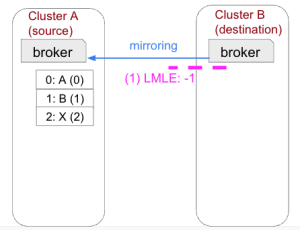
1. Cluster B creates a mirror and starts mirroring from the source cluster A. At this point, because the source cluster stores nothing about the LMLE for this partition, -1 will be returned. The "-1" means the source cluster (A) doesn't recognize any leader epoch in destination cluster (B), so all the logs should be truncated.
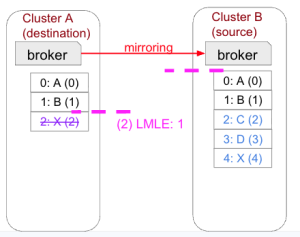
2. Revere mirroring. Cluster B becomes the source cluster. And before cluster B stops the mirroring from A, it stores the LMLE in the internal topic, which is 1 in this case. When cluster A mirrors from cluster B, it will first query the LMLE from cluster B, and then truncate every record beyond this leader epoch. That is, for cluster A and B, leader epochs for [0, 1] are in sync.
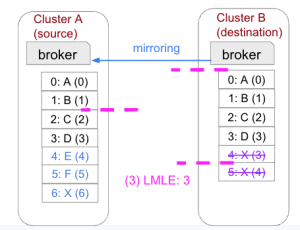
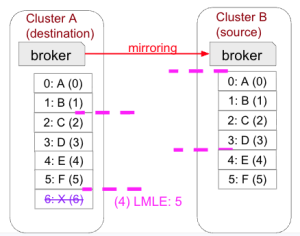
3. Reverse mirroring again. Cluster A stores LMLE 3 in the internal topic, and cluster B queries this LMLE and truncate records beyond leader epoch 3.
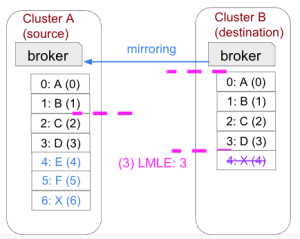
Please note that after LMLE truncation, it doesn't mean the log between 2 clusters are in sync. It only means the leader epoch history is in sync. The leader epoch history (i.e. the leader-epoch-checkpoint file in the partition directory) contains the entry for each [leader epoch, start offset]. However, the log might still not converge, yet. In the example below, after cluster B truncates LMLE 3, the offset 4 (in leader epoch 3) still exists, which is inconsistent with the source cluster. In this case, the second log truncation will be triggered by the replication protocol by the last fetched leader epoch comparison. So the offset 4 will be truncated this time, and the logs in these 2 clusters are completely in sync.