Current state: Under discussion
Discussion thread: thread-1 thread-2,
Voting thread:
JIRA: Related
Summary: Extract transaction identity and lifecycle management from `KafkaProducer` into a first-class
`TransactionSession` client abstraction, enabling any Kafka client (producer, share consumer, external coordinator, or any other entity)
to participate in transactions without producer coupling or reflection hacks.
Kafka's transaction coordinator is a general-purpose distributed transaction manager. Its metadata (TransactionMetadata) stores:
```
transactionalId   -- session identity
producerId        -- session token
producerEpoch     -- fencing token
state             -- lifecycle state (ONGOING, PREPARE_COMMIT, ...)
topicPartitions   -- participating partitions
txnTimeoutMs      -- correctness bound
```
None of these fields are producer-specific. The naming is historical -- producerId and producerEpoch could equally be called sessionId and sessionEpoch. The wire protocol RPCs (InitProducerId, AddPartitionsToTxn, EndTxn, TxnHeartbeat) carry only these identity fields. They do not carry a "client type" discriminator.
KIP-939 enabled Kafka to act as a formal participant in Two-Phase Commit (2PC) transactions by:
Adding Recovery APIs: Introduced prepareTransaction() and completeTransaction(), allowing external systems to coordinate Kafka's commit/abort status.
Resilient Resumption: Allowed new producers to resume a "prepared" transaction after a crash without automatically aborting it.
Removing Timeouts: Provided an enable2Pc mode that sets transaction timeouts to infinity, preventing premature aborts during external coordination.
While KIP-939 added the right tools, it put them in the wrong place:
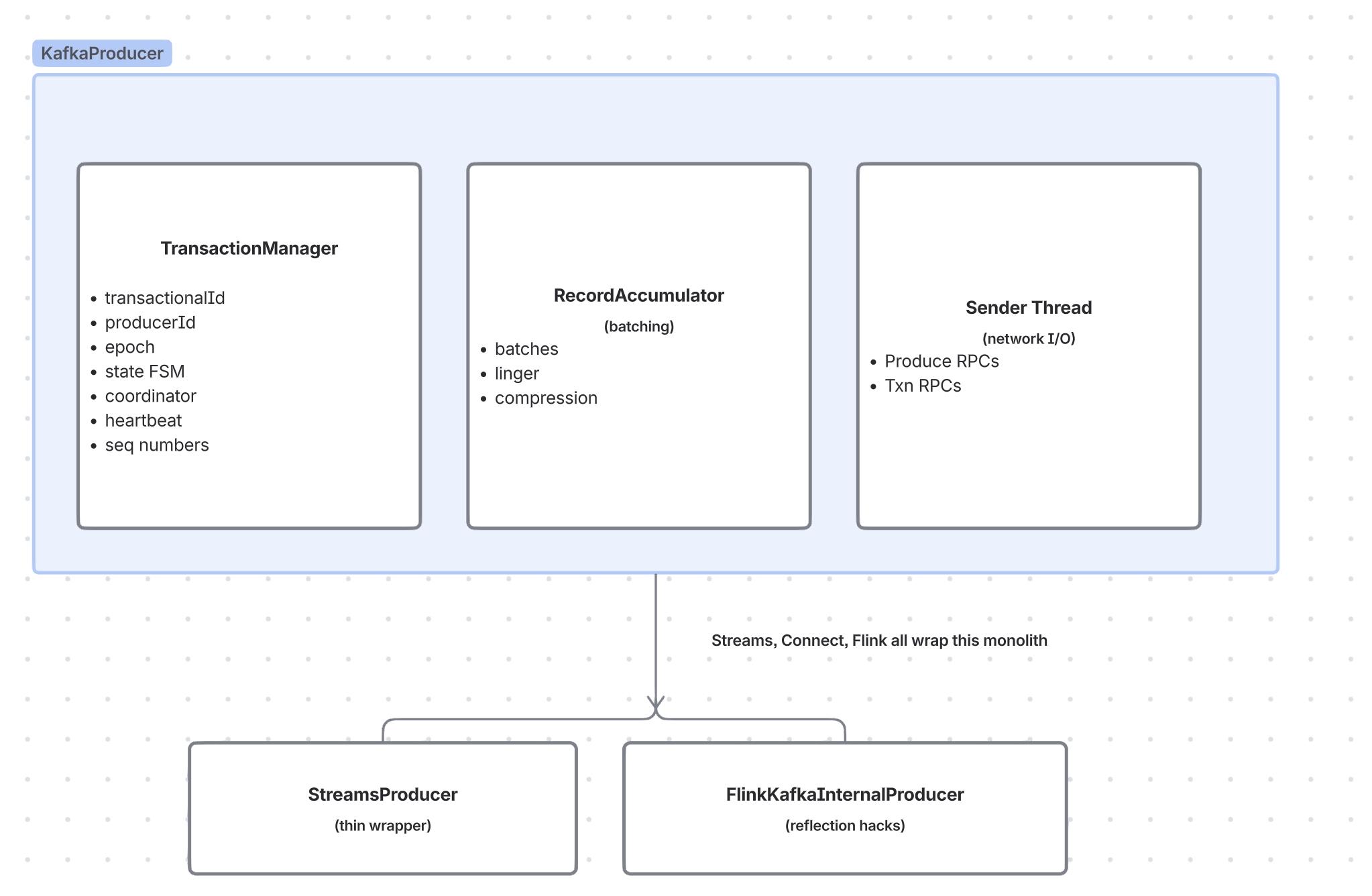
Wrong Abstraction: Transaction methods (like preparing and completing) are forced into the KafkaProducer class, even though they don't involve producing records.
Heavyweight Bloat: To simply commit a transaction, you are forced to instantiate a full KafkaProducer with its entire infrastructure (buffer pools, sender threads, serializers).
Inaccessible Logic: The core "brain" of transactions—the state machine and coordinator logic—is buried in internal producer packages, making it impossible for other clients (like consumers or custom coordinators) to use transactions independently.
The Kafka ecosystem already has six distinct entity types that interact with the transaction coordinator, each working around the producer-centric API:
| Entity | Role | Current Workaround | Core Pain Point |
| KafkaProducer | Owner | Native API | Transaction logic is monolithic and coupled to the produce path. |
| Kafka Streams | EOS Processor | Wraps Producer | Lifecycle is forced to match record batching. |
| Connect Source | EOS Ingest | Wraps Producer | Boundary management is coupled to producer lifecycle. |
| Connect Sink | KIP-1302 | N/A | No way to share transaction identity between consumer and producer. |
| Flink / 2PC | External Committer | Reflection | Fragile; manually forces state into TransactionManager internals. |
| Share Consumer | KIP-1289 | N/A | Must "borrow" Producer IDs without a proper client abstraction. |
TransactionSessionPackage: org.apache.kafka.clients.transaction
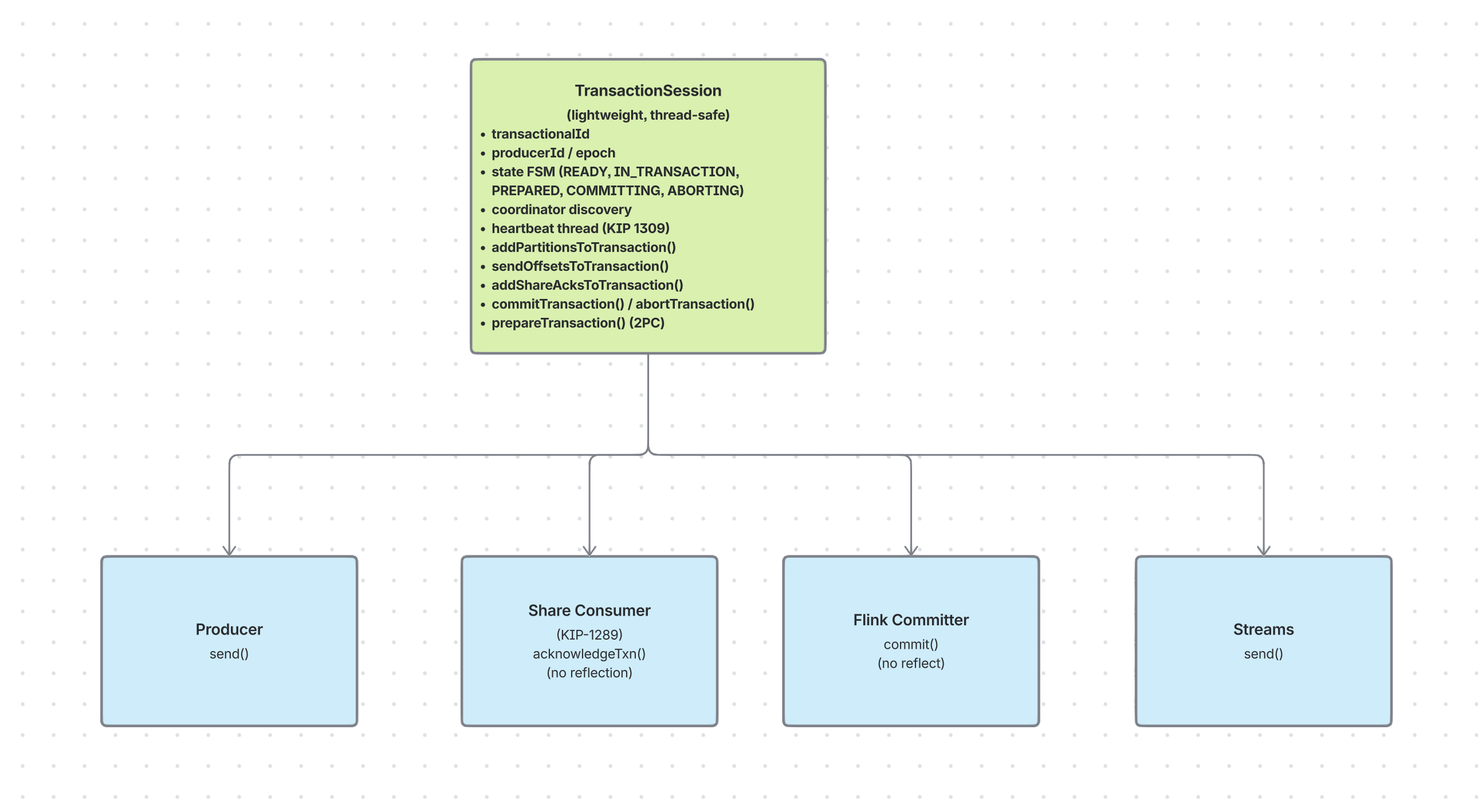
TransactionSession is a lightweight, thread-safe client focused strictly on transaction coordinator interaction.
It decouples lifecycle management from record production.
```
public class TransactionSession implements Closeable {

    public TransactionSession(Map<String, Object> configs);

    public static TransactionSession resume(
        String transactionalId,
        long producerId,
        short producerEpoch,
        Map<String, Object> configs
    );

    // --- Lifecycle ---
    public void initialize();
    public void beginTransaction();
    public PreparedTxnState prepareTransaction();
    public void completeTransaction(PreparedTxnState preparedTxnState);
    public void commitTransaction();
    public void abortTransaction();

    // --- Identity ---
    public String transactionalId();

    // --- Participation ---
    public void addPartitionsToTransaction(Collection<TopicPartition> partitions);

    public void sendOffsetsToTransaction(
        Map<TopicPartition, OffsetAndMetadata> offsets,
        ConsumerGroupMetadata groupMetadata
    );

    public void addShareAcksToTransaction(
        String groupId,
        Collection<ShareAcknowledgment> acknowledgments
    );

    // --- Liveness ---
    public void heartbeat();

    @Override
    public void close();
}
```
TransactionSession accepts a subset of existing producer configs plus one new config:
Config | Source | Description |
|---|---|---|
Existing producer config | The transactional ID for this session. Required. | |
Existing producer config | Correctness timeout for the transaction. | |
| Session heartbeat timeout. -1 to disable. | |
| Existing | Broker addresses for coordinator discovery. |
| Existing | Authentication/encryption settings. |
Existing | Client identifier for metrics and logging. |
No new broker-side configs. No new wire protocol RPCs. TransactionSession sends the same RPCs that KafkaProducer sends today:
FindCoordinator, InitProducerId, AddPartitionsToTxn, EndTxn, AddOffsetsToTxn, TxnOffsetCommit, TxnHeartbeat (KIP 1309).
KafkaProducer gains a new constructor and method to accept an external TransactionSession:
```
public class KafkaProducer<K, V> {
    /**
     * Bind producer to an external session.
     * Lifecycle methods (e.g., beginTransaction) throw IllegalStateException.
     */
    public KafkaProducer(Map<String, Object> configs, TransactionSession session);

    /**
     * Access the session (internal or external). Returns null if non-transactional.
     */
    public TransactionSession transactionSession();
}
```
Backward Compatibility: Constructing a producer with transactional.id in the config works as it does today.
It will internally create a TransactionSession and use its existing methods (initTransactions, beginTransaction, etc.) as convenience wrappers.
No code changes are required for existing users.
 void bindTransactionSession(TransactionSession session);
 void unbindTransactionSession();
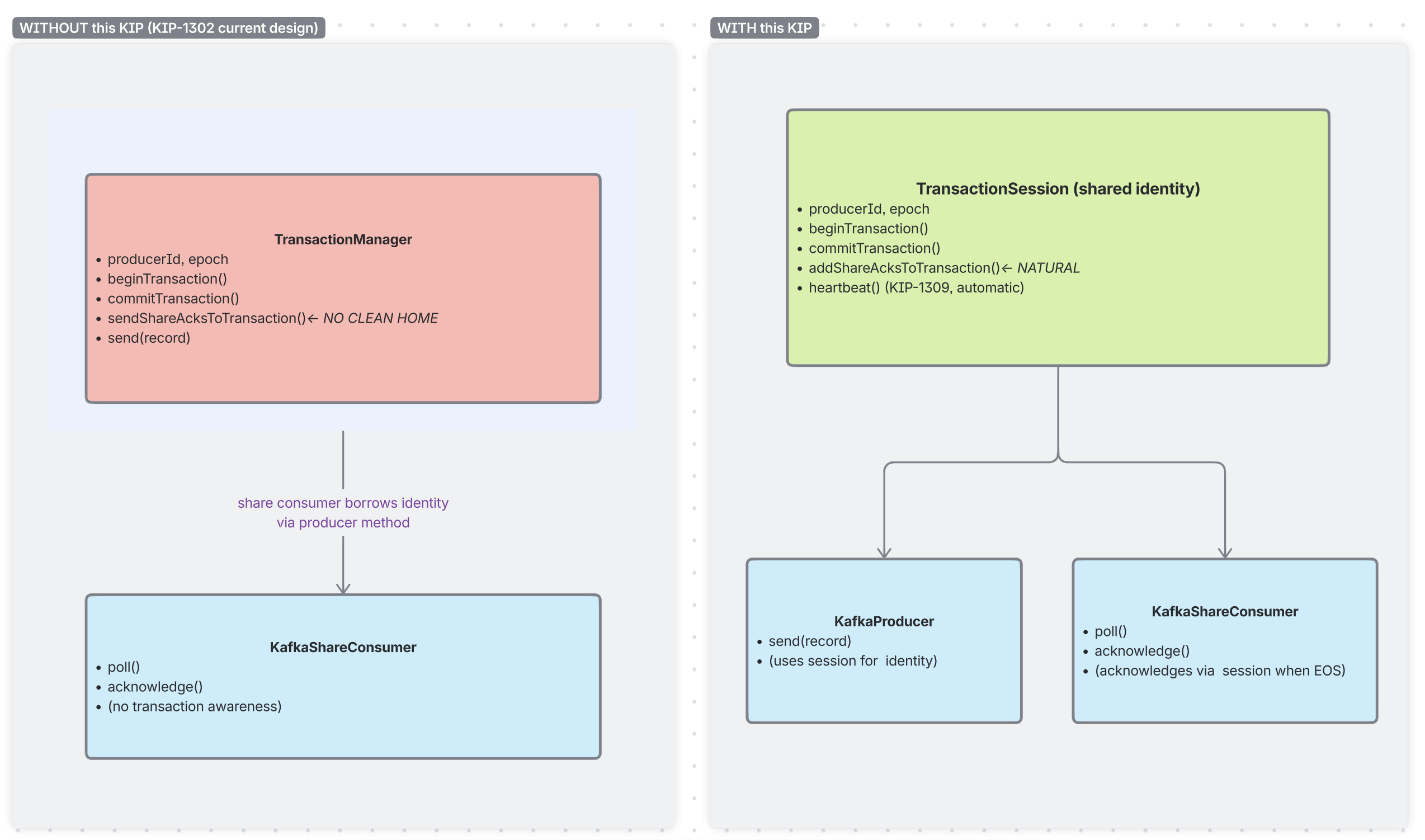
Before (current):
After (this KIP):
Flink's exactly-once KafkaSink separates the write path (writer subtask) from the commit path (committer).
```java
// Before (Flink -- reflection, fragile)
FlinkKafkaInternalProducer producer = new FlinkKafkaInternalProducer(configs);
producer.resumeTransaction(producerId, epoch);  // reflection on TransactionManager internals
producer.commitTransaction();

// After (this KIP -- public API, stable)
TransactionSession session = TransactionSession.resume(
    transactionalId, producerId, epoch, configs
);
session.commitTransaction();
session.close();
```
```
// 1. Open shared session
TransactionSession session = new TransactionSession(configs);
session.initialize();
session.beginTransaction();

// 2. Producer writes records using session identity
KafkaProducer<K, V> producer = new KafkaProducer<>(producerConfigs, session);
producer.send(outputRecord);

// 3. Share consumer acknowledges within the SAME transaction
shareConsumer.acknowledgeTransactionally(session, acknowledgments);

// 4. Atomic commit for both entities
session.commitTransaction();
```
```java
class ExactlyOnceWorkerSourceTask {
private TransactionSession session;
private KafkaProducer<byte[], byte[]> producer;
void maybeBeginTransaction() { session.beginTransaction(); }
void commitTransaction() { session.commitTransaction(); }
}
```
```java
// Phase 1: Prepare
kafkaSession.beginTransaction();
producer.send(records);
database.prepareTransaction(dbTxnId);
kafkaSession.prepareTransaction();
// Phase 2: Commit (Recovery-friendly)
TransactionSession resumed = TransactionSession.resume(txnId, pid, epoch, configs);
resumed.commitTransaction();
database.commitTransaction(dbTxnId);
```
// KIP-1302 exactly-once pattern with TransactionSession
void iterationExactlyOnce() {
    ConsumerRecords<byte[], byte[]> records = shareConsumer.poll(pollTimeout);

    session.beginTransaction();
    try {
        // 1. Producer writes output records
        for (SinkRecord record : convertMessages(records)) {
            producer.send(new ProducerRecord<>(outputTopic, record.key(), record.value()));
        }

        // 2. Share consumer acknowledges input within the SAME session
        session.addShareAcksToTransaction(
            shareConsumer.groupMetadata().groupId(),
            ShareAcknowledgements.fromRecords(records, AcknowledgeType.ACCEPT)
        );

        session.commitTransaction();
    } catch (Exception e) {
        session.abortTransaction();
    }
} |
Architectural comparison:
KafkaProducer constructed with transactional.id in the config continues to work exactly as today.
Internally, it creates a TransactionSession and delegates to it, but the public API (initTransactions(), beginTransaction(), commitTransaction(), abortTransaction(), sendOffsetsToTransaction()) is unchanged.
API | Status | Replacement |
|---|---|---|
| Not deprecated (convenience wrapper) |
|
| Not deprecated (convenience wrapper) |
|
| Not deprecated (convenience wrapper) |
|
| Not deprecated (convenience wrapper) |
|
| Not deprecated (convenience wrapper) |
|
No deprecations. The KafkaProducer convenience methods remain the recommended API for simple produce-and-commit patterns. TransactionSession is for advanced use cases: 2PC, cross-entity transactions, external coordinators.
TransactionSession requires the same ACLs as the current producer transaction API:
RPC | Resource Type | Operation |
|---|---|---|
|
|
|
|
|
|
|
|
|
|
|
|
|
|
|
When a TransactionSession is shared between a producer and a share consumer (Use Case 4.2), both entities operate under the same transactionalId and require the same ACLs.
The session identity is not multiplied -- there is one session, one producerId, one epoch, regardless of how many clients use it
| Test | Description |
| Session Lifecycle | Verify transitions: UNINITIALIZED → INITIALIZING → READY → IN_TRANSACTION → COMMITTING → READY. |
| Session Resume | Verify resume() starts in IN_TRANSACTION and can execute commitTransaction(). |
| Heartbeat Logic | Verify heartbeat thread lifecycle based on transaction.session.timeout.ms. |
| Backward Compatibility | Verify standard KafkaProducer transaction methods work via internal session delegation. |
| Epoch Fencing | Verify that a new session with the same transactional.id correctly fences the older session. |
Producer + external session E2E
Resume and commit from different process
| Test | Description |
| Legacy Producer | Run existing test suite on KafkaProducer without external sessions to ensure zero regression. |
| Mixed Mode | Run internal and external sessions concurrently on the same cluster to verify no interference. |
KIP-98 - Exactly Once Delivery and Transactional Messaging
KIP-939: Support Participation in 2PC
KIP-1289 Support Transactional Acknowledgments for Share Groups
KIP-1302: Support Share Groups (Queue Semantics) in Kafka Connect Sink Connectors
KIP-1309: Improve transaction liveness checking
--