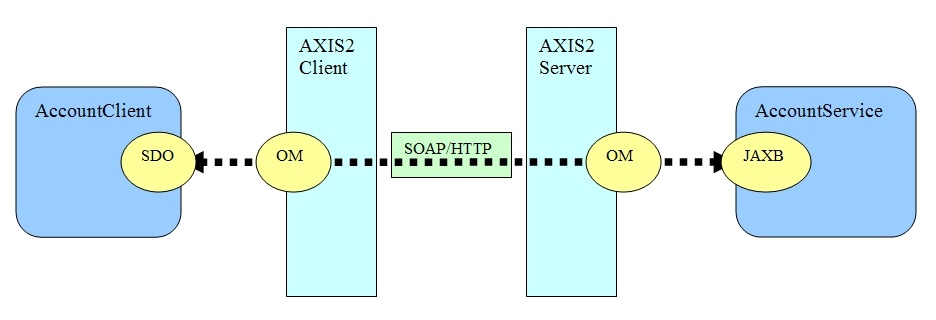
In an SOA environment, business functions can be implemented in various technologies such as Java, C++, Scripting, BPEL, Spring, OSGi and XQuery. The business data can also be represented in different formats such as DOM, JAXB, SDO, AXIOM or POJO. Business services often communicate with each other on the network using various protocols such as RMI, RMI/IIOP, SOAP/HTTP, JMS, JCA, FEED and JSON-RPC. The service collaborations are achieved by data exchanges between service components. The SCA programming model defines an extension model for interface, implementation and binding types. The extensibility is essential to SOA as we need to be able to leverage and integrate all kinds of technologies. On the data side, we also need the extensibility for different formats so that we can flow any data type that is supported by both the client and the provider.
Business data are represented in different ways even they are for the same infoset. For example, we can model a Customer business object as:
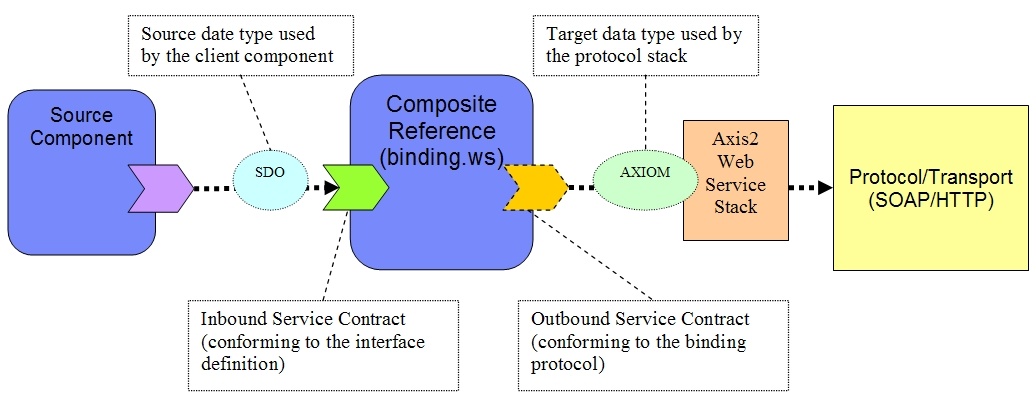
And different protocol implementation stacks support different data representations. For example, in the Web Service domain, we have:
Implementation technologies may impose requirements on the data too. For example,
Application developers should have the freedom to choose their preferred data representation and components with compatible data should be able to interoperate without the intervention of the business logic. With the ability to attach data transformation mediations to wires, this actually becomes a requirement to support any data type that can be mapped from client to provider and back again.
In any interchange there are just two things that are defined: the format of data that will be supplied by the client and the format of data that will be consumed by (delivered to) the provider. Neither client or provider needs to be aware of the format of data on the other end or of what gyrations the fabric went though in order to make the connection. As part of making the connection, it is the fabric's job to make the connection as efficient as possible, factoring in the semantic meaning of the data, the policies that need to be applied, and what the different containers support.
Each SCA implementation and binding type just needs to declare which data formats it can support for each endpoint it manages. The wiring framework need to know about these formats and about what transformations can be engaged in the invocation pipeline.
For example, the Axis2 transport may declare that it can support Axiom and StAX for a certain port and the Java container may declare that it can only handle SDOs for an implementation that expects to be passed a DataObject. The wiring framework can resolve this by adding a StAX->SDO transform into the pipeline.
The limitation here is whether a transformation can be constructed to match the formats on either end. If one exists then great, but as the number increases then developing n-squared transforms becomes impractical. A better approach would be to pick the most common formats and require bindings and containers to support those at a minimum, with other point-to-point transforms being added as warranted.
Let's look at a simple scenario. The business function is to report all accounts for a given customer. The data exchanged between the client and server side will be Customer and AccountReport. Let's assume that the business objects are modeled using XML schema and the client side will talk to the server side over Web Service using Axis2. The client program decides to use SDO to represent the business data while the server side prefers to use JAXB.
In this case, there are three data formats involved: SDO, JAXB and AXIOM (The AXIS2 XML Infoset) and all of them come from the same model in the following XSD type definitions:
    <xsd:complexType name="Customer">
        <xsd:sequence>
            <xsd:element name="id" type="xsd:string"></xsd:element>
            <xsd:element name="firstName" type="xsd:string"></xsd:element>
            <xsd:element name="lastName" type="xsd:string"></xsd:element>
        </xsd:sequence>
    </xsd:complexType>

    <xsd:complexType name="AccountReport">
        <xsd:sequence>
            <xsd:element name="id" type="xsd:string"></xsd:element>
            <xsd:element name="type" type="xsd:string"></xsd:element>
            <xsd:element name="balance" type="xsd:double"></xsd:element>
        </xsd:sequence>
    </xsd:complexType>
|
Client java component:
SDO_AccountReport getAccountReport(SDO_Customer customer); // SDO_Customer and SDO_AccountReport are generated SDO interfaces |
AXIS2 Web Service Stack:
OMElement getAccountReport(OMElement customer); // pseudo method, the operation is defined in WSDL |
Service java component:
JAXB_AccountReport getAccountReport(JAXB_Customer customer); // JAXB_Customer and JAXB_AccountReport are generated JAXB classes |
A databinding represents a specific data format in the Tuscany runtime. Each databinding has a unique name which identifies the data format.
Typical databindings
|
Please note the I/O kind of databindings are further defined by the type of the content. For example, the InputStream can feed XML stream, fastinfoset, or something else. The context of a String can be a XML document, a JSON string or a CSV. |
A transformer is the data conversation logic that transforms data from one format to another format. For example, a transformer can convert the DOM Node into a SDO dataobject. A transformer will be registered as an edge connecting the source databinding to the target databinding. The weight of a transformer represents the cost
of the transformation.
The following is an incomplete list of transformers that we ship in 1.0-incubating release.
org.apache.tuscany.sca.databinding.sdo.DataObject2String;source=commonj.sdo.DataObject,target=java.lang.String,weight=40 org.apache.tuscany.sca.databinding.sdo.DataObject2XMLStreamReader;source=commonj.sdo.DataObject,target=javax.xml.stream.XMLStreamReader,weight=10 org.apache.tuscany.sca.databinding.sdo.XMLDocument2String;source=commonj.sdo.helper.XMLDocument,target=java.lang.String,weight=40 org.apache.tuscany.sca.databinding.sdo.String2DataObject;source=java.lang.String,target=commonj.sdo.DataObject,weight=50 org.apache.tuscany.sca.databinding.sdo.XMLDocument2XMLStreamReader;source=commonj.sdo.helper.XMLDocument,target=javax.xml.stream.XMLStreamReader,weight=10 org.apache.tuscany.sca.databinding.sdo.XMLStreamReader2DataObject;source=javax.xml.stream.XMLStreamReader,target=commonj.sdo.DataObject,weight=15 org.apache.tuscany.sca.databinding.sdo.XMLStreamReader2XMLDocument;source=javax.xml.stream.XMLStreamReader,target=commonj.sdo.helper.XMLDocument,weight=15 org.apache.tuscany.sca.databinding.sdo.DataObject2Node;source=commonj.sdo.DataObject,target=org.w3c.dom.Node,weight=40 org.apache.tuscany.sca.databinding.sdo.Node2DataObject;source=org.w3c.dom.Node,target=commonj.sdo.DataObject,weight=40 org.apache.tuscany.sca.databinding.xml.InputSource2Node;source=org.xml.sax.InputSource,target=org.w3c.dom.Node,weight=40 org.apache.tuscany.sca.databinding.xml.InputStream2Node;source=java.io.InputStream,target=org.w3c.dom.Node,weight=40 org.apache.tuscany.sca.databinding.javabeans.DOMNode2JavaBeanTransformer;source=org.w3c.dom.Node,target=java.lang.Object,weight=10000 org.apache.tuscany.sca.databinding.xml.Node2String;source=org.w3c.dom.Node,target=java.lang.String,weight=40 org.apache.tuscany.sca.databinding.xml.Node2XMLStreamReader;source=org.w3c.dom.Node,target=javax.xml.stream.XMLStreamReader,weight=40 org.apache.tuscany.sca.databinding.javabeans.JavaBean2DOMNodeTransformer;source=java.lang.Object,target=org.w3c.dom.Node,weight=10000 org.apache.tuscany.sca.databinding.xml.Reader2Node;source=java.io.Reader,target=org.w3c.dom.Node,weight=40 org.apache.tuscany.sca.databinding.xml.SAX2DOMPipe;source=org.xml.sax.ContentHandler,target=org.w3c.dom.Node,weight=30 org.apache.tuscany.sca.databinding.xml.StreamDataPipe;source=java.io.OutputStream,target=java.io.InputStream,weight=50 org.apache.tuscany.sca.databinding.xml.String2Node;source=java.lang.String,target=org.w3c.dom.Node,weight=50 org.apache.tuscany.sca.databinding.xml.String2XMLStreamReader;source=java.lang.String,target=javax.xml.stream.XMLStreamReader,weight=50 org.apache.tuscany.sca.databinding.xml.Writer2ReaderDataPipe;source=java.io.Writer,target=java.io.Reader,weight=50 org.apache.tuscany.sca.databinding.xml.XMLStreamReader2Node;source=javax.xml.stream.XMLStreamReader,target=org.w3c.dom.Node,weight=40 org.apache.tuscany.sca.databinding.xml.XMLStreamReader2String;source=javax.xml.stream.XMLStreamReader,target=java.lang.String,weight=40 org.apache.tuscany.sca.databinding.xml.Node2SimpleJavaType;source=org.w3c.dom.Node,target=java:simpleType,weight=10000 org.apache.tuscany.sca.databinding.xml.SimpleJavaType2Node;source=java:simpleType,target=org.w3c.dom.Node,weight=10000 org.apache.tuscany.sca.databinding.axiom.Object2OMElement;source=java:simpleType,target=org.apache.axiom.om.OMElement,weight=10000 org.apache.tuscany.sca.databinding.axiom.OMElement2Object;source=org.apache.axiom.om.OMElement,target=java:simpleType,weight=10000 org.apache.tuscany.sca.databinding.axiom.OMElement2String;source=org.apache.axiom.om.OMElement,target=java.lang.String,weight=40 org.apache.tuscany.sca.databinding.axiom.OMElement2XMLStreamReader;source=org.apache.axiom.om.OMElement,target=javax.xml.stream.XMLStreamReader,weight=10 org.apache.tuscany.sca.databinding.axiom.String2OMElement;source=java.lang.String,target=org.apache.axiom.om.OMElement,weight=40 org.apache.tuscany.sca.databinding.axiom.XMLStreamReader2OMElement;source=javax.xml.stream.XMLStreamReader,target=org.apache.axiom.om.OMElement,weight=10 org.apache.tuscany.sca.databinding.jaxb.JAXB2Node;source=javax.xml.bind.JAXBElement,target=org.w3c.dom.Node,weight=30 org.apache.tuscany.sca.databinding.jaxb.Node2JAXB;source=org.w3c.dom.Node,target=javax.xml.bind.JAXBElement,weight=30 org.apache.tuscany.sca.databinding.jaxb.Reader2JAXB;source=java.io.Reader,target=javax.xml.bind.JAXBElement,weight=30 org.apache.tuscany.sca.databinding.jaxb.XMLStreamReader2JAXB;source=javax.xml.stream.XMLStreamReader,target=javax.xml.bind.JAXBElement,weight=10 org.apache.tuscany.sca.databinding.saxon.Node2NodeInfoTransformer;source=org.w3c.dom.Node,target=net.sf.saxon.om.NodeInfo,weight=10 org.apache.tuscany.sca.databinding.saxon.NodeInfo2NodeTransformer;source=net.sf.saxon.om.NodeInfo,target=org.w3c.dom.Node,weight=10 org.apache.tuscany.sca.databinding.saxon.Object2ValueTransformer;source=java.lang.Object,target=net.sf.saxon.value.Value,weight=10000 org.apache.tuscany.sca.databinding.saxon.Value2ObjectTransformer;source=net.sf.saxon.value.Value,target=java.lang.Object,weight=10000 org.apache.tuscany.sca.databinding.saxon.SimpleType2ValueTransformer;source=java:simpleType,target=net.sf.saxon.value.Value,weight=10000 org.apache.tuscany.sca.databinding.saxon.Value2SimpleTypeTransformer;source=net.sf.saxon.value.Value,target=java:simpleType,weight=10000 org.apache.tuscany.sca.databinding.saxon.NodeInfo2DataObjectTransformer;source=net.sf.saxon.om.NodeInfo,target=commonj.sdo.DataObject,weight=20 org.apache.tuscany.sca.databinding.saxon.DataObject2NodeInfoTransformer;source=commonj.sdo.DataObject,target=net.sf.saxon.om.NodeInfo,weight=10 org.apache.tuscany.sca.databinding.sdo2om.DataObject2OMElement;source=commonj.sdo.DataObject,target=org.apache.axiom.om.OMElement,weight=1000 org.apache.tuscany.sca.databinding.sdo2om.XMLDocument2OMElement;source=commonj.sdo.helper.XMLDocument,target=org.apache.axiom.om.OMElement,weight=1000 |
In Tuscany, we register transformers to form a graph as folllows:
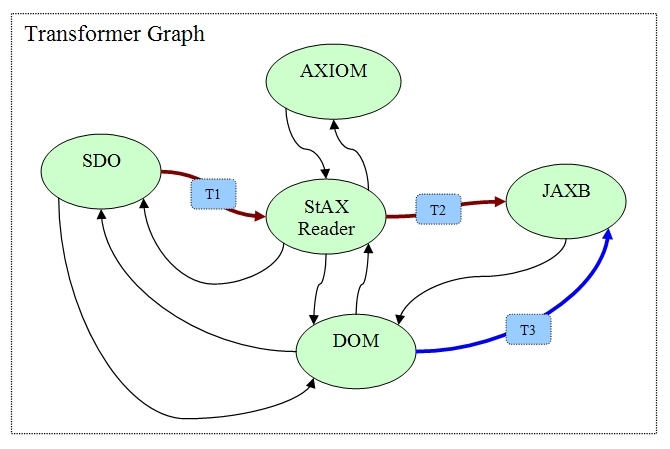
With the transformer graph, we support not only point-to-point transformations but also multiple-hop transformations. This approach greatly reduces the number of transformers required and makes it possible to transform data without a direct transformation logic. It's very common that some databindings will be supported as the intermediaries, for example, the XML Sting, DOM Node and StAX XMLStreamReader are very populate in the XML world.
The algorithm to calculate the transformation path
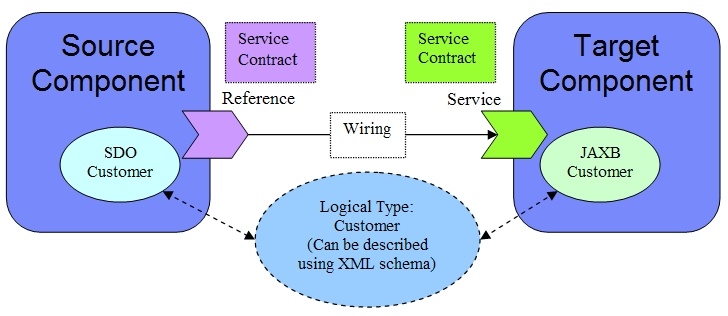
DataType is the decription of the data. It contains three pieces: the data binding, the physical type and the logical type. The runtime's main job is to connect user components together so typically the actual type used would be determined by the user code that implements the source or target. The databinding framework's role here is to convert from the type used by the source to the type used by the target. The internal types used by the runtime should not influence this - which is an essential separation to maintain given the components and the wire connecting them need to work on different runtimes (implemented in different languages).
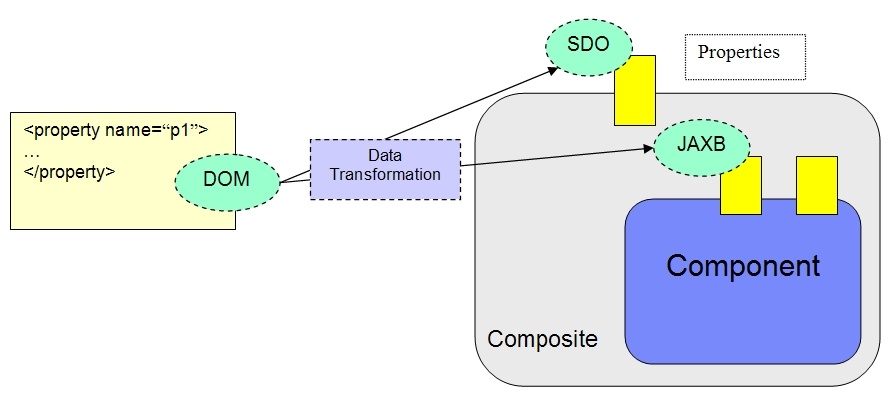
Where runtime types do matter is in the conversion between some serialized form and an in-memory representation and the two places where that occurs are in the configuration properties and in the binding implementations. To handle configuration properties (with the XPath requirement) we use DOM in the Java runtime. Each transport binding also tends to deserialize using a specific technology - for example, AXIOM for Axis2, JAXB for JAX-WS, Serializable for RMI and so the databinding framework is used to convert between the form generated by the binding and the form used by the component.
The logical type represents the data type the user thinks is flowing across a wire. This could be a Java type, a XML type, a CORBA type, whatever depending on the /logical/ service contract defined in the assembly.
The physical type is the actual representation of that type that is flowed by the runtime. In the Java runtime this will always be a Java type (i.e. some subclass of Object). In some cases it will be the same as the logical type - e.g. when a Java component calls another Java component over a local wire using a Java interface then both logical and physical types will be the same. In many cases though they will be different - for example, if the service contract was WSDL then the logical type would be the XML type used by the WSDL.
Within the runtime the same logical type may have different physical forms. For example, the same XML document could be represented physically as a DOM, a StAX stream, an SDO, a JAXB object, or an AXIOM stream. The framework supports conversion between these different physical forms.
1. A component (A) consumes a service provided by another component (B). The implementation of A prefers SDO while the implementation of B prefers JAXB.
In the SCA term, A is wired to B using a reference.
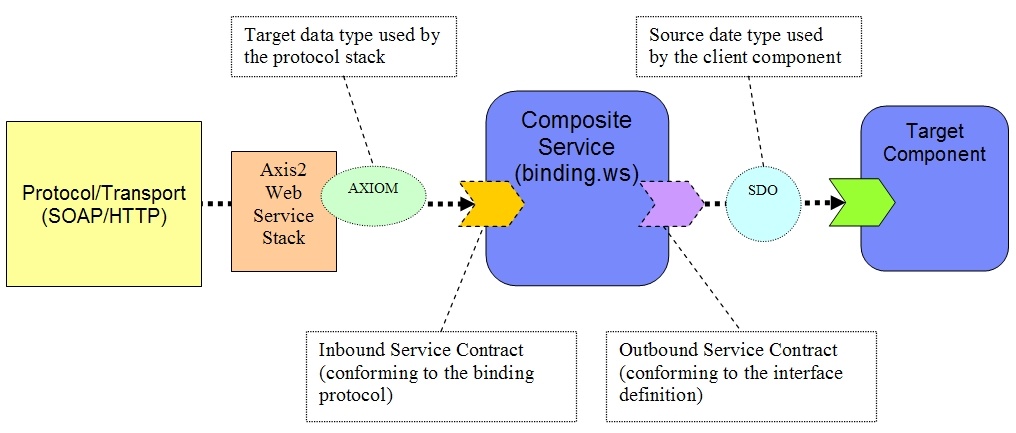
2. A component (A) consumes a web service using axis2. Axis2 engine expects to handle AXIOM objects.
3. A component is exposed as a service over a transport/protocol.
Where runtime types do matter is in the conversion between some serialized form and an in-memory representation and the two places where that occurs are in the configuration properties and in the binding implementations. To handle configuration properties (with the XPath requirement) we use DOM in the Java runtime; I believe the C++ runtime uses SDO. Each transport binding also tends to deserialize using a specific technology - for example, AXIOM for Axis2, JAXB for JAX-WS, Serializable for RMI and so the databinding framework is used to convert between the form generated by the binding and the form used by the component.
interfaces for services and references are the contracts for SCA assembly.
The DataBindingJavaInterfaceProcessor is responsible to introspect the java interfaces to figure out the databindings of the parameters and return types. It delegates to all of the databinding implementations which will set the databinding and logical type if such data type is recognized by the databinding. This introspection process can handle most of the cases as the java types usually have some patterns, for example, implementing a know interface.
DataBindingRuntimeWireProcessor is responsible to insert a DataTransformationInteceptor into the invovcation chains if the data transformation is required between the source and target operations. Depending on the invocation patterns, it uses the effective interface contracts to determine if transformation should be applied.
Typically, there are three cases:
Interaction |
Effective Source Interface contract |
Effective Target Interface Contract |
A SCA component talks to another SCA component over a remotable interface using binding.sca |
The interface contract of the reference defined by the source component type |
The interface contract of the service defined by the target component type |
A SCA component talks to an external service using binding.x |
The interface contract of the reference defined by the source component type |
The interface contract imposed by the binding protocol |
The request from binding.y is routed to a component service |
The interface contract imposed by binding.y |
The interface contract of the service defined by the target component type |
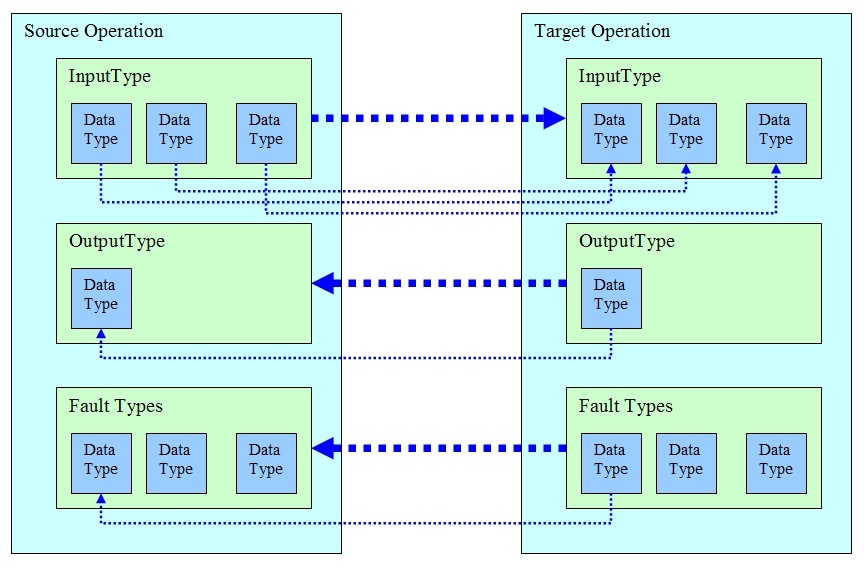
Deal with interfaces defined using different IDLs
The signature of an operation is modeled as follows:
<?xml version="1.0" encoding="UTF-8"?>
<wsdl:definitions name="AccountService" targetNamespace="http://www.example.org/AccountService/"
    xmlns:wsdl="http://schemas.xmlsoap.org/wsdl/" xmlns:tns="http://www.example.org/AccountService/"
    xmlns:xsd="http://www.w3.org/2001/XMLSchema">
    <wsdl:types>
        <xsd:schema xmlns:xsd="http://www.w3.org/2001/XMLSchema"
            targetNamespace="http://www.example.org/AccountService/">

            <xsd:complexType name="Customer">
                <xsd:sequence>
                    <xsd:element name="id" type="xsd:string"></xsd:element>
                    <xsd:element name="firstName" type="xsd:string"></xsd:element>
                    <xsd:element name="lastName" type="xsd:string"></xsd:element>
                </xsd:sequence>
            </xsd:complexType>

            <xsd:complexType name="AccountReport">
                <xsd:sequence>
                    <xsd:element name="id" type="xsd:string"></xsd:element>
                    <xsd:element name="type" type="xsd:string"></xsd:element>
                    <xsd:element name="balance" type="xsd:double"></xsd:element>
                </xsd:sequence>
            </xsd:complexType>

            <xsd:element name="getAccountReport">
                <xsd:complexType>
                    <xsd:sequence>
                        <xsd:element name="customer" type="tns:Customer"></xsd:element>
                    </xsd:sequence>
                </xsd:complexType>
            </xsd:element>

            <xsd:element name="getAccountReportResponse">
                <xsd:complexType>
                    <xsd:sequence>
                        <xsd:element name="report" type="tns:AccountReport"></xsd:element>
                    </xsd:sequence>
                </xsd:complexType>
            </xsd:element>
        </xsd:schema>
    </wsdl:types>
    <wsdl:message name="getAccountReportRequest">
        <wsdl:part name="parameters" element="tns:getAccountReport"></wsdl:part>
    </wsdl:message>
    <wsdl:message name="getAccountReportResponse">
        <wsdl:part name="return" element="tns:getAccountReportResponse"></wsdl:part>
    </wsdl:message>
    <wsdl:portType name="AccountService">
        <wsdl:operation name="getAccountReport">
            <wsdl:input message="tns:getAccountReportRequest"></wsdl:input>
            <wsdl:output message="tns:getAccountReportResponse"></wsdl:output>
        </wsdl:operation>
    </wsdl:portType>
</wsdl:definition
|
The WrapperHandler provides wrapper style WSDL wrapping/unwrapping support
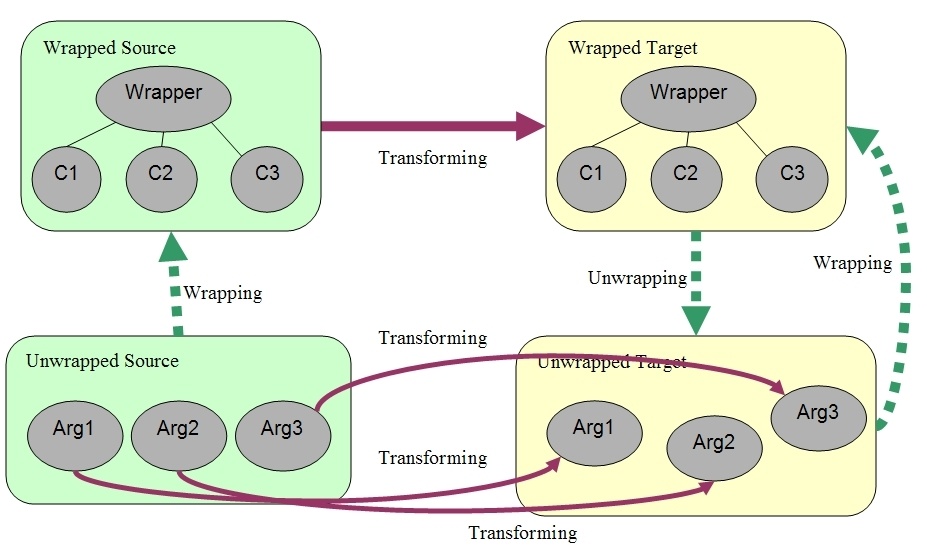
The Tuscany databinding framework can be extended in two ways:
1. Add more databinding providers to support new formats to represent business data
2. Add more transformers to facilitate the data exchange accross databindings
Databindings and transformers can be plugged into Tuscany runtime following the Tuscany extensibility story. It can be achieved in the following steps:
Add a new databinding:
1. Provide a java class which implements the DataBinding interface. You can subclass the BaseDataBinding.
2. Register your databindings against the DataBindingExtensionPoint.
Add a new transformer:
1. Provide a java class which implements the Transformer interface. You can subclass the BasePullTransformer or BasePushTransformer.
2. Register your transformers against the TransformerExtensionPoint.
/**
 * DataBinding represents a data representation, for example, SDO, JAXB and AXIOM
 */
public interface DataBinding {
    /**
     * A special databinding for input message of an operation
     */
    String IDL_INPUT = "idl:input";
    /**
     * A special databinding for output message of an operation
     */
    String IDL_OUTPUT = "idl:output";
    /**
     * A special databinding for fault message of an operation
     */
    String IDL_FAULT = "idl:fault";
    /**
     * The name of a databinding should be case-insensitive and unique
     *
     * @return The name of the databinding
     */
    String getName();

    /**
     * Get the aliases for the databinding
     *
     * @return An array of aliases
     */
    String[] getAliases();

    /**
     * Introspect and populate information to a DataType model
     *
     * @param dataType The data type to be introspected
     * @param annotations The java annotations
     * @return true if the databinding has recognized the given data type
     */
    boolean introspect(DataType dataType, Annotation[] annotations);

    /**
     * Introspect the data to figure out the corresponding data type
     *
     * @param value The object to be checked
     * @return The DataType or null if the java type is not supported by this databinding
     */
    DataType introspect(Object value);

    /**
     * Provide a WrapperHandler for this databinding
     * @return A wrapper handler which can handle wrapping/wrapping for this databinding
     */
    WrapperHandler getWrapperHandler();

    /**
     * Make a copy of the object for "pass-by-value" semantics
     * @param source object to copy
     * @return copy of the object passed in as argument
     */
    Object copy(Object object);

    /**
     * Get the type mapper for simple types
     * @return The databinding-specific simple type mapper
     */
    SimpleTypeMapper getSimpleTypeMapper();

    /**
     * Get the handler that can handle exceptions/faults in the
     * databinding-specific way
     *
     * @return An instance of the exception handler
     */
    ExceptionHandler getExceptionHandler();
}
|
/**
 * A transformer provides the data transformation from source type to target type. The cost of the transformation is
 * modeled as weight.
 */
public interface Transformer {
    /**
     * Get the source type that this transformer transforms data from. The type is used as the key when the transformer
     * is registered with TransformerRegistry.
     *
     * @return A key indentifying the source type
     */
    String getSourceDataBinding();

    /**
     * Get the target type that this transformer transforms data into. The type is used as the key when the transformer
     * is registered with TransformerRegistry.
     *
     * @return A key indentifying the target type
     */
    String getTargetDataBinding();

    /**
     * Get the cost of the transformation. The weight can be used to choose the most efficient path if there are more
     * than one available from the source to the target.
     *
     * @return An integer representing the cost of the transformation
     */
    int getWeight();
}


/**
 * PullTransformer transforms data from one binding format to the other one which can be directly consumed
 *
 * @param <S> The source data type
 * @param <R> the target data type
 */
public interface PullTransformer<S, R> extends Transformer {
    /**
     * Transform source data into the result type.
     *
     * @param source The source data
     * @param context The context for the transformation
     * @return The transformed result
     */
    R transform(S source, TransformationContext context);
}
|
To regsiter one or more databindings, you need to add entries to a plain text file named as META-INF/services/org.apache.tuscany.sca.databinding.DataBinding. This service provider file needs to be on the classpath when Tuscany is bootstrapped.
# implementation classes for the databindings org.apache.tuscany.sca.databinding.axiom.AxiomDataBinding;type=org.apache.axiom.om.OMElement,name=axiom |
The syntax is: <implementation_class_name>;type=<databinding_id>,name=<databinding_alias>
To register one or more transformers, you need to add entries to a plain text file named as META-INF/services/org.apache.tuscany.sca.databinding.PullTransformer. This service provider file needs to be on the classpath when Tuscany is bootstrapped.
# Implementation classes for the transformers org.apache.tuscany.sca.databinding.axiom.Object2OMElement;source=java:simpleType,target=org.apache.axiom.om.OMElement,weight=10000 org.apache.tuscany.sca.databinding.axiom.OMElement2Object;source=org.apache.axiom.om.OMElement,target=java:simpleType,weight=10000 org.apache.tuscany.sca.databinding.axiom.OMElement2String;source=org.apache.axiom.om.OMElement,target=java.lang.String,weight=40 org.apache.tuscany.sca.databinding.axiom.OMElement2XMLStreamReader;source=org.apache.axiom.om.OMElement,target=javax.xml.stream.XMLStreamReader,weight=10 org.apache.tuscany.sca.databinding.axiom.String2OMElement;source=java.lang.String,target=org.apache.axiom.om.OMElement,weight=40 org.apache.tuscany.sca.databinding.axiom.XMLStreamReader2OMElement;source=javax.xml.stream.XMLStreamReader,target=org.apache.axiom.om.OMElement,weight=10 |
The syntax is: <implementation_class_name>;source=<source_databinding_id>,target=<target_databinding_id>,weight=<cost_of_the_transformation>