<div class="content"> |
The objective of this handler is to simplify the development of extender-based architecture. This architecture-style is based on two different entities:
|
|
This architecture-style is based on two different roles:
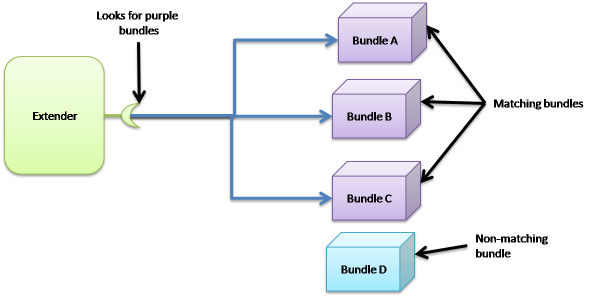
The relation is basically a 1..n relation. The extender tracks extensions. The particularity of this architecture-style is that extensions are packaged in different bundles. An extension is detected by analyzing the bundle. Indeed these bundles can have a special mark in their manifest of a special file...
Implementing an extender pattern could be complex as the extender needs to track these marks dynamically. When a bundle starts, it needs to look at the mark. Then a bundle leave, the extender must release all object created from this bundle.
This handler tracks bundle for you based on the specified required mark. At each time a matching bundle appears or disappears, a callback is invoked. The mark is currently a header in the bundle manifest.
Nowadays, a lot of frameworks use this pattern such as iPOJO it-self (to find both bundles containing components and bundles adding a new implementation type), Spring-DM ...
First of all, you need to configure the component type to use the handler such as:
<ipojo xmlns:extender="org.apache.felix.ipojo.extender">
	<component
		classname="org.apache.felix.ipojo.extender.MyExtender">

                <!-- Extender Pattern handler configuration -->
		<extender:extender
                  extension="My-Extension"
                  onArrival="onBundleArrival"
                  onDeparture="onBundleDeparture"
                />

		<callback transition="invalidate" method="stopping" />
		<callback transition="validate" method="starting" />
		<provides />
	</component>
</ipojo>
|
Notice that, this handler is an external handler. So, it uses the "org.apache.felix.ipojo.extender" namespace.
You can also use annotations:
@Component
@Extender(
	onArrival="onBundleArrival",
	onDeparture="onBundleDeparture",
	extension="My-Extension")
public class MyExtender {

	@Validate
	public void starting() {
	  // ...
	}

	@Invalidate
	public void stopping {
	  // ...
	}

	void onBundleArrival(Bundle bundle, String header) {
	         // Do something
	}

	void onBundleDeparture(Bundle bundle) {
	        // Do something
	}
}
|
The methods specified methods will be called when a matching bundle arrives or leaves.
In the previous example, these methods could be:
void onBundleArrival(Bundle bundle, String header) {
         // Do something
}

void onBundleDeparture(Bundle bundle) {
        // Do something
}
|
Notice the different signatures of the methods. The arrival method is called with the arriving bundle and the matching header value (i.e. the value of the My-Extension header of the bundle manifest). The departure method just receives the leaving bundle.
The handler has only three mandatory attributes:
<div class="box"> <div class="box-yellow-header"> <div class="box-yellow-title"> <img src="http://people.apache.org/~clement/ipojo/site/warning.gif"> <b>Called despite being invalid</b> </div> </div> <div class="box-yellow-content"> The implementation will be notified of arrivals and departures despite the instance is invalid. Indeed, the implementation must release all objects created from another bundle as soon it leaves. </div> <div class="box-yellow-footer"></div> </div> |
The handler is available on the download page.
Sources are available on the Felix trunk at the following location: http://svn.apache.org/repos/asf/felix/trunk/ipojo/handler/extender/
It is possible to configure the handler with a simple annotation available in the annotation pack ('annotation' project in the iPOJO trunk). Here is an example of usage:
import org.apache.felix.ipojo.annotations.Component;
import org.osgi.framework.Bundle;

@Component
@org.apache.felix.ipojo.extender.Extender(extension="foo", onArrival="onArrival", onDeparture="onDeparture")
public class Extender {

    public void onArrival(Bundle bundle, String foo) {
        // do something
    }

    public void onDeparture(Bundle bundle) {
        // do something
    }
}
|
The extension attribute allows setting the bundle filter.
The Junit4OSGi framework, available here , uses this handler to track Junit Test Suite offered by the installed bundles. The Junit4Osgi bundle has a component using this handler to be notified when a bundle with the Test-Suite header appears or leaves.