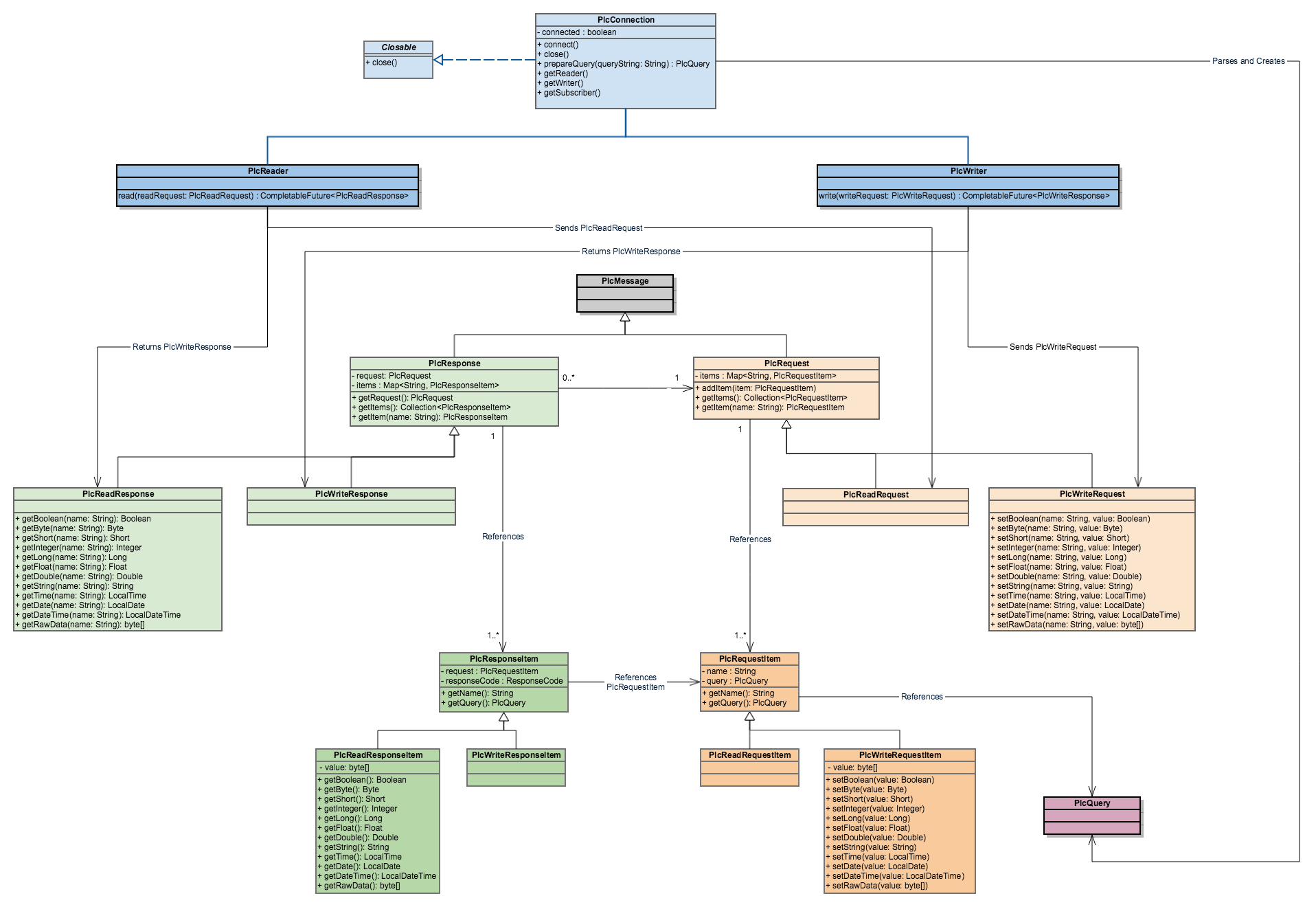
I removed the "getLister" method as I haven't seen any protocol or use-case where this actually made sense.
NOTE: I would suggest to not remove PlcReadRequestItem or PlcWriteResponseItem class entirely, even if we could simply make PlcRequestItem and PlcResponseItem non-abstract. For simplicity of the API I would opt for keeping it ... so we always have matching pairs of PlcXYZRequestItem and PlcXYZResponseItems.
Here comes some example code to demonstrate how a Programm using this API could look like.
    public static void main(String[] args) throws Exception {
        PlcDriverManager manager = new PlcDriverManager();
        try (PlcConnection conn = manager.getConnection("s7://192.168.167.211/0/0")) {
            Optional<PlcReader> optionalReader = conn.getReader();
            if (!optionalReader.isPresent()) {
                return;
            }

            PlcReader Reader = optionalReader.get();

			PlcReadRequest request = new PlcReadRequest(
				new PlcReadRequestItem("parameterX", conn.prepareQuery("%DB8.DBX3:INT")),
				new PlcReadRequestItem("parameterY", conn.prepareQuery("%DB9.DBW4:DOUBLE")),
				new PlcReadRequestItem("others", conn.prepareQuery("%DB2.DBW2:BYTE[10]")));

            CompletableFuture<PlcReadResponse> future = reader.read(request);

            PlcReadResponse response = future.get();


			// Access an item by it's name.
            System.out.println("Parameter X: " + response.getInteger("parameterX"));


			// Iterate over all items
			for(PlcReadResponseItem item: response.getItems()) {
				// Conditionally handle an item by it's name.
				if("parameterY".equals(item.getName()) {
					// If using getInteger without an index, the index 0 is used.
					System.out.println("Parameter y: " + item.getDouble());
				}
				else if("others".equals(item.getName()) {
					System.out.println("Others:");
					// Handle multi-value items.
					for(int i = 0; i < item.getNumValues(); i++) {
						// Intentionally using short instead of byte
						// In this case it will return Byte[i] but convert that into a Short.
						System.out.println(" - " + item.getShort(i));
					}
				}
			}
        }
} |