DUE TO SPAM, SIGN-UP IS DISABLED. Goto Selfserve wiki signup and request an account.
This page is meant as a template for writing a KIP. To create a KIP choose Tools->Copy on this page and modify with your content and replace the heading with the next KIP number and a description of your issue. Replace anything in italics with your own description.
Status
Current state: Under Discussion
Discussion thread: here
JIRA: [KAFKA-19883](
KAFKA-19883
-
Getting issue details...
STATUS
)
Please keep the discussion on the mailing list rather than commenting on the wiki (wiki discussions get unwieldy fast).
Motivation
Share Groups currently support only immediate acknowledgement modes (IMPLICIT/EXPLICIT). This causes data loss in distributed streaming frameworks:
1. Worker acknowledges records → Records removed from Kafka
2. Checkpoint fails before sink write
3. Records lost (acknowledged but never persisted)
Goal: Enable exactly-once read semantics via transactional acknowledgements.
We will be following the similar existing pattern we have in Kafka Producer Transactions.
Use Cases
- Apache Flink: Exactly-once checkpointing with Share Group sources
- Apache Spark: Structured Streaming with Share Group consumers
- Any coordinator-worker streaming framework requiring atomic acknowledgements
Public Interfaces
APIs
- KafkaProducer.sendShareAcksToTransaction(acks, groupId) - for CTP
- This mirrors the existing KafkaProducer.sendOffsetsToTransaction(offsets, groupMetadata)
```
// When you have a producer and want atomic output + acks
producer.beginTransaction();
producer.send(output);
producer.sendShareAcksToTransaction(acks, groupId);
producer.commitTransaction();
```
- TransactionalShareAcknowledger - for standalone ack transactions
```
// When there's no producer (Flink source, Spark source, pure consumer)
public class TransactionalShareAcknowledger implements Closeable {
public TransactionalShareAcknowledger(Map<String, Object> config);
public void initTransactions();
public void commitAcknowledgements(
Map<TopicPartition, List<ShareAcknowledgement>> acks, String groupId);
public void abortAcknowledgements();
public void close();
}
```
Internally, TransactionalShareAcknowledger is a thin wrapper around a KafkaProducer (or its TransactionManager). It use the exact same RPCs - InitProducerId, AddShareAcksToTxn, TxnShareAcknowledge, EndTxn.
No new server-side infrastructure needed.
```
// TransactionalShareAcknowledger — internally just wraps a KafkaProducer
TransactionalShareAcknowledger acknowledger =
new TransactionalShareAcknowledger(config); // config has transactional.id
acknowledger.initTransactions();
acknowledger.commitAcknowledgements(acks, shareGroupId); // begin+ack+commit in one call
```
Coordinator API
- Reuses the existing TransactionCoordinator
- new server-side component is a completeTransaction() method on ShareCoordinator, mirroring GroupCoordinator.completeTransaction().
- WriteTxnMarkers as the mechanism for the transaction coordinator to tell the group coordinator to complete transactional operations on __consumer_offsets
- For consumer group we have => groupCoordinator.completeTransaction(partition, ...)
- Similarly implement shareCoordinator.completeTransaction(partition, ...) for share group
New Configuration
Config Default Description
share.acknowledgement.mode explicit Values: implicit, explicit, transactional
share.transaction.timeout.ms 60000 Maximum transaction duration before auto-abort
share.transaction.max.pending 5 Maximum concurrent transactions per group
New Metrics
Metric Type Description
share-transaction-active Gauge Active transactions
share-transaction-prepare-time-ms Histogram Prepare latency
share-transaction-commit-time-ms Histogram Commit latency
share-transaction-abort-total Counter Aborted transactions
share-transaction-timeout-total Counter Timed-out transactions
Proposed Changes
1. Two-Phase Commit Protocol
Transaction States Transitions
existing Kafka 2PC (TransactionState: ONGOING→PREPARE_COMMIT→COMPLETE_COMMIT)
- EMPTY -> ONGOING -> PREPARE -> ABORTED (abort after prepare)
- EMPTY -> ONGOING -> ABORTED (early abort)
Sequence Diagram
Two-Phase Commit Protocol Flow:
Step 1: Coordinator sends BeginBatchTxn(id) to Broker
Step 2: Executor-1 calls poll() to Broker - gets records
Step 3: Executor-2 calls poll() to Broker - gets records
Step 4: Executor-1 sends ack(txnId, records) to Broker - records become LOCKED
Step 5: Executor-2 sends ack(txnId, records) to Broker - records become LOCKED
Step 6: Coordinator sends PrepareBatchTxn(id) to Broker - state becomes PREPARE
Step 7: Broker responds "prepared" to Coordinator
Step 8: Coordinator sends CommitBatchTxn(id) to Broker - LOCKED records become ACKNOWLEDGED
Step 9: Broker responds "committed" to Coordinator
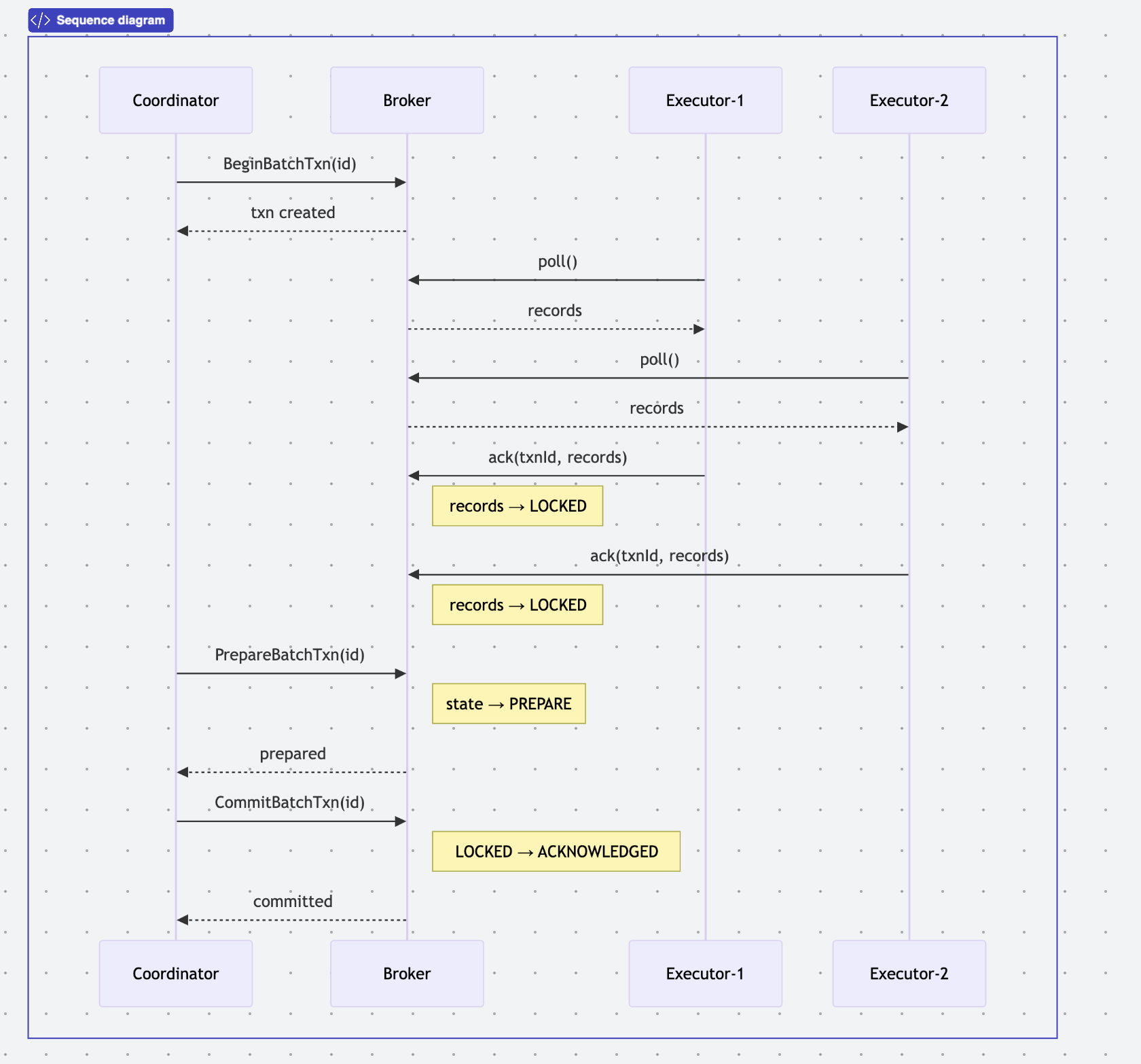
This KIP reuses Kafka's existing two-phase commit protocol:
- EndTxn(COMMIT) transitions the transaction to PREPARE_COMMIT in __transaction_state
- WriteTxnMarkers dispatches commit markers to all partitions (data topics, __consumer_offsets, and now __share_group_state)
- When all markers are confirmed, state transitions to COMPLETE_COMMIT
Transaction metadata stays in __transaction_state.
Share acks are written transactionally to __share_group_state using CoordinatorRuntime.scheduleTransactionalWriteOperation().
Failure Handling
existing TransactionCoordinator recovery
2. Wire Protocol Details
TxnShareAcknowledgeRequest
```
ShareAcknowledgeTransactionalRequest => GroupId TransactionId [Topics]
GroupId => STRING
TransactionId => STRING
Topics => TopicId [Partitions]
Partitions => Partition [AcknowledgementBatches]
AcknowledgementBatches => FirstOffset LastOffset AcknowledgeType
```
ShareBeginTransactionRequest
Use existing InitProducerIdRequest
SharePrepareTransactionRequest
Use existing EndTxnRequest
ShareCommitTransactionRequest / ShareAbortTransactionRequest
Handled by existing WriteTxnMarkersRequest (inter-broker) and EndTxnRequest(ABORT)
AddShareAcksToTxnRequest
mirrors AddOffsetsToTxnRequest; This tells the TransactionCoordinator to add __share_group_state partitions to the producer's transaction.
Consume-Transform-Produce Pattern
This is the exactly-once guarantee: either both output AND acks commit, or neither does:
```
KafkaShareConsumer<K, V> consumer = new KafkaShareConsumer<>(props); // NOT transactional
KafkaProducer<K, V> producer = new KafkaProducer<>(props); // transactional.id
producer.initTransactions();
while (true) {
ConsumerRecords<K, V> records = consumer.poll(...); // ← just reads, not transactional
producer.beginTransaction();
for (var record : records) {
producer.send(new ProducerRecord<>("output", transform(record)));
}
producer.sendShareAcksToTransaction(buildAcks(records), "my-share-group"); // transactional write
producer.commitTransaction();
// Atomically: output records committed + share acks committed
// If abort: output rolled back + acks discarded → records return to AVAILABLE
}
```
In the existing consumer group CTP pattern, the same thing happens (in the above code instead of KafkaShareConsumer, use KafkaConsumer and Consumer offsets to __consumer_offsets).
If abortTransaction() is called (or the transaction times out):
- Output records get ABORT markers -> consumers with read_committed skip them
- Share acks are discarded -> records stay ACQUIRED -> acquisition lock timeout -> records return to AVAILABLE -> re-delivered to another consumer
Compatibility, Deprecation, and Migration Plan
Impact on Existing Users
- No breaking changes for existing Share Group users
- `transactional` mode is opt-in via `share.acknowledgement.mode` config
- Existing `implicit` and `explicit` modes continue to work unchanged
Migration Path
1. Phase 1: Add `transactional` acknowledgement mode (backward compatible)
2. Phase 2: Streaming frameworks (Flink, Spark) implement transactional sources
3. Phase 3: Documentation and best practices for exactly-once semantics
Deprecation
- No deprecation of existing modes planned
- `transactional` mode recommended for exactly-once use cases
Test Plan
Unit Tests
- Transaction state machine transitions
- Idempotency of all transaction operations
- Timeout handling and auto-abort
- Record state transitions (ACQUIRED → LOCKED → ACKNOWLEDGED)
Integration Tests
- End-to-end transaction commit/abort flows
- Multi-consumer transactions within same group
- Coordinator failure and recovery
- Network partition scenarios
System Tests
- Flink checkpoint integration with transactional Share Groups
- Exactly-once delivery verification under failures
- Performance benchmarks comparing transactional vs non-transactional modes
- Stress testing with concurrent transactions
Chaos Tests
- Broker failure during PREPARE state
- Coordinator crash before/after prepare
- Consumer crash during transaction
- Network partitions between coordinator and brokers
Rejected Alternatives
If there are alternative ways of accomplishing the same thing, what were they? The purpose of this section is to motivate why the design is the way it is and not some other way.